Yes, online AI courses for beginners can be worth the investment, especially if you choose a program that combines fundamentals, hands-on projects, instructor guidance, and career preparation rather than simply giving you hours of videos and a certificate.
That distinction matters more in 2026 than it did a few years ago. AI and big data are currently identified by the World Economic Forum as the fastest-growing skills through 2030, while employers also continue to value analytical thinking, creativity, adaptability, and lifelong learning.
So the real question isn’t “Should I learn AI?”
It’s:
“What kind of AI course will actually help me go from beginner to someone who can build, explain, and apply AI skills?”
And if you’re starting from scratch and want a structured, career-oriented path, H2K Infosys is one option worth examining closely.
Why Are So Many Beginners Looking at AI Courses Online?
AI has moved well beyond research labs and specialist engineering teams.
It’s showing up in software development, analytics, marketing, finance, customer service, cybersecurity, healthcare, manufacturing, and plenty of ordinary business workflows.
The World Economic Forum’s Future of Jobs Report 2025, based on input from more than 1,000 employers representing over 14 million workers, identified AI and big data as the fastest-growing skills expected through 2030. The report also expects AI and information-processing technologies to have a major effect on businesses.
And we’re seeing that interest reflected in education too. In India, for example, new AI-focused programs continue to appear across universities and industry initiatives in 2026, including short-term online programs and youth-focused AI training.
For a beginner, that’s encouraging.
But it also creates a problem.
There are now hundreds of AI courses online, and they aren’t all teaching the same thing.
What Should a Beginner Actually Learn in an online AI Courses?
This is where I’d be careful.
A course that promises to make you an “AI expert” in a couple of weeks should probably raise an eyebrow.
AI is a big field. A sensible beginner roadmap usually builds skills progressively.
1. Python and programming fundamentals
You don’t necessarily need to arrive as an experienced programmer.
But if you want to build AI applications rather than simply use AI tools, Python becomes extremely useful.
You’ll eventually need to understand things like:
- Variables and data structures
- Functions
- Libraries
- Data manipulation
- Basic object-oriented concepts
- Working with APIs
- Debugging
You don’t have to become a Python wizard on day one.
You just need enough foundation to understand what your AI code is actually doing.
2. Data and statistics
AI doesn’t exist independently of data.
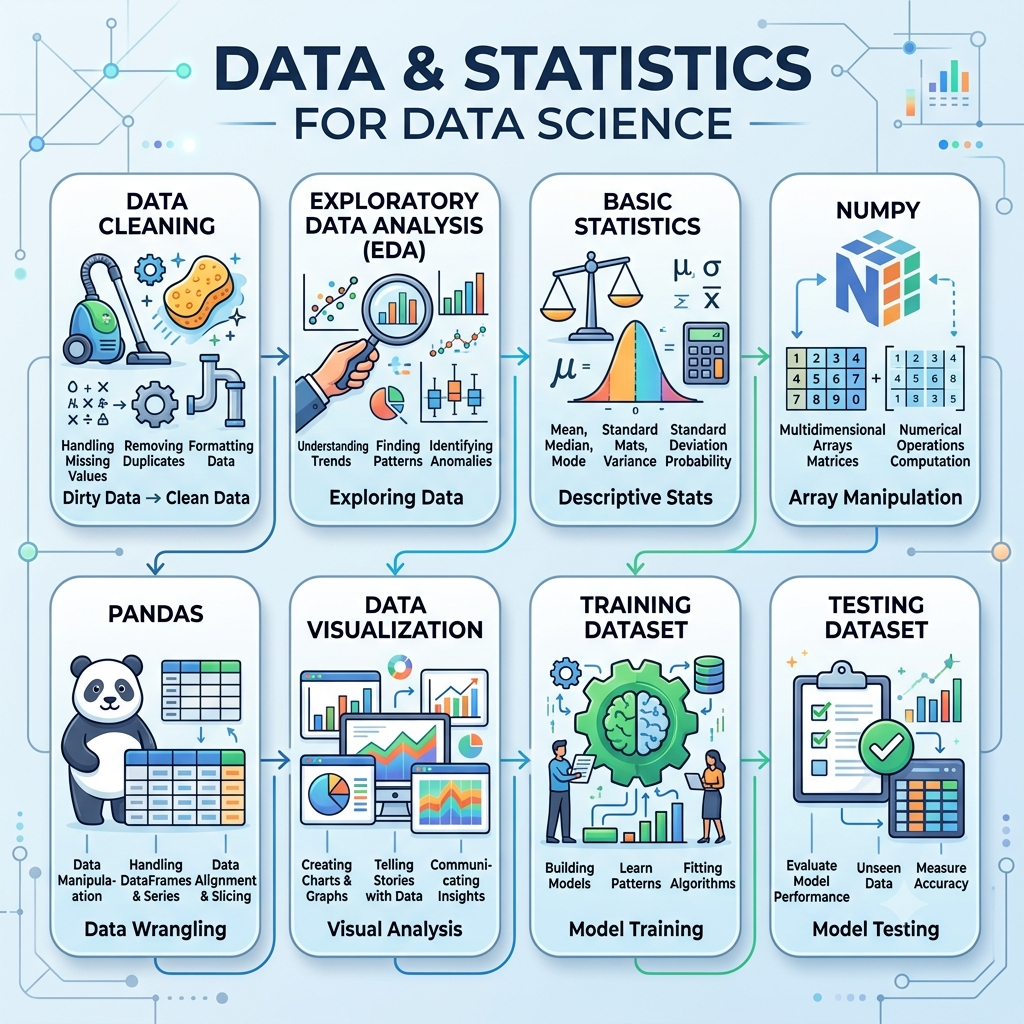
Beginners should get comfortable with:
- Data cleaning
- Exploratory data analysis
- Basic statistics
- NumPy
- Pandas
- Data visualization
- Training and testing datasets
This part can feel less exciting than building a chatbot. Trust me, though it becomes important very quickly.
3. Machine learning
Once the foundations are in place, you can move into concepts such as:
- Regression
- Classification
- Clustering
- Model evaluation
- Feature engineering
- Overfitting and underfitting
The goal isn’t to memorize algorithms.
It’s to understand when and why you’d use them.
4. Generative AI and LLM applications
This is one area beginners shouldn’t ignore in 2026.
Modern AI work increasingly includes applications built around large language models, retrieval systems, APIs, automation, and AI-powered workflows.
Depending on the course, you may encounter concepts such as:
- Prompt engineering
- LLM APIs
- RAG
- Vector databases
- AI assistants
- NLP
- AI automation
- Model deployment
The exact tools will change. The underlying ability to understand and apply them is what you want to keep.
Are AI Courses Online Better Than Learning for Free?
Not automatically.
There is an enormous amount of free AI material available. You can learn Python from YouTube, experiment with AI tools, read documentation, take introductory courses, and build projects without spending much money.
Google, for example, currently offers Google AI Essentials, a self-paced online program designed for people with zero experience and focused on generative AI, prompting, responsible AI, and workplace applications.
So why pay for training?
The answer is structure and support.
Imagine two beginners.
The first spends Monday watching a Python tutorial, Wednesday reading about machine learning, Friday experimenting with an LLM, and Sunday wondering what they’re supposed to learn next.
The second follows a curriculum, attends instructor sessions, completes assignments, builds projects, gets feedback, and has someone to ask when their code refuses to cooperate.
Both can learn.
The second learner simply has fewer decisions to make along the way.
That’s one of the strongest arguments for structured online ai courses .
What Makes H2K Infosys Interesting for Beginners?
If your goal is specifically to build AI skills for a career, H2K Infosys positions its AI training around more than just recorded educational content.
Its published material describes a combination of instructor-led learning, practical projects, certification, mentorship, interview preparation, and career support.
That approach is worth considering because beginners often hit the same wall:
“Okay, I completed the course. Now what?”
Knowing the definition of machine learning isn’t the same as being able to discuss an AI project during an interview.
That’s where project-based learning becomes useful.
H2K Infosys AI Training: What Can Beginners Expect?
According to H2K Infosys’ current published course information, its AI training emphasizes practical learning and career preparation. Its materials mention areas including machine learning, deep learning, NLP, neural networks, modern AI tools, projects, certification, resume preparation, mock interviews, and placement support.
Here’s how that can translate into a beginner’s journey.
Start with the foundations
You don’t want to jump directly into complicated LLM architecture without understanding the basics.
A structured progression can make concepts like data, Python, machine learning, and model evaluation less intimidating.
Move into projects
This is probably the part I’d pay the most attention to when comparing courses.
For example, instead of merely learning what classification means, imagine working on a customer-churn prediction problem.
Now you’re asking:
- What data do we have?
- How should it be cleaned?
- Which features matter?
- Which model should we try?
- How do we measure performance?
- What does the result actually mean for a business?
That’s a much more useful learning experience than memorizing definitions.
H2K Infosys describes its AI training as incorporating real-world-oriented projects and hands-on work.
What About Generative AI?
This is where an AI course needs to stay current.
The industry isn’t standing still.
A beginner learning AI in 2026 shouldn’t necessarily follow a curriculum designed around the AI landscape of five years ago.
Generative AI applications now include things like:
- Document question-answering systems
- Customer-support assistants
- Intelligent search
- AI-powered data tools
- Workflow automation
- Content generation
- Developer assistants
H2K Infosys’ published Generative AI training information describes hands-on training, live projects, certification, and career support, with a published duration of 90 hours.
A practical example would be building a document Q&A assistant.
Instead of simply asking ChatGPT a question, the application could retrieve relevant information from a company’s documents and use that context to generate an answer.
That one project can introduce a beginner to several modern concepts at once.
Do Certificates From AI Courses Online Actually Matter?
They can help, but I wouldn’t make the certificate the main reason you enroll.
This is one of those areas where expectations need to be realistic.
A certificate can show that you completed training.
It doesn’t automatically demonstrate that you can:
- Write Python
- Clean a dataset
- Train a model
- Build an AI application
- Debug a problem
- Explain your project
- Work with APIs
- Answer technical interview questions
That’s why a portfolio project can be much more useful during a conversation with a recruiter.
Instead of saying:
“I completed an AI certification.”
You can say:
“I built a customer-support assistant using retrieval and an LLM, and here’s how I handled the data and evaluated the responses.”
Now there’s something concrete to discuss.
H2K Infosys itself emphasizes practical projects alongside certification rather than treating certification as the entire outcome.
Can Beginners With No AI Background Join?
Yes, beginner-oriented AI programs can be designed for people coming from different backgrounds.
And this is important because not everyone entering AI in 2026 is a computer science graduate.
You might be:
- A software tester
- A business analyst
- A data analyst
- A recent graduate
- A developer moving into AI
- An IT professional
- Someone changing careers
The better question is not whether you already know AI.
It’s whether you’re prepared to learn the technical foundations consistently.
H2K Infosys’ own beginner-focused material says its AI learning path is designed to start from foundational concepts and progressively move toward practical applications.
What Does Career Support Actually Mean?
This deserves some attention because “placement support” can mean different things from one training provider to another.
H2K Infosys currently describes career assistance that can include areas such as:
- Resume preparation
- Mock interviews
- Interview guidance
- Project presentation support
- Job-search guidance
- Placement assistance
But here’s the realistic part:
Career support isn’t the same thing as a guaranteed job.
Your technical skills, previous experience, portfolio, communication, interview performance, location, role requirements, and the hiring market all matter.
So before enrolling, it’s sensible to ask the provider exactly what its current placement assistance includes and what eligibility or program conditions apply.
That’s a five-minute conversation that can save a lot of confusion later.
H2K Infosys vs. Completely Self-Paced Learning
There’s no universal winner here. It depends on how you learn.
| Learning approach | Usually works well for |
|---|---|
| Free tutorials | Exploring AI before committing |
| Self-paced AI courses | Independent learners who enjoy figuring things out |
| University programs | Learners wanting formal academic structure |
| Instructor-led training | People who learn better through guidance and questions |
| Career-focused programs | Beginners who want technical learning plus interview preparation |
H2K Infosys sits toward the structured, career-oriented end of that spectrum, based on its published approach to live training, projects, certification, and career support.
That can be particularly relevant if you’re not looking to casually experiment with AI and instead want a roadmap toward an AI-related role.
What Should You Check Before Paying for Any AI Course?
Even if you’re considering H2K Infosys, don’t skip this checklist.
Check the curriculum
Does it include the fundamentals you actually need?
Look for projects
Ask what you’ll build.
“Hands-on” sounds great until you discover it means following a 20-minute tutorial.
Ask about instructor access
Can you ask questions when you’re stuck?
Look at the technology stack
Does the curriculum reflect modern AI development rather than only older machine-learning theory?
Understand the career services
Ask exactly what resume support, mock interviews, and placement assistance mean.
Check the current terms
Course fees, duration, schedules, curriculum, eligibility, and support can change. Confirm the current details directly with the provider before enrolling.
Are the Best AI Courses Online the Most Expensive Ones?
Not necessarily.
Price and quality aren’t interchangeable.
A $2,000 course isn’t automatically better than a $200 course. Likewise, a free course isn’t automatically inadequate.
What you’re really paying for with a structured program is often the learning system around the content:
Curriculum + instructor access + practice + projects + feedback + career guidance.
If you’re disciplined enough to create that system yourself, you may not need to pay for it.
If you’ve already tried learning independently and keep getting stuck at “I understand the tutorial, but I don’t know what to build next,” structured training can make more sense.
A Simple Beginner AI Career Roadmap for 2026
If I were starting from zero today, I’d think about the journey in stages rather than trying to learn everything at once.
Stage 1: Understand AI
Learn what AI, machine learning, deep learning, NLP, and generative AI actually mean.
Stage 2: Learn Python and data
Build enough programming and data skills to work comfortably with real datasets.
Stage 3: Learn machine learning
Understand the core algorithms, evaluation methods, and practical workflow.
Stage 4: Build projects
Create projects that solve recognizable problems.
Stage 5: Learn modern GenAI
Explore LLM applications, RAG, APIs, prompt engineering, and AI automation.
Stage 6: Build a portfolio
Document what you built, why you built it, what went wrong, and how you improved it.
Stage 7: Prepare for interviews
Practice explaining your technical decisions in plain English.
That’s the part people sometimes underestimate.
Being able to explain why you chose a model can be just as important as knowing how to import the library.
So, Are Online AI Courses Worth It for Beginners?
They can be provided the course gives you more than information.
The AI skills market is expanding, but employers aren’t simply looking for people who have watched AI tutorials. The World Economic Forum expects AI and big data to remain among the fastest-growing skills through 2030, alongside human capabilities such as analytical thinking, creativity, adaptability, and lifelong learning.
For someone who prefers learning independently, a combination of free resources and inexpensive self-paced courses may be enough.
For someone who wants structure, instructor guidance, practical projects, and career preparation, a career-focused program deserves a closer look.
That is where H2K Infosys fits the discussion. Its current AI training materials emphasize instructor-led learning, hands-on projects, certification, and career support, which can be useful for beginners who don’t want to figure out the entire AI learning path alone.
Just don’t approach any course as a shortcut.
The certificate is not the career.
The skills, projects, and ability to solve real problems are.
And if you’re willing to put in the practice between classes, that’s where an online AI course can start becoming a genuine career investment rather than just another item on your resume.