
You can land roles like SOC Analyst, Security Analyst, IT Security Support, or Junior Penetration Tester right after completing cyber security training with job placement especially through programs like H2K Infosys provided you’ve worked with real tools and labs, not just theory and entry-level jobs.
What entry-level jobs can you realistically get?
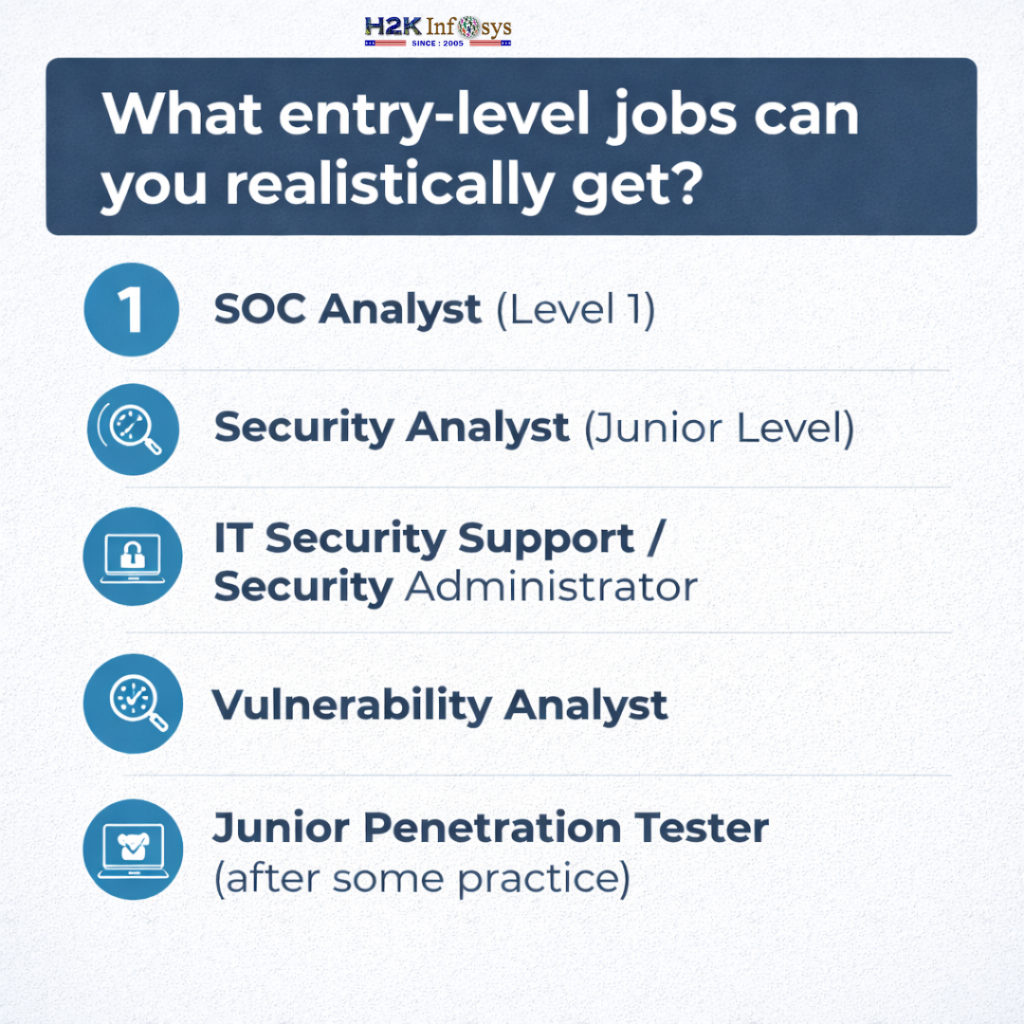
If I’m being honest, most people expect a “cybersecurity job” to be one single role. It’s not. It’s more like an entry gate with a few common starting points, depending on what your training actually covered.
1. SOC Analyst (Level 1)
This is where a lot of beginners start and for good reason.
You sit inside a Security Operations Center (SOC), watching alerts, investigating suspicious activity, and escalating real threats. Sounds intense, but at entry level, it’s more structured than chaotic.
What you actually do:
- Monitor SIEM tools like Splunk
- Investigate login anomalies or malware alerts
- Follow playbooks (a lot of them, initially)
From what I’ve seen, anyone who’s done cyber security training and job placement programs with hands-on SIEM exposure tends to get here faster.
2. Security Analyst (Junior Level)
This role overlaps with SOC work but gives you slightly broader exposure.
Instead of just reacting to alerts, you start understanding why they happen.
Typical tasks:
- Reviewing vulnerabilities
- Running basic risk assessments
- Supporting incident response teams
I remember one case where a junior analyst caught repeated failed login attempts across regions turned out to be an early-stage brute-force attack. That kind of pattern recognition gets valued quickly.
3. IT Security Support / Security Administrator
Not glamorous, but honestly, very underrated.
If your background leans a bit toward IT (networks, systems), this role fits naturally.
You might handle:
- User access controls
- Firewall rule updates
- Endpoint security tools
This is where people quietly build strong fundamentals. A lot of professionals pivot from here into cloud or advanced security roles later.
4. Vulnerability Analyst
If your training included tools like Nessus or OpenVAS, this path opens up.
You’re basically looking for weaknesses before attackers do.
Daily work looks like:
- Running vulnerability scans
- Prioritizing risks based on severity
- Working with teams to patch systems
There’s something satisfying about this role: it’s structured, analytical, and less reactive than SOC work.
5. Junior Penetration Tester (after some practice)
This one’s a bit trickier straight out of training for getting entry-level jobs, but not impossible.
Most people don’t jump into this role immediately unless they’ve spent extra time practicing on platforms like H2K Infosys.
You’ll be:
- Testing systems for weaknesses
- Simulating attacks (ethically)
- Writing reports (yes, lots of writing)
Where training actually makes the difference
Here’s the part people don’t always say out loud the course alone doesn’t get you hired. The type of training does entry-level jobs.
Programs like H2K Infosys, for example, try to simulate real-world environments for entry-level jobs instead of just explaining concepts. That matters more than people think.
Because when an interviewer asks:
“Have you worked with real incident scenarios?”
They’re not looking for textbook answers.
They want:
- “I analyzed logs in Splunk and identified a phishing attempt pattern”
- Not: “I understand phishing attacks conceptually”
That gap is exactly where many candidates struggle entry-level jobs.
Current hiring trends (2025–2026 reality check)
Things have definitely shifted and not in a subtle way either.
Companies aren’t as impressed by a stack of certifications anymore. I mean, they still matter, but what really gets attention now is whether you’ve actually done the work. Hands-on experience is starting to outweigh theory in a big way in entry-level jobs.
There’s also this clear push toward cloud security. If you’ve spent even a little time around AWS or Azure environments, you’re already in a better position than a lot of entry-level candidates. It’s not about mastering everything, just knowing your way around basic configurations and risks goes a long way.
Another thing I’ve noticed: scripting is quietly becoming expected. Nothing too advanced, but being able to write simple Python or Bash scripts? That’s no longer a “nice to have.” It’s creeping into the baseline entry-level jobs.
And about AI despite all the noise, it hasn’t really replaced cybersecurity roles. If anything, it’s added more layers. Automated systems throw out alerts constantly, but someone still has to make sense of them. That human judgment piece hasn’t gone anywhere.
So, what should you focus on?
If you’re going through cyber security jobs with training right now, I’d suggest:
- Get comfortable with at least one SIEM tool
- Practice real incident scenarios (not just quizzes)
- Learn how to explain your work clearly (this matters in interviews more than you expect)
And maybe the most overlooked thing is consistency beats intensity here. Even 1–2 hours daily of hands-on practice compounds fast.
Final thought
Entry-level jobs cybersecurity isn’t about knowing everything, it’s about proving you can do something useful on day one. The roles are there. The demand is real. But the edge always goes to those who’ve actually touched the tools, not just read about them.