The Artificial Intelligence Online Training 2026 program at H2K Infosys is meant to impart professionals with practical and job-oriented skills succeed in today’s fast-paced digital sector. The Best Ai Certification Courses are targeted towards advanced topics in high-demand areas such as Machine Learning, Deep Learning, Generative AI, Natural Language Processing (NLP), Computer Vision, AI-enabled analytics, and MLOps. Students also learn to use industry-standard tools and technologies, including Python, TensorFlow, PyTorch, scikit-learn, and major cloud platforms such as AWS, Microsoft Azure, and Google Cloud.
Most Trending AI Topics programs integrate theory with hands-on projects, using real-world data sets and deployment procedures to let learners design and deploy AI solutions for workplace needs.
What is AI?
Artificial Intelligence (AI) is a sub-field of computer science that focuses on constructing systems that can carry out tasks that traditionally need human intelligence. These Trending AI Topics tasks include learning from data, language processing, pattern recognition, problem solving and decision making.
Core AI Areas in Training
Machine Learning (ML)
- Machine Learning allows computers to learn from data and improve performance without being explicitly programmed.
- Topics include supervised learning, unsupervised learning, and reinforcement learning.
Deep Learning (DL)
- A subset of ML, DL uses neural networks to analyse complex data such as photos, videos, audio, and text.
Generative AI
- Generative AI uses complex models such as transformers and diffusion networks to create material such as text, graphics, code, and audio.
Natural Language Processing (NLP)
- NLP is the technology that enables robots to read, interpret, and synthesise human language for applications like chatbots, virtual assistants, language translation, and more.
Computer Vision
- Through computer vision, Trending AI Topics can analyse and interpret visual information to recognise objects, classify images, and assess quality.
How AI is Being Used in Real World Business
Most successful Trending AI Topics initiatives follow a defined lifecycle to ensure accuracy, scalability and business benefit.
1. Data Acquisition and Processing
- Companies collect data from databases, APIs, applications, sensors and business systems. Then the data is cleaned, processed, and readied for analysis.
Standard Tools:
- Python, Pandas, Numpy, SQL, Apache Spark
2. Model Construction
- Data scientists choose the right algorithms for the business challenge, train models, validate performance and optimise findings.
Popular Frameworks:
- scikit-learn, TensorFlow, PyTorch
3. Model Implementation
- The models are then deployed in production environments using cloud services and containerised deployment methods post development.
Deployment Technologies:
- Docker®, Kubernetes
- Azure Machine Learning, AWS SageMaker
4. Tracking & Optimisation
- Organisations are always monitoring model performance and retraining systems as new data comes in.
Monitoring Tools:
- MLflow, Prometheus, Grafana
Example: Predictive Maintenance
- The manufacturing company collects sensor data from the equipment, analyses operational trends, trains machine learning models to predict failures, and generates alerts before breakdowns.
- This helps reduce maintenance expenses and downtime.
Why Professionals Need Digital Skills
Increasing Industry Demand
- Organisations across all sectors are looking to hire talent with AI, machine learning and data analytics experience.
Greater Productivity
- Trending AI Topics automates tedious work so teams may focus on innovation and strategic projects.
Improved Decision Making
- AI-powered insights help firms enhance their forecasts, client engagement, risk management and operational efficiency.
Opportunities for Innovating
- AI is driving sophisticated goods, intelligent automation and tailored customer experiences across industries.
Must-Know Skills to Learn AI
Technical and Analytical Skills
- Programming: Python, Jupyter notebook
- Math: Stochastic, Linear Algebra, Calculus, Statistics
- Data Management: SQL, Data Cleansing, Feature Engineering
- Artificial Intelligence Frameworks: TensorFlow 2, PyTorch, scikit-learn
- Cloud Technologies: AWS, Azure, Google Cloud Platform
- Problem Solving: Interpretation of Data, Evaluating the Model, Optimising Performance
Suggested AI Learning Path
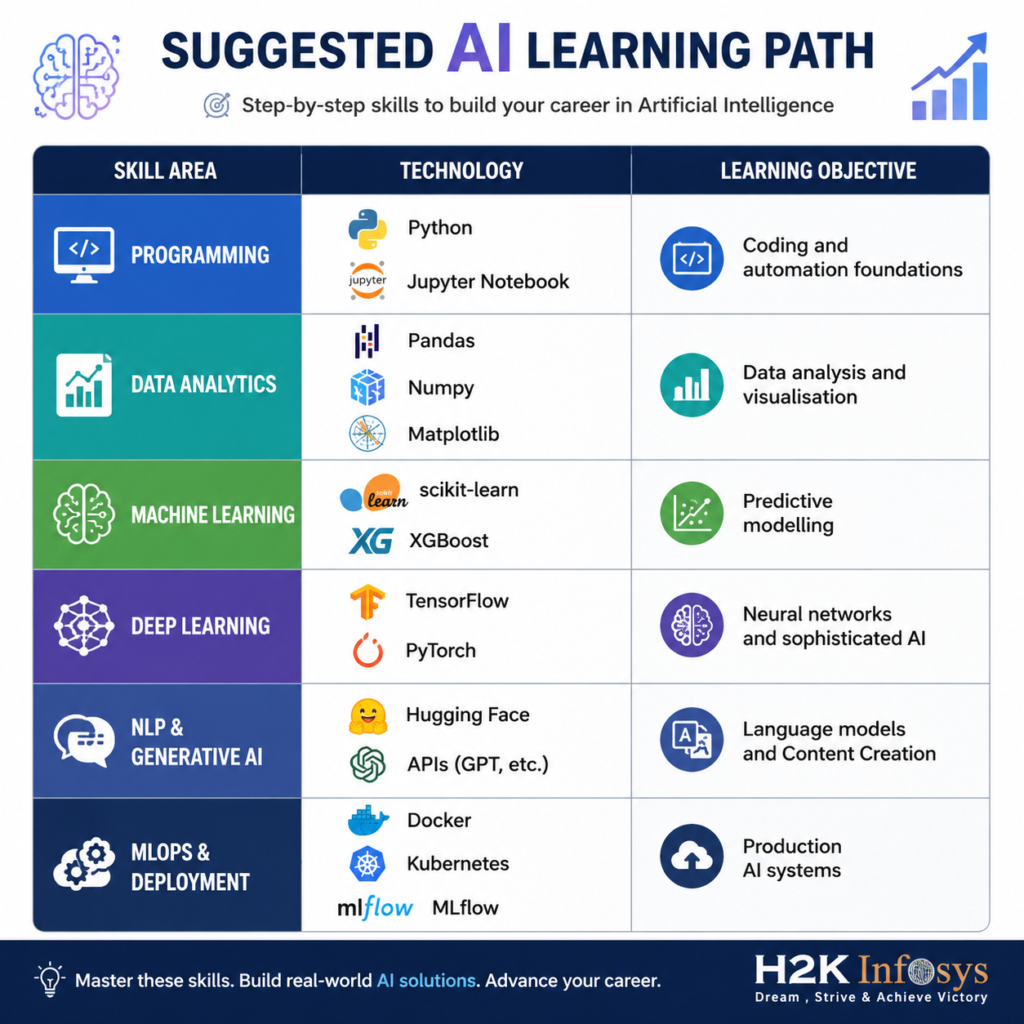
| Skill Area | Technology | Learning Objective |
|---|---|---|
| Programming | Python, Jupyter Notebook | Coding and automation foundations |
| Data Analytics | Pandas, Numpy, Matplotlib | Data analysis and visualisation |
| Machine Learning | scikit-learn, XGBoost | Predictive modelling |
| Deep Learning | TensorFlow, PyTorch | Neural networks and sophisticated AI |
| NLP & Generative AI | Hugging Face, APIs GPT | Language models and Content Creation |
| MLOps & Deployment | Docker, Kubernetes, MLflow | Production AI systems |
AI Applications in Industries
Medical
- Disease forecasting
- Medical image analysis
- Drug discovery
Finance
- Detection of fraud
- Credit scoring
- Assessment of risk
Retailing
- Personalised suggestions
- Forecasting demand
- Analytics of customers
Production
- Predictive maintenance
- Quality assurance
- Optimisation of processes
IT Ops
- Automation monitoring
- Incident prediction
- Smart troubleshooting
Example of Retail Analytics
- Retail organisations gather data on customer transactions, analyse purchase behaviour, develop predictive models to detect possible churn, apply the insights to CRM systems, and continuously improve forecasts using new customer data.
Job Opportunities After AI Courses
| Role | Major Responsibilities | Typical Tools |
|---|---|---|
| Data Scientist | Build predictive models and analyse data | Python, TensorFlow |
| Machine Learning Engineer | Build and deploy AI systems | Kubernetes, PyTorch |
| AI Consultant | Assistance with AI strategy and implementation | AI platforms and analytics tools |
| Business Intelligence Analyst | Harness AI insights to business choices | SQL, Tableau |
| MLOps Engineer | Deployment & Monitoring Pipelines | Docker, MLflow |
Career Development Path
- Entry Level: AI Developer Intern, Junior ML Engineer, Analytics Associate
- Intermediate Level: Data Scientist, ML Engineer, BI Analyst
- Senior Level: AI Research Scientist, Lead ML Engineer, AI Product Manager
Frequently Asked Questions
Is AI training beginner friendly?
Yes. Programs start with basics like Python programming, statistics, and ML fundamentals before advanced topics.
Is it up to date with the latest AI technologies?
Yes. Modern Trending AI Topics include generative AI, large language models (LLMs), NLP, deep learning, reinforcement learning, and MLOps.
Will I get practical experience?
Many programs feature cloud-based labs, hands-on projects, case studies, and real-world datasets.
Typical Tools Taught:
Python, TensorFlow, PyTorch, scikit-learn, Docker, MLflow, AWS SageMaker, Azure ML, Generative AI frameworks.
Will training in AI increase professional prospects?
Yes. Skills in AI are highly sought-after for roles such as Data Scientist, ML Engineer, AI Consultant, BI Analyst, and MLOps Engineer.
Essential Points
- An Online Ai Classes in 2026 covers Machine Learning, Deep Learning, NLP, Generative AI and MLOps.
- Hands-on experience with projects, cloud platforms and real-world datasets is given to learners.
- AI capabilities are relevant across industries like healthcare, banking, retail, manufacturing, and IT.
- Career options: Data Scientist, AI Consultant, BI Analyst, ML Engineer, MLOps Specialist.
- Enterprise training enables experts to deploy scalable AI and apply it to business problems.