Live project experience helps in cyber security interviews because it gives candidates real proof that they can handle actual security tasks, not just explain theory. Employers today want people who’ve worked on SIEM alerts, incident response workflows, vulnerability scans, cloud security configurations, and SOC operations in practical environments. That’s exactly why many learners now choose cyber security training and job placement programs that include hands-on projects instead of only classroom lectures.
Honestly, this shift became even more obvious over the last couple of years. Companies hiring for SOC Analyst, Cyber Security Analyst, and Threat Detection roles are asking candidates scenario-based questions rather than textbook definitions. Recruiters don’t just ask, “What is phishing?” anymore. They ask things like:
- “How would you investigate repeated failed login attempts?”
- “What steps would you take after detecting suspicious PowerShell activity?”
- “How did you handle alerts during your project training?”
And if you’ve worked on live projects before, those questions suddenly become much easier to answer naturally.
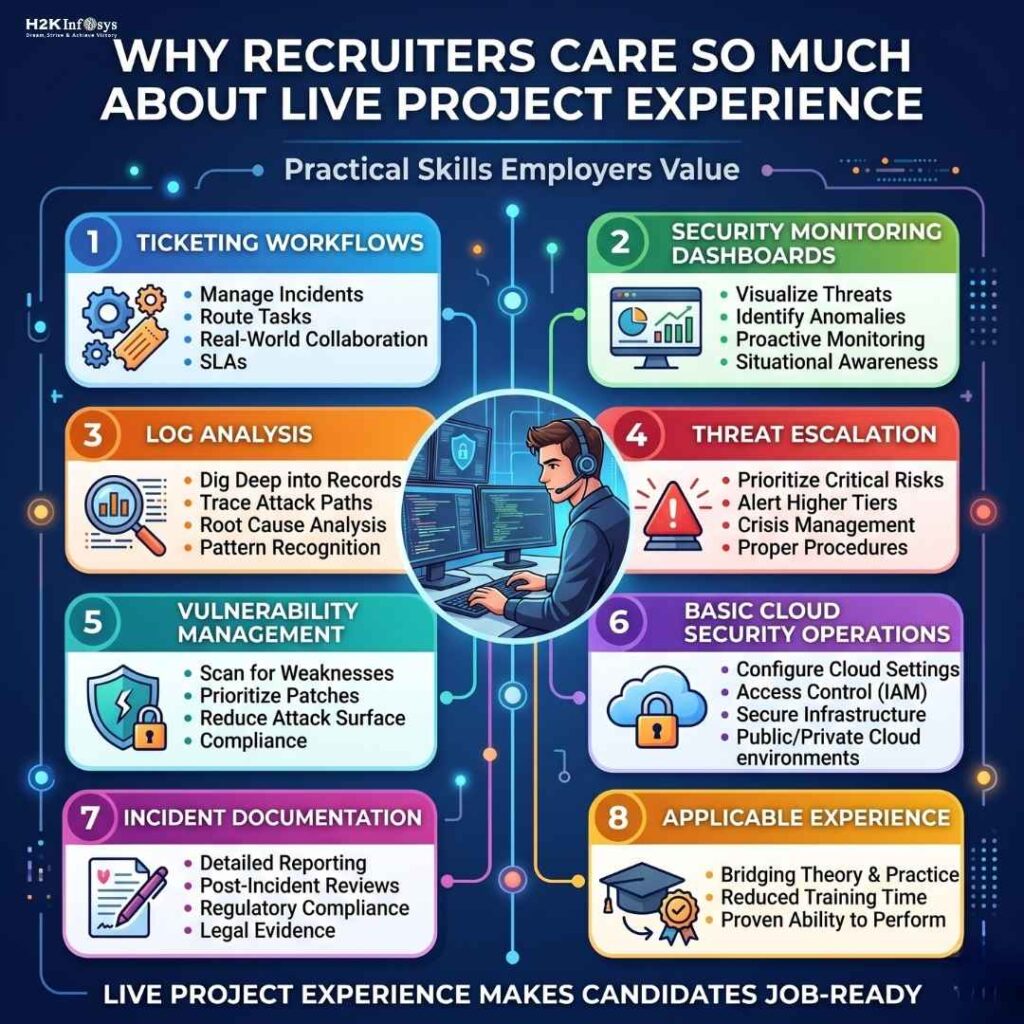
Why Recruiters Care So Much About Live Project Experience
A lot of entry-level applicants still make the same mistake. They memorize definitions from certification dumps and expect that to carry them through interviews. It rarely works now.
Cyber security interviews teams are under pressure because attacks are happening faster, especially with ransomware campaigns, cloud breaches, AI-assisted phishing, and insider threats increasing globally. Companies don’t have months to train fresh hires from scratch anymore.
So hiring managers lean toward candidates who already understand:
- Ticketing workflows
- Security monitoring dashboards
- Log analysis
- Threat escalation
- Vulnerability management
- Basic cloud security operations
- Incident documentation
That’s where cyber security jobs with training programs become valuable. They simulate the kind of environment candidates actually step into after getting hired.
I’ve seen interview panels completely change tone once a candidate starts discussing a real Splunk investigation or a Nessus vulnerability report they worked on during training. The conversation becomes practical instead of theoretical. And practical conversations build trust fast.
The Difference Between Theory and Real SOC Exposure
There’s a massive difference between saying:
“I know SIEM tools.”
…and saying:
“During my training project, I used Splunk to investigate unusual outbound traffic and correlated logs from multiple endpoints before escalating the alert.”
The second answer sounds believable because it comes from experience.
That’s one reason cyber security training with job placement programs are gaining attention in 2026. Employers increasingly want job-ready analysts who can contribute early without needing constant supervision.
At institutes like H2K Infosys, learners often work in project-based environments that mimic real SOC operations. Instead of only watching recorded lessons, students get exposure to tools and workflows commonly used in enterprise security teams.
And honestly, that matters more than people think during interviews.
How Live Projects Improve Interview Confidence
Confidence is one of the most underrated parts of technical interviews.
Candidates without practical exposure usually hesitate a lot. Their answers sound cautious because they’re trying to remember definitions perfectly.
People with live project experience tend to explain things more naturally:
- what they observed,
- how they investigated it,
- what tools they used,
- what mistakes happened,
- and what they learned afterward.
Interviewers notice that immediately.
I remember talking to someone who struggled through multiple interviews despite having certifications. After joining a practical cyber security training and job placement program, they started working on simulated SOC cases daily. A few months later, their interview responses completely changed because they finally had “stories” to discuss.
And interviews are often about storytelling more than people realize.
Real Examples Candidates Can Discuss During Interviews
Here are a few examples of live project experiences that genuinely help candidates stand out:
1. Investigating Phishing Emails
Instead of defining phishing theoretically, candidates can explain:
- how they analyzed email headers,
- checked suspicious URLs,
- verified sender reputation,
- and documented findings.
That instantly sounds closer to real-world work.
2. Working With Splunk Dashboards
Many SOC interviews now include SIEM-related questions.
Candidates who practiced Splunk during cyber security interviews jobs with training programs can discuss:
- creating alerts,
- analyzing failed logins,
- detecting brute-force patterns,
- and correlating logs.
That practical exposure often becomes a huge advantage.
3. Vulnerability Assessment Projects
Using tools like Nessus or OpenVAS during training gives candidates practical talking points:
- identifying outdated software,
- prioritizing vulnerabilities,
- understanding CVSS scores,
- recommending remediation steps.
Employers love hearing structured responses like that.
4. Incident Response Simulations
Some training programs simulate ransomware incidents or suspicious endpoint behavior.
Candidates learn:
- containment procedures,
- escalation processes,
- evidence collection,
- and incident documentation.
Those are exactly the kinds of experiences interviewers ask about now.
Why Hands-On Learning Matters More in 2026
Cyber security interviews hiring changed quite a bit recently because of AI-driven attacks and cloud infrastructure expansion.
Security teams now deal with:
- AI-generated phishing campaigns,
- deepfake social engineering,
- cloud misconfigurations,
- identity-based attacks,
- and API security risks.
Because of that, employers prefer candidates who’ve already practiced security operations in realistic environments.
A certification alone doesn’t always prove that anymore.
This is why many learners specifically search for cyber security interviews training with job placement opportunities instead of purely academic courses. They want practical exposure before entering interviews.
And honestly, recruiters expect that now.
How H2K Infosys Helps Candidates Prepare for Real Interviews
One thing that makes it stand out is the focus on combining training with practical implementation.
Their programs often include:
- live instructor-led sessions,
- real-time project scenarios,
- SOC workflow simulations,
- resume preparation,
- mock interviews,
- and placement support.
That combination helps learners speak confidently during cyber security interviews because they’ve already worked through practical situations beforehand.
Instead of memorizing answers, candidates learn how security operations actually function in day-to-day environments.
That difference becomes pretty obvious when interviews move into scenario-based discussions.
Employers Notice Practical Thinkers Faster
One interesting thing I’ve noticed from recent hiring trends: cyber secuity interviews are becoming less impressed by perfect textbook answers and more interested in how candidates think under pressure.
Even if someone doesn’t know every answer technically, being able to explain:
- how they approached an alert,
- why they escalated an incident,
- or how they investigated suspicious behavior
creates a stronger impression.
Live projects help build that mindset naturally.
That’s why cyber security training with job placement programs with real project exposure tend to produce interview-ready candidates much faster than theory-only learning paths.
Final Thoughts
Live project experience helps in cyber security interviews because it transforms knowledge into practical understanding. Candidates become better at explaining investigations, discussing tools confidently, solving scenarios logically, and answering behavioral questions with real examples.
In today’s hiring market, especially for SOC and analyst roles, practical exposure often matters just as much as certifications.
Programs like H2K Infosys that combine hands-on labs, live projects, and placement-focused preparation give learners a much stronger chance of succeeding in interviews and honestly, of feeling genuinely prepared once they land the job too.