At H2K Infosys, we explain that Trusted Artificial Intelligence Online Training is basically about teaching computer systems how to analyze information, recognize patterns, make predictions, and assist with decisions that would normally require some level of human judgment. In modern IT environments, AI shows up almost everywhere now automation tools, analytics platforms, cybersecurity systems, cloud monitoring, recommendation engines, and customer support applications. A lot of people interact with AI daily without even realizing it.
For beginners, an Ai Machine learning Courses usually starts with the fundamentals first. Python programming, machine learning basics, data processing, simple model training that’s typically where things begin. Many professionals also pursue an artificial intelligence certificate online because it gives them structured exposure to tools and workflows companies are already using in production systems today.
Trusted Artificial Intelligence Online Training What’s interesting is how quietly AI became part of normal business operations. A few years ago, most organizations treated machine learning projects like experimental side initiatives. Now AI sits behind everyday systems people barely think about anymore fraud alerts from banks, chatbot responses, intelligent search tools, cloud monitoring dashboards, spam filtering, recommendation feeds. It kind of slipped into enterprise environments gradually instead of arriving all at once.
What is Most Trusted Artificial Intelligence Online Training?
rusted Artificial Intelligence Online Training refers to systems designed to perform tasks that usually involve human reasoning, pattern recognition, or decision-making. That might include recognizing images, understanding written language, identifying anomalies in huge datasets, or predicting future outcomes based on historical information.
In practice, AI isn’t a single technology. It’s more of a collection of approaches working together.
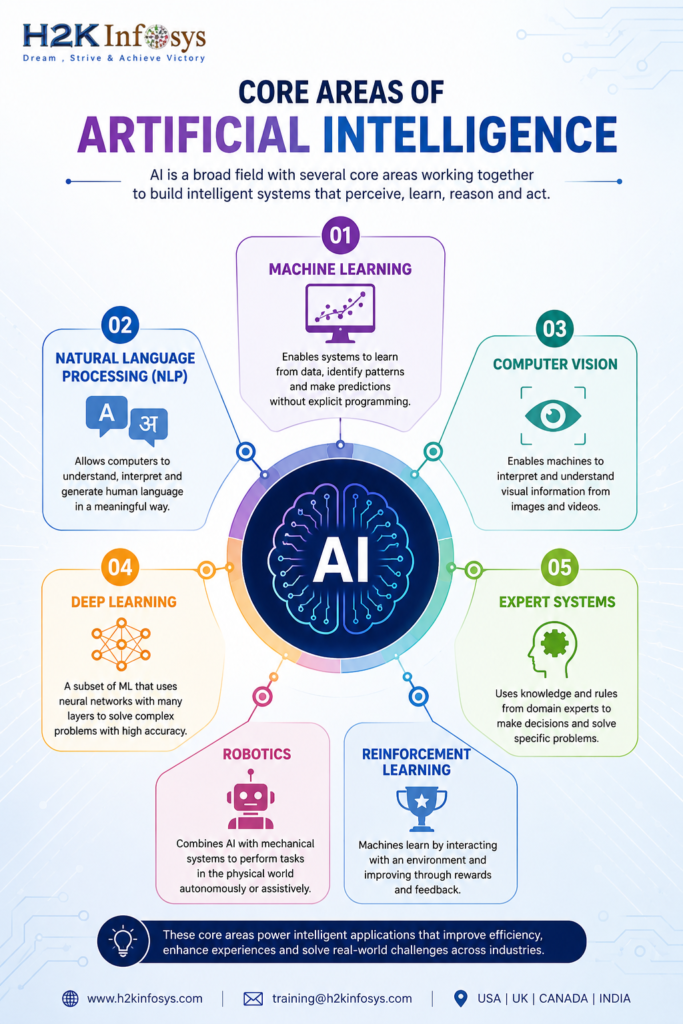
Core Areas of Artificial Intelligence
| AI Area | Purpose |
|---|---|
| Machine Learning | Learns patterns from data |
| Deep Learning | Uses neural networks for complex prediction tasks |
| Natural Language Processing (NLP) | Helps systems understand human language |
| Computer Vision | Interprets images and video |
| Data Analytics | Extracts insights from business data |
| Intelligent Automation | Reduces repetitive operational work |
Most enterprise AI systems combine several of these areas instead of relying on one standalone model.
Why AI Matters for Working Professionals
AI skills are becoming relevant across almost every IT role now, even for people who are not officially “AI engineers” or data scientists.
Cloud engineers, DevOps teams, cybersecurity analysts, software developers, even business analysts regularly interact with AI-powered systems. Sometimes they’re building models directly. Other times they’re integrating AI services into larger applications or infrastructure workflows.
And honestly, many professionals end up working with AI before they intentionally decide to “learn AI.”
Where Businesses Actually Use AI
In real enterprise environments, Trusted Artificial Intelligence Online Training usually enters through practical operational needs rather than futuristic innovation projects.
Some common examples:
- Predictive maintenance
- Customer support automation
- Fraud detection
- Recommendation systems
- Security threat analysis
- Inventory forecasting
- Intelligent reporting dashboards
Most companies aren’t trying to build humanoid robots or fully autonomous systems. Usually they just want better efficiency, faster workflows, fewer repetitive tasks, or improved visibility into operations.
A cybersecurity team, for example, might use anomaly detection models to flag suspicious login activity. A cloud operations team may rely on predictive monitoring tools to catch infrastructure issues before customers notice anything wrong.
That’s often how AI gets adopted in production quietly, through operational improvements that save time or reduce risk.
How AI Works in Real IT Projects
Most Trusted Artificial Intelligence Online Training projects follow a fairly structured lifecycle, although reality tends to be messier than diagrams suggest. Data is almost never clean on the first attempt. Teams usually discover problems halfway through implementation.
Typical AI Workflow
| Stage | Description |
|---|---|
| Data Collection | Gathering business or operational data |
| Data Preparation | Cleaning and organizing datasets |
| Feature Engineering | Selecting useful variables |
| Model Training | Building machine learning models |
| Validation | Measuring prediction accuracy |
| Deployment | Integrating models into applications |
| Monitoring | Tracking long-term performance |
Every stage matters. Even a strong algorithm performs badly if the underlying data is inconsistent or incomplete.
Example: AI-Based Ticket Classification
Imagine an IT support organization processing thousands of service requests every month.
Instead of manually sorting every ticket, teams can train a machine learning model using historical support data. Over time, the system learns to recognize categories like:
- Password reset requests
- Software installation problems
- Network connectivity issues
- Hardware failures
Once deployed, the model can automatically route tickets to the correct support queue.
Sounds simple when explained in theory. In production, though, things get complicated pretty quickly inconsistent ticket wording, missing records, security permissions, approval workflows, strange edge cases nobody predicted initially. That’s usually the part beginners don’t see right away.
What Skills Are Needed to Learn AI?
A lot of people assume Trusted Artificial Intelligence Online Training requires advanced mathematics immediately. Realistically, most beginners start with programming basics and build technical depth gradually over time.
Programming Skills
Python remains one of the most widely used programming languages in AI because the ecosystem is mature and relatively beginner-friendly.
Learners usually start with:
- Variables and functions
- Loops and conditional logic
- File handling
- APIs
- Data structures
- Python libraries
Once those basics feel comfortable, machine learning concepts start making more sense.
Mathematics and Statistics
You don’t need a mathematics degree to begin learning AI. Still, concepts like probability, statistics, and linear algebra definitely help explain why models behave the way they do.
Some learners avoid math entirely at first, but eventually understanding the underlying logic becomes useful — especially during debugging or model evaluation.
Data Handling Skills
A surprisingly large amount of AI work revolves around cleaning and preparing data.
Professionals often spend time:
- Removing duplicates
- Handling missing values
- Writing SQL queries
- Transforming raw datasets
- Fixing formatting inconsistencies
Honestly, this part is less glamorous than training models, but it’s critical. Most experienced teams know poor-quality data causes more problems than weak algorithms.
Machine Learning Fundamentals
Most beginner AI courses eventually introduce concepts such as:
- Classification
- Regression
- Clustering
- Supervised learning
- Unsupervised learning
- Reinforcement learning
The best learning experiences usually involve small hands-on projects rather than endless theory slides.
What Does an Artificial Intelligence Course for Beginners Usually Cover?
A practical beginner-level Best Online Artificial Intelligence Course generally balances theory with implementation. Too much theory without application becomes difficult to retain after a while.
Typical Course Structure
| Module | Topics Included |
|---|---|
| Introduction to AI | AI concepts and business applications |
| Python Programming | Python basics for AI workflows |
| Data Processing | Cleaning and transforming datasets |
| Machine Learning | Regression and classification models |
| Deep Learning | Neural networks and TensorFlow |
| NLP Basics | Text analysis and language processing |
| Model Evaluation | Accuracy and performance metrics |
| Deployment Basics | APIs and cloud integration |
Many learners understand concepts more clearly once they build something themselves even a small prediction model or sentiment analysis application.
Common Tools Used in AI Projects
Real-world AI environments rarely depend on a single platform.
A machine learning engineer might train models in Python, deploy services using Docker containers, store datasets in cloud environments, and monitor systems through dashboards. Everything tends to connect together.
Popular AI Development Tools
| Tool | Common Use |
|---|---|
| Python | Core AI programming language |
| TensorFlow | Deep learning development |
| PyTorch | Neural network training |
| Scikit-learn | Machine learning algorithms |
| Pandas | Data analysis |
| NumPy | Numerical computing |
| Jupyter Notebook | Interactive experimentation |
| Matplotlib | Data visualization |
Cloud and Deployment Technologies
| Platform | Typical Use Case |
|---|---|
| AWS SageMaker | Cloud-based model training |
| Azure Machine Learning | Enterprise AI workflows |
| Google Vertex AI | Scalable AI development |
| Docker | Containerized deployment |
| Kubernetes | Workload orchestration |
| MLflow | Model lifecycle management |
These tools help teams manage deployment, scaling, monitoring, and retraining more efficiently.
How AI Is Used Across Industries
Financial Services
Banks and financial institutions commonly use AI for:
- Fraud detection
- Risk analysis
- Transaction monitoring
- Spending behavior analysis
Trusted Artificial Intelligence Online Training Machine learning models can process huge transaction volumes much faster than manual review systems.
Healthcare
Healthcare organizations often apply AI to:
- Medical imaging analysis
- Patient risk prediction
- Workflow optimization
- Clinical reporting systems
In most cases, AI supports healthcare professionals rather than replacing human decision-making entirely.
Retail and E-Commerce
Retail businesses regularly use AI for:
- Product recommendations
- Demand forecasting
- Customer segmentation
- Pricing optimization
Anyone who has received personalized shopping recommendations online has already interacted with AI systems, whether they realized it or not.
Cybersecurity
Security operations teams use AI-driven tools for:
- Threat detection
- Malware analysis
- Log monitoring
- Network anomaly detection
Since enterprise systems generate enormous amounts of security data, AI helps analysts prioritize suspicious activity faster.
Challenges Teams Face During AI Implementation
AI Trusted Artificial Intelligence Online Training can improve efficiency significantly, but implementation is rarely smooth from start to finish.
A lot of organizations eventually realize deployment challenges are often more operational than algorithmic.
Data Quality Issues
AI models depend heavily on clean datasets.
Common problems include:
- Missing records
- Duplicate data
- Poor labeling quality
- Inconsistent formatting
Even advanced models struggle when the underlying information is unreliable.
Infrastructure Requirements
Some AI workloads require:
- GPU resources
- Distributed storage
- Scalable cloud environments
- High-performance computing infrastructure
Infrastructure planning becomes especially important for large-scale real-time systems.
Model Drift
Over time, prediction quality can decline because business conditions change.
Teams usually monitor:
- Prediction accuracy
- Usage patterns
- Data distribution shifts
- Performance degradation
Retraining models periodically becomes part of normal operations.
Security and Compliance
Trusted Artificial Intelligence Online Training AI systems often process sensitive business or customer information.
Because of that, organizations typically implement:
- Encryption controls
- Access management
- Audit logging
- Compliance monitoring
This becomes especially important in industries like healthcare, banking, and insurance.
How Beginners Usually Learn AI
Trying to learn everything at once tends to overwhelm people pretty fast. A gradual roadmap works better for most learners.
Beginner Learning Roadmap
| Phase | Learning Focus |
|---|---|
| Phase 1 | Python programming |
| Phase 2 | Data analysis and SQL |
| Phase 3 | Statistics and machine learning |
| Phase 4 | Deep learning concepts |
| Phase 5 | Cloud deployment workflows |
| Phase 6 | Real-world projects |
Recommended Beginner Projects
Beginners often start with projects like:
- Spam email detection
- Customer churn prediction
- Sentiment analysis
- Sales forecasting
- Image classification
Small projects matter because they expose learners to the complete workflow — data preparation, training, debugging, testing, deployment. And honestly, debugging models teaches patience pretty quickly.
Career Opportunities After Learning AI
AI knowledge now supports a wide range of technical and analytical roles.
Common AI-Related Roles
| Role | Responsibilities |
|---|---|
| Machine Learning Engineer | Builds and deploys models |
| Data Scientist | Analyzes and interprets data |
| AI Engineer | Integrates AI into applications |
| Data Analyst | Creates analytical reports |
| NLP Engineer | Develops language-processing systems |
| Computer Vision Engineer | Builds image recognition systems |
| MLOps Engineer | Manages AI deployment pipelines |
Many Trusted Artificial Intelligence Online Training professionals transition into AI after backgrounds in software development, analytics, cloud computing, or infrastructure operations.
What to Look for in an Artificial Intelligence Certificate Online
Not every training program provides the same level of practical exposure.
Hands-On Learning
Good programs usually include:
- Real datasets
- Coding exercises
- Practical assignments
- Deployment examples
Industry-Relevant Tools
Training becomes far more useful when learners work with tools already used in enterprise environments.
Structured Curriculum
A step-by-step structure helps beginners avoid feeling overwhelmed early on.
Project Experience
Projects help learners understand:
- Data preprocessing
- Model building
- Debugging workflows
- Deployment pipelines
Experienced instructors also make a big difference because they can explain production challenges documentation rarely covers clearly scaling problems, monitoring concerns, infrastructure bottlenecks, deployment failures. That kind of insight usually comes from real project experience.
How AI Models Are Deployed
Trusted Artificial Intelligence Online Training model is only one part of the process. Deployment introduces an entirely different set of responsibilities.
Common Deployment Workflow
| Step | Purpose |
|---|---|
| Packaging | Preparing the trained model |
| API Development | Connecting applications to predictions |
| Containerization | Standardizing deployments |
| Monitoring | Tracking reliability and usage |
| Scaling | Supporting higher workloads |
Example Production Environment
An e-commerce platform might deploy a recommendation engine using:
- Python APIs
- Docker containers
- Cloud databases
- Kubernetes orchestration
Once deployed, the system continuously processes customer activity and generates recommendations dynamically.
AI and Cloud Computing
Modern AI systems rely heavily on cloud infrastructure.
Cloud platforms provide:
- Scalable computing power
- Distributed storage
- Managed AI services
- Deployment automation
Common Cloud AI Platforms
| Cloud Provider | AI Services |
|---|---|
| AWS | SageMaker and AI APIs |
| Microsoft Azure | Azure Machine Learning |
| Google Cloud | Vertex AI and AutoML |
Without cloud infrastructure, large-scale Trusted Artificial Intelligence Online Training workloads would become far more difficult and expensive for many organizations.
Best Practices in Enterprise AI Projects
Experienced Trusted Artificial Intelligence Online Training teams usually follow operational standards to maintain reliability and long-term stability.
Version Control
Teams commonly track:
- Dataset versions
- Model updates
- Configuration changes
Monitoring and Logging
Production AI systems often include:
- Error monitoring
- Drift detection
- Usage analytics
- Performance dashboards
Security Controls
Enterprise AI systems typically rely on:
- Authentication policies
- Encryption standards
- Secure APIs
- Audit trails
AI systems are rarely “deploy once and forget forever.” Continuous monitoring and improvement are part of normal operations.
FAQ: Artificial Intelligence Training and Careers
Is an artificial intelligence course for beginners suitable for non-programmers?
Yes. Many beginner programs start with programming fundamentals before introducing machine learning concepts.
How long does it take to learn AI?
That depends on prior experience, consistency, and how much hands-on practice someone gets. Many beginners spend several months building a solid foundation.
Is Python necessary for AI?
Python remains one of the most commonly used languages in Trusted Artificial Intelligence Online Training because of its extensive machine learning ecosystem.
Do AI professionals need mathematics?
Basic statistics and mathematical concepts are helpful, especially for understanding how algorithms process data.
Which industries use AI the most?
AI is widely used in healthcare, finance, cybersecurity, retail, telecommunications, logistics, and manufacturing.
Can cloud professionals transition into AI?
Yes. Cloud infrastructure and AI deployment are closely connected, so many cloud engineers eventually work on AI-related systems.
Is project experience important?
Absolutely. Practical implementation helps learners understand how theoretical concepts behave in real environments.
Key Takeaways
- Artificial Intelligence combines machine learning, analytics, automation, and predictive modeling.
- AI systems are widely used for forecasting, monitoring, automation, and operational decision support.
- A structured artificial intelligence course for beginners usually includes Python, machine learning, data processing, and deployment concepts.
- Hands-on projects help learners understand real-world AI workflows much more effectively than theory alone.
- An artificial intelligence certificate online can help professionals demonstrate practical AI and machine learning knowledge.
Professionals interested in practical Trusted Artificial Intelligence Online Training often look for programs focused on hands-on projects, structured learning paths, and enterprise-relevant workflows. The real goal usually isn’t just memorizing theory it’s understanding how AI systems actually behave in modern production environments, where things are rarely as clean as textbook examples make them look.