
If you’re specifically looking for a cyber security course that consistently gets positive feedback for placements in the USA, a lot of learners and working professionals keep pointing toward H2K Infosys because of its job-focused training model, real-time project exposure, and placement-oriented mentoring.
And honestly, that difference matters more in 2026 than many people realize.
There are thousands of people completing cybersecurity certifications every year. But employers in the U.S. market are still asking the same thing during interviews:
“Have you actually worked with SIEM tools, alerts, incident response workflows, or cloud security environments?”
That’s where cyber security training and job placement programs stand apart from theory-heavy courses.
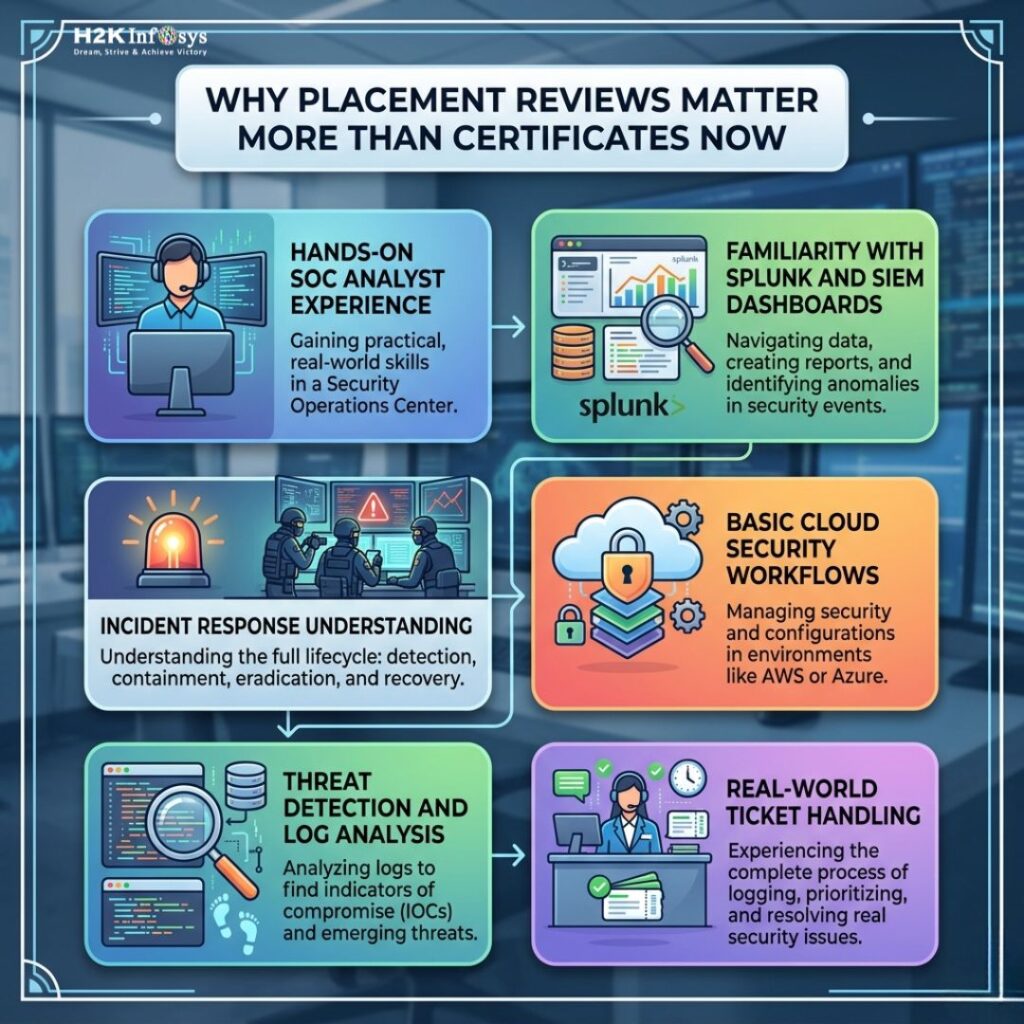
Why Placement Reviews Matter More Than Certificates Now
A few years ago, earning a certification alone could help candidates land interviews. Things have shifted.
Most hiring managers now prefer candidates who can demonstrate:
- Hands-on SOC analyst experience
- Familiarity with Splunk and SIEM dashboards
- Incident response understanding
- Basic cloud security workflows
- Threat detection and log analysis
- Real-world ticket handling
I’ve seen many learners spend months watching recorded videos only to realize they still freeze during technical interviews. That gap between “learning cybersecurity” and “being job-ready” is exactly why cyber security training with job placement support is becoming more valuable in the U.S. market.
Programs that simulate real workplace environments tend to receive stronger student reviews because learners actually feel prepared when interviews begin.
Why H2K Infosys Gets Strong Placement Feedback
H2K Infosys Cyber Security course Training focuses heavily on practical implementation instead of just certification theory.
That’s something many students mention repeatedly in reviews and community discussions.
The program usually stands out for a few specific reasons:
1. Real-Time Project Exposure
This is probably one of the biggest reasons learners talk positively about placements.
Instead of stopping at concepts, students work on:
- SIEM monitoring
- Splunk dashboards
- Threat detection exercises
- Security incident workflows
- Log analysis
- Risk assessment basics
A lot of beginners underestimate how important this is until interviewers start asking scenario-based questions.
For example:
“What would you investigate first after a suspicious login alert?”
People with only textbook preparation often struggle here. Learners exposed to simulated SOC environments usually answer more confidently because they’ve already practiced similar cases.
The U.S. Job Market Is Looking for Practical Skills
The cyber security course hiring trend in the USA right now is interesting.
Companies are still hiring aggressively for:
- SOC Analysts
- Cybersecurity Analysts
- SIEM Specialists
- Cloud Security Associates
- Incident Response Support roles
But the expectations for “entry-level” jobs have quietly increased.
Even junior candidates are expected to know tools like:
- Splunk
- Wireshark
- Nessus
- Jira
- Basic Linux commands
- Security monitoring concepts
That’s why cyber security jobs with training programs that include labs and mock environments tend to produce better placement outcomes.
Recruiters notice the difference pretty quickly.
What Makes H2K Infosys Different From Typical Online Courses
One thing I’ve personally noticed about many online cyber security course programs is that they feel disconnected from actual hiring processes.
You finish the course… get a certificate… and then suddenly you’re alone figuring out resumes, interviews, LinkedIn optimization, and technical rounds.
H2K Infosys Placement Assistance appears to approach things differently by combining:
- Technical training
- Resume preparation
- Mock interviews
- Real-time use cases
- Career mentoring
- Placement assistance
That combination matters more than people think.
A candidate may know cyber security course concepts perfectly but still fail interviews because they don’t know how to explain projects clearly.
Good placement-oriented programs help bridge that communication gap too.
Students Often Mention the “Job Readiness” Factor
One pattern you’ll notice in placement-focused reviews is that students repeatedly mention confidence.
That might sound small, but it’s actually huge in cybersecurity hiring.
A learner who has practiced:
- Alert investigations
- Security scenarios
- SOC workflows
- Splunk queries
- Threat monitoring
usually performs much better under interview pressure.
I remember talking to someone transitioning from a non-IT background who mentioned that the mock interview sessions helped more than expected because recruiters were asking practical workflow questions rather than pure theory.
That’s becoming increasingly common in the USA hiring market.
Cybersecurity in 2026 Is Becoming More AI-Driven
This is another reason practical training matters now.
With AI-generated phishing attacks, automated threat detection, and cloud infrastructure growing rapidly, cyber security course teams are adapting quickly.
Employers want analysts who understand:
- Real-time monitoring
- Security automation basics
- AI-assisted threat analysis
- Cloud security concepts
- Detection engineering fundamentals
Courses that stay connected to current industry workflows naturally receive better placement reviews because students aren’t learning outdated material.
And honestly, outdated cybersecurity content is still surprisingly common online.
Is H2K Infosys Good for Beginners?
For many beginners, yes especially those trying to enter the U.S. job market without prior cybersecurity experience.
A lot of learners come from:
- QA backgrounds
- Help desk support
- Networking
- Non-IT careers
- Recent graduation programs
The training structure is generally designed to make complex security topics feel manageable instead of overwhelming.
That’s important because cybersecurity can feel intimidating at first. Terms like SIEM correlation, incident response lifecycle, or threat intelligence sound complicated until you actually start using them in practical labs.
Once learners interact with real scenarios, things usually start clicking faster.
Why Placement Assistance Matters More Than Ever
The biggest mistake many students make is assuming:
“If I complete a cybersecurity course, recruiters will automatically call me.”
That’s rarely how it works now.
The market is competitive, especially in the USA.
Placement-focused support helps with:
- Resume positioning
- LinkedIn optimization
- Technical interview preparation
- Understanding recruiter expectations
- Confidence building
- Real project storytelling
This is why cyber security training and job placement programs tend to generate stronger outcomes compared to self-paced learning alone.
Typical Roles Students Aim For After Training
Many learners pursuing cyber security training with job placement support are targeting roles such as:
- SOC Analyst Level 1
- Cybersecurity Analyst
- Information Security Associate
- Security Operations Specialist
- Threat Monitoring Analyst
- Junior Cloud Security Analyst
The good thing is that companies still need these roles urgently because cyber threats continue increasing across finance, healthcare, cloud infrastructure, and retail sectors.
Cybersecurity isn’t slowing down anytime soon.
Final Thoughts
If your goal is simply to collect certificates, there are countless cybersecurity courses online.
But if your focus is actual employability in the USA, then programs built around cyber security jobs with training, practical SOC exposure, interview preparation, and placement assistance tend to create far better outcomes.
That’s why many learners researching placement-focused cybersecurity programs continue leaning toward H2K Infosys in 2026.
The combination of hands-on labs, real-world cybersecurity workflows, mentoring, and career support seems to align much more closely with what employers are currently expecting from entry-level and transition candidates in the U.S. cybersecurity market.