
Introduction
As businesses become increasingly dependent on online systems and digital technologies, the need for cybersecurity specialists is growing. To help learners long-term, H2K Infosys offers industry-centric cybersecurity training focused on developing the skills needed to secure systems and gain practical and real-world exposure. Understanding the various technologies and methodologies that underpin modern information systems is not the only requirement of a successful Cybersecurity Analyst Career.
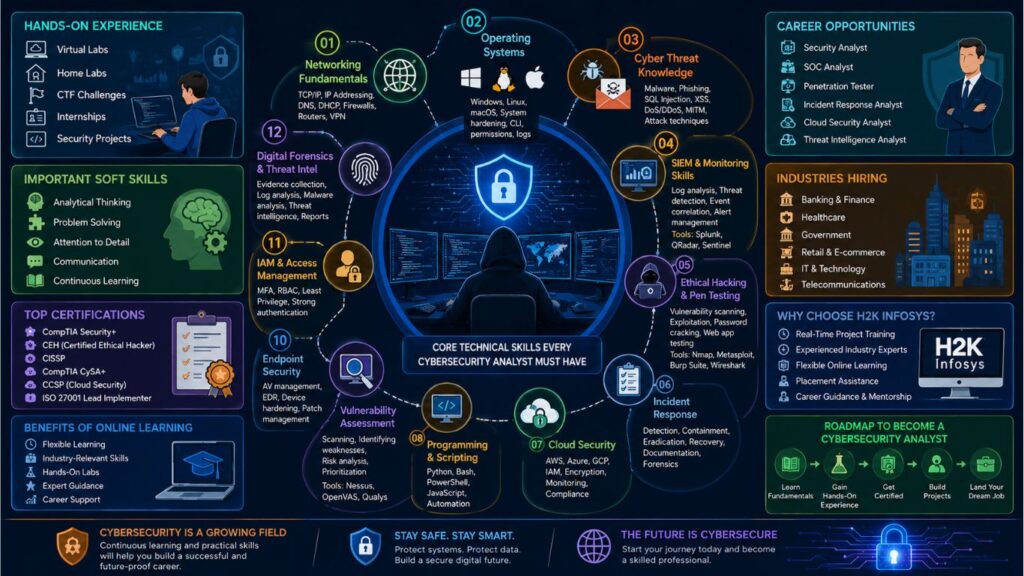
Cybersecurity Analysts need to have an excellent working knowledge of networking, operating systems, cloud security, and a number of other key technologies in contemporary IT. Coupled with this is the ability to think and act defensively in the face of numerous and varied threats to the IT infrastructure of an organization. With the growing trend of Cybercrime and the added sophistication that comes with it, it is no wonder that organizations are turning to the more established and professional Cybersecurity Analysts.
Due to the growing sophistication of the Cyber security training industry, many students and IT professionals are now taking online courses to advance their competencies with a technical basis for the field. This blog will detail the most valuable technical skills for a Cybersecurity Analyst Career and how aspirants can prepare for a career in this technical and high-paying profession.
Why Technical Skills Matter in a Cybersecurity Analyst Career
A career in Cybersecurity requires specialized knowledge in several overlapping domains including systems and networks. Cybersecurity professionals work to secure systems and networks from malicious actors every day. Analysts are responsible for scanning for weaknesses and malicious behavior to help carry out protective measures.
A lack of technical knowledge can result in the following:
- Managing security threats
- Initiating preventative measures to maintain system privilege
- Conducting analysis of cyber related activities
- Forensic analysis of malicious software
- Establishing protective measures for cloud resources
- Maintaining confidentiality of the enterprise resources
Having technical knowledge can help Cybersecurity Analyst Career professionals mitigate security breaches, and help manage risk for an organization. This is primarily the reason that most hirers prefer professionals with a high level of practical knowledge.
Employees also prefer training programs that consolidate skills and knowledge with practical sessions, real life projects, virtual labs, practice assessments, and other activities that target the improvement of technical skills.
Networking Fundamentals for a Cybersecurity Analyst Career
Networking is a foundational skill for Cybersecurity Analysts. Analysists should have an understanding of the anatomy of the systems as well as how attacks of opportunity are executed on various types of system vulnerabilities on the network.
Networking Skills
TCP/IP Knowledge
Analysts should have knowledge of the TCP/IP suite for the purpose of monitoring malicious behavior within the systems.
IP Addressing and Subnetting
As Cybersecurity Analysts, individuals should have a full understanding of the IPv4 and IPv6 structures as well as the elements of subnetting.
Firewalls and Routers
The construction of secure networks for an organization should have the full knowledge of Firewalls and Routers.
DNS and DHCP
An understanding of these systems allows the Analyst the ability to troubleshoot issues within the network and malicious behavior.
VPN Security
VPNs allow secure communication and the remote working environment actively employs this specific technology.
The networking skills of an Analyst serve as the building blocks to a successful Cybersecurity Analyst Career because the first line of a Cyber threat is often initiated on network vulnerabilities.
Operating System Knowledge
Cybersecurity Analysts constantly use various Operating Systems. To build a successful Cybersecurity Analyst Career, must have a good grasp on Operating Systems.
Most Commonly Used Operating Systems
Windows
Lots of companies use Windows environments, so knowledge in Windows security is extremely useful.
Linux
Linux has many uses for servers, the cloud, and environments used for ethical hacking.
macOS
Cybersecurity professionals must also secure Apple-based systems in enterprise environments.
Valuable Operating System Skills
- User management
- File permissions
- Patch management
- System hardening
- Log monitoring
- Command-Line
- Labs
All the online courses for Cybersecurity Analyst Career contain Operating System labs, as they are a vital part of the role.
Cyber Threat Awareness and Security Knowledge
One of the essential elements in a career as an analyst in Cybersecurity is knowledge of Cyber Threats. An analyst must have knowledge of how an attacker attacks, how different attacks affect systems, and what the targets are in each of those attacks.
Some Examples of Cyber Threats
Malware
Examples are Ransomware, Spyware, Viruses, and Trojans. These programs can harm the system and even disrupt the data.
Phishing
These are planned Emails intending to obtain Private Information by deceiving the user.
SQL Injection
These methods are used by attaching harmful scripts as Commands over a Secure Query Language.
Denial of Service
These methods are employed in order to disturb the services by overloading the system with requests.
XSS
These methods consist of attaching a harmful script to a Website.
Knowing such methods of attacks can greatly help these Cybersecurity Analyst Career in strengthening the organizational security.
SIEM Tools and Monitoring Skills
Security Information and Event Management tools are integral to the success of contemporary cybersecurity initiatives. The mastery of SIEM tools is a vital element for all individuals aspiring to be Cybersecurity Analyst Career.
The following tools are classified as SIEM tools:
Splunk
IBM QRadar
ArcSight
Microsoft Sentinel
The following are classified as important SIEM skills
Log Analysis
Cybersecurity analysts use logs to analyze and find suspicious behavior.
Threat Detection
Behavioral analysis and SIEM tools help recognize and analyze security incidents.
Event Correlation
Professionals join several events to recognize the pattern of attacks.
Alert Management
The management of security alerts and the appropriate response is part of the daily operations of Cybersecurity Analyst Career.
This is the reason many firms prefer candidates with SIEM exposure and thus the better online courses in cybersecurity include practical SIEM training.
Ethical Hacking Skills
Being an Ethical Hacker makes a Cybersecurity Analyst Career really successful because they can evaluate a Cybersecurity defense from the perspective of the attacker helping them implement better Cybersecurity controls.
Essential Ethical Hacking Skills
Vulnerability Scanning
Recognizing and Understanding weaknesses in systems and applications.
Penetration Testing
Taking the initiative to test to see if an attacker can exploit the system.
Password Security Testing
Utilizing a passive methodology to test the strength of an authentication system.
Web Application Testing
Investigating to see if security flaws exist in websites and applications.
Sometimes Used Ethical Hacking Tools
- Metasploit
- Burp Suite
- Nmap
- Wireshark
- Nessus
Knowing ethical hacking techniques can make someone a better Cybersecurity Analyst Career professional with a better skill set over the course of their work.
Cloud Security Skills
Cloud security is critical to any Cybersecurity Analyst Career job as cloud computing continues to rise in popularity.
The Big Three Cloud Providers
- AWS
- Microsoft Azure
- Google Cloud Platform
Key Cloud Security Competencies
Identity and Access Management
Control user access to cloud resources.
Data Encryption
Safeguarding sensitive data in the cloud.
Cloud Monitoring
Identifying anomalous activities in the cloud.
Compliance Management
Making sure cloud-based systems are secure.
Cloud security skills are in high demand as companies continue to adopt cloud-based infrastructures in Cybersecurity Analyst Career.
Programming and Scripting Knowledge
If you plan to become a Cybersecurity Analyst, learning to code is extremely helpful.
Commonly Used Programming Languages:
Python
Scripting and automation language within the domain of cybersecurity.
JavaScript
Indispensable when learning how to find security problems in web applications.
Bash Scripting
Linux administration and automation.
PowerShell
Windows security operations management.
Programming skills let analysts:
Automate tasks that are boring and redundant
Malware analysis
Security tools design
Handle large quantities of security-related data
Numerous Python and scripting courses are available, and to better assist students in improving their technical skills, many now admit coding as necessary for their Cybersecurity Analyst Career programs.
Incident Response Skills
A Cybersecurity Analyst needs to know how to handle Incident Responses. Companies rely on analysts for fast action when a breach occurs.
Key Steps in an Incident Response
Detection
Locating anything seen as odd. This could be anomalous behavior in users or even an attack in progress.
Containment
Infectious threats need to be kept from making control of more systems.
Eradication
Again, this involves threats needing to be fully resolved.
Recovery
After incidents, the best course is to return to a normal state and ensure that the systems are fully functioning.
Documentation
This includes reports and new strategies to prevent these issues in the future.
When a company loses money on an attack, it can lose even more from a long term shutdown. Handling these issues in the best possible way takes time, but good incident response skills can minimize both outcomes.
Vulnerability Assessment Skills
The assessment of systems for deficiencies is an everyday task of a cybersecurity analyst. Essentially, vulnerability management supports a prosperous cybersecurity analyst career.
Useful Tools for Vulnerability Assessments
- Nessus
- OpenVAS
- Qualys
- Nikto
Key Duties
- Vulnerability scanning
- Outdated software detection
- Risk assessment
- Security enhancement recommendations
Businesses will appreciate workers who can detect weaknesses and patch a security gap before someone can take advantage of it.
Practical experience is vital to a prosperous career as a Cybersecurity Analyst Career. Candidates who are proficient at being able to apply their knowledge and skills in actual circumstances are preferred by businesses.
Importance of Hands-On Experience
Practical experience is essential for building a strong Cybersecurity Analyst Career. Employers prefer candidates who can apply technical knowledge in real-world situations.
Ways to Gain Hands-On Experience
Virtual Labs
Practice cybersecurity scenarios safely.
Home Labs
Build personal testing environments for learning.
Capture the Flag Challenges
Improve hacking and problem-solving skills.
Security Projects
Work on real cybersecurity tools and tasks.
Internships
Gain industry exposure and practical experience.
A quality cyber security course with placement often includes hands-on labs and practical training to prepare students for job roles.
Benefits of Online Cybersecurity Training
The popularity of online courses for cybersecurity continues to grow because they provide flexible and career-focused learning opportunities.
Advantages of Online Learning
Flexible Schedule
Students can learn at their own pace.
Industry-Relevant Skills
Courses are updated based on current cybersecurity trends.
Practical Labs
Hands-on practice improves technical confidence.
Affordable Learning
Online programs are often more cost-effective than traditional education.
Career Support
Many platforms provide interview preparation and resume guidance.
Online training helps learners prepare for a successful Cybersecurity Analyst Career without disrupting their current work or education.
Why a Cyber Security Course With Placement Is Important
A cyber security course with placement helps students build technical skills while improving their chances of securing a cybersecurity job.
Benefits of Placement Assistance
Resume Building
Professional resume support improves job applications.
Mock Interviews
Practice interviews help students gain confidence.
Technical Interview Preparation
Students learn how to answer cybersecurity interview questions.
Job Referrals
Training institutes connect students with hiring companies.
Career Guidance
Mentorship helps learners choose the right career path.
Placement-focused training programs are highly beneficial for beginners entering the cybersecurity industry.
Career Opportunities in Cybersecurity
A successful Cybersecurity Analyst Career opens the door to multiple job opportunities across industries.
Popular Cybersecurity Roles
- Security Analyst
- SOC Analyst
- Penetration Tester
- Incident Response Analyst
- Cloud Security Analyst
- Threat Intelligence Analyst
Cybersecurity professionals are needed in:
- Banking
- Healthcare
- Government
- Retail
- Technology companies
- Telecommunications
The demand for cybersecurity experts continues to increase worldwide due to rising cyber threats.
Why Choose H2K Infosys for Cybersecurity Training
H2K Infosys provides industry-oriented cybersecurity training programs designed to help learners build a successful Cybersecurity Analyst Career.
Benefits of H2K Infosys
Real-Time Project Experience
Students work on practical cybersecurity scenarios.
Experienced Trainers
Industry professionals provide expert guidance.
Flexible Learning Options
Courses are designed for students and working professionals.
Placement Assistance
Career support helps learners secure job opportunities.
Hands-On Training
Practical labs improve technical expertise and confidence.
For learners searching for online courses for cybersecurity or a reliable cyber security course with placement, H2K Infosys offers practical learning and career-focused training solutions.
Conclusion
A flourishing cybersecurity analyst career seamlessly blends technical and practical elements and rewards those who value staying informed and continuing their education. Occupations in this field rely on an assortment of diverse skills. Knowledge of data networks and operating systems, virtualization and SIEM, and other tools used in cloud security are useful. A background in ethical hacking is essential, and the ability to assess and respond to system vulnerabilities is a bonus.
As the occurrence of cyberattacks continues to grow, more and more companies are on the lookout for talent. There are numerous Online courses for cyber security, but the best offer the flexibility of self-paced training while combining an online placement services for work. If an individual possesses the right mix of practical skills, technical know-how, and relevant certificates, a lucrative career as a cyber security analyst is well within reach.