The best Playwright automation course in the USA is one that teaches more than basic browser commands. It should help you build a complete automation framework, test APIs, run tests through CI/CD pipelines, handle real application failures, and prepare for actual QA automation interviews.
For learners comparing a Playwright Automation Course with practical, instructor-led Playwright Training, H2K Infosys is a strong career-focused option. Its current Playwright Automation Course with Java + Gen AI Testing program combines Java automation, Playwright Automation Course, API testing, framework development, CI/CD, generative AI, live projects, and job-oriented support in one structured learning path.
That said, “best” depends on what you are trying to achieve. Someone casually exploring browser automation may be fine with free documentation and YouTube tutorials. Someone trying to move from manual testing into an Automation Engineer or SDET position usually needs more structure, feedback, project practice, and interview preparation.
Let’s break down what actually matters.
Why Playwright Training Matters in 2026
Playwright has moved well beyond being just another Selenium alternative.
Microsoft describes Playwright Automation Course as a tool for reliable browser automation across testing, scripting, and AI-agent workflows. It supports Chromium, Firefox, and WebKit through a unified API and is available for TypeScript, Python, .NET, and Java. Its test runner includes auto-waiting, assertions, tracing, browser isolation, and parallel execution.
That combination solves several problems QA teams regularly face.
Picture a familiar testing scenario: a checkout button appears on the screen, but it is not yet ready to accept a click. A basic automation script may click too early and fail randomly. The tester then adds a fixed five-second wait. The suite becomes slower, and the failure eventually returns anyway.
Playwright’s auto-waiting behavior is designed to reduce that kind of fragile synchronization logic. But learning the feature name is not enough. A tester must also understand locator strategy, application state, retries, assertions, traces, network activity, and why a test failed in the first place.
This is why practical Playwright Course matters. The tool may make automation cleaner, but you still need to think like a test engineer.
Recent Playwright Automation Course updates also show how quickly the platform is evolving. Official release notes now include capabilities such as improved HAR tracing, expanded video retention options, WebSocket request capture in traces, support for newer operating systems, and updated browser versions.
A course recorded once and left untouched for two years will struggle to keep up with that pace.
What Should a Good Playwright Online Course Teach?
A useful course should take you from “I can run a test” to “I can contribute to an automation project.”
Those are very different levels.
At minimum, look for the following areas.
1. Programming Fundamentals
You do not need to become a full-time application developer before learning Playwright Automation Course. You do, however, need enough coding knowledge to write reusable and maintainable tests.
For a Java-based course, that means understanding:
- Variables, conditions, loops, and methods
- Classes and objects
- Inheritance and interfaces
- Collections
- Exception handling
- File handling
- Maven dependencies
- Basic debugging
This part is often skipped by short courses. Then, a few weeks later, learners can copy a locator but cannot explain why their test class will not compile.
A good course closes that gap early.
2. Reliable Locator Strategies
Locators are where many beginner frameworks quietly go wrong.
A course should teach you when to use roles, labels, visible text, test IDs, CSS selectors, and XPath. It should also explain why copying a long XPath from the browser’s developer tools is usually a bad long-term strategy.
But a small UI redesign could break it tomorrow.
A locator based on the button’s role and accessible name is generally easier to understand and maintain. That difference seems small in a classroom exercise. Across 800 automated tests, it becomes a major engineering decision.
3. Framework Development
Writing ten tests in one file is not framework development.
Strong Playwright Automation Course should cover:
- Page Object Model
- Reusable utilities
- Configuration management
- Environment variables
- Test data handling
- Logging and reporting
- Parallel execution
- Retry policies
- Hooks and fixtures
- Screenshot and video capture
- Failure analysis
A framework should be understandable to another tester who joins the project six months later. That is the real test not whether the original author can make it run on their own laptop.
4. API and UI Testing Together
Modern applications are rarely tested only through the browser.
Suppose an e-commerce test creates an order through the user interface, then checks whether the order appears correctly in the backend. A slow approach would repeat every setup action through the UI.
A better approach may be to create test data through an API, validate the response, open the application, and confirm that the user sees the correct result.
This is faster and closer to the way experienced automation teams design end-to-end coverage.
5. CI/CD Integration
A script running successfully from IntelliJ is a good start. It is not the finished job.
The automation suite should also run when code is pushed, when a build is created, or when a deployment reaches a test environment. That requires exposure to tools and concepts such as:
- Git and GitHub
- Jenkins
- GitHub Actions
- Maven pipelines
- Docker fundamentals
- Scheduled test execution
- Test reports and build artifacts
This is one area where structured training can save a lot of trial and error.
Why H2K Infosys Is a Strong Playwright Automation Course Option
H2K Infosys currently offers a Playwright Automation Course with Java + Gen AI Testing program aimed at QA engineers, manual testers, automation testers, SDETs, developers, students, and IT graduates.
As of July 2026, its official course page lists a 100-hour program with certification and a live project. The curriculum includes software-testing foundations, Core Java, Git, GitHub, Maven, Playwright Automation Course fundamentals, advanced framework development, API testing, CI/CD, generative AI testing, Selenium-to-Playwright migration, and domain-based framework projects.
That breadth is the main reason it stands out as a career-oriented option.
The Course Starts Before Playwright Syntax
The program does not assume that memorizing commands is the whole job. It begins with areas such as SDLC, STLC, Agile, test-case design, defect lifecycle, Java fundamentals, and Maven.
This is useful for manual testers because the difficult part of moving into automation is often not Playwright Automation Course itself. The difficult part is learning to connect testing knowledge with programming logic.
For instance, a manual tester may already know that a login page needs positive, negative, boundary, security, and usability checks. Automation training should help that person convert the right scenarios into stable automated tests not simply automate every manual step without thinking.
It Uses Java for Enterprise-Oriented Automation
A lot of Playwright Automation Course material online is written in TypeScript. That is useful, and TypeScript remains a sensible language for modern web-testing teams.
Java is also relevant for testers targeting organizations that already use Java, Maven, Jenkins, TestNG, Selenium, and enterprise backend systems. H2K Infosys takes this Java-oriented route while covering modern Playwright Automation Course practices.
For someone already familiar with Selenium and Java, that can make the migration easier. You are not changing the programming language, test tool, framework style, and build system all at once.
It Includes API Testing and CI/CD
The published curriculum includes REST fundamentals, HTTP methods, JSON handling, authentication, Playwright Automation Course API testing, and combined API-plus-UI scenarios.
It also covers Jenkins, GitHub Actions, Docker basics, Maven pipelines, scheduled suites, and CI reporting.
This matters because employers generally do not hire someone merely to write isolated browser scripts. They need testers who understand how automation fits into the delivery pipeline.
It Includes Gen AI Testing Workflows
AI-assisted testing is becoming part of the QA workflow, but it needs to be taught carefully.
The H2K Infosys curriculum includes prompt engineering for testers, AI-assisted test generation, locator creation, API test creation, debugging, test-data generation, GitHub Copilot, Cursor AI, flaky-test optimization, and AI-based defect analysis.
The useful lesson here is not “let AI write everything.”
A generated test can look convincing and still contain a weak assertion, unstable selector, exposed credential, or completely incorrect business assumption. A capable automation tester must be able to review the output, challenge it, run it, and improve it.
AI can reduce repetitive work. It cannot replace test judgment.
It Adds Career Preparation
H2K Infosys lists class recordings, sample resumes, interview questions, flexible scheduling, course certification, resume preparation, mock interviews, and job-placement support among the program materials and highlights.
These services should not be confused with a guaranteed job. No ethical training provider can promise that every learner will receive a particular role or salary.
Still, resume reviews and mock interviews can be valuable, especially for someone who knows the material but struggles to present project experience clearly.
What Skills Can You Gain?
By the end of a serious Playwright Automation Course, you should be able to do more than list Playwright Automation Course on your resume.
You should be able to:
- Write maintainable browser tests
- Automate Chromium, Firefox, and WebKit scenarios
- Design stable locators and assertions
- Build a Page Object Model framework
- Test APIs and validate JSON responses
- Combine API setup with UI verification
- Manage dependencies with Maven
- Store and collaborate on code through GitHub
- Run tests in parallel
- Connect automation to Jenkins or GitHub Actions
- Analyze traces, videos, screenshots, and logs
- Explain flaky tests instead of repeatedly rerunning them
- Use AI tools without blindly trusting generated code
- Discuss your framework choices during an interview
That last point is easy to underestimate.
Interviewers frequently ask why a framework was designed in a particular way. Saying, “The trainer gave us this code,” will not take the conversation very far. Saying, “We separated page behavior from test logic to reduce duplication and improve maintenance,” shows that you understand the engineering decision.
Career Outcomes After Playwright Training
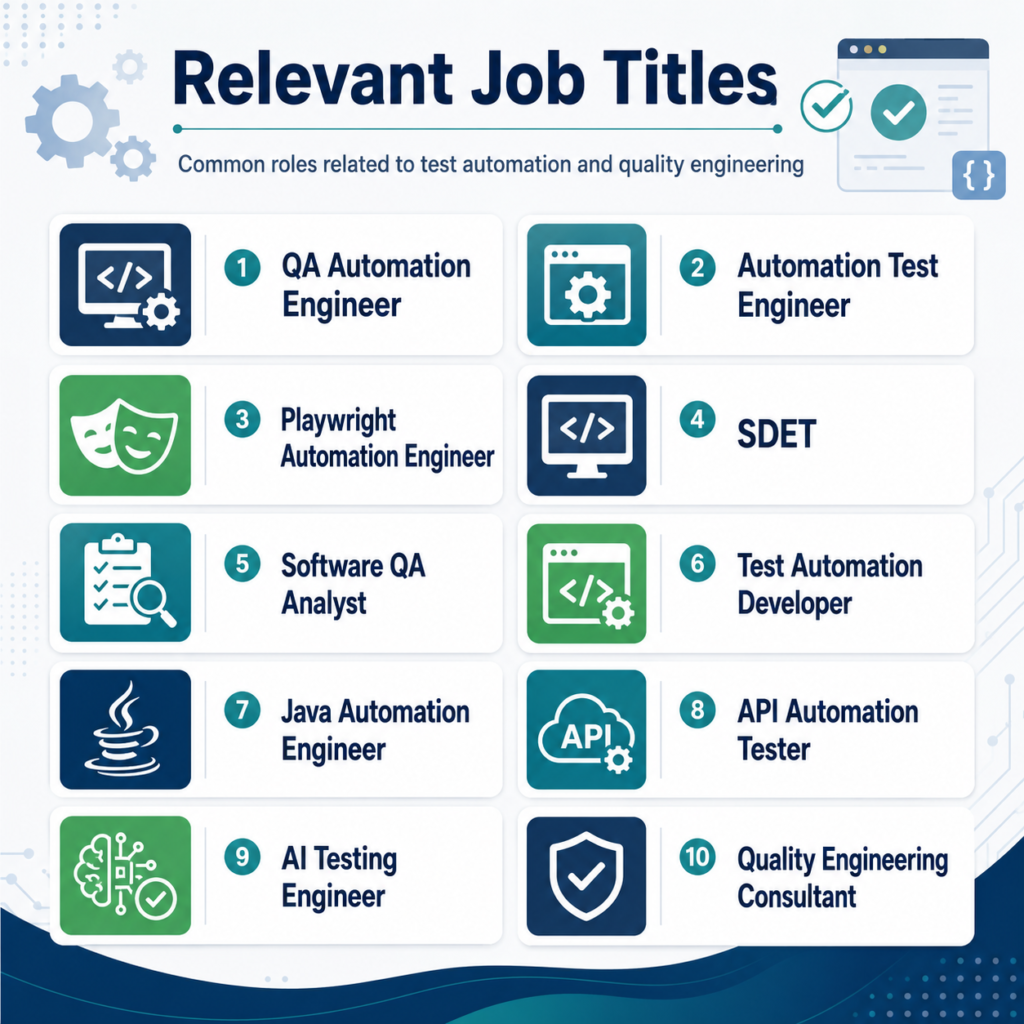
Relevant job titles may include:
- QA Automation Engineer
- Automation Test Engineer
- Playwright Automation Engineer
- SDET
- Software QA Analyst
- Test Automation Developer
- Java Automation Engineer
- API Automation Tester
- AI Testing Engineer
- Quality Engineering Consultant
The broader U.S. software-quality field continues to offer meaningful career potential. The U.S. Bureau of Labor Statistics reports a median annual wage of $102,610 for software quality assurance analysts and testers, based on May 2024 wage data. It projects employment for that specific occupation to grow 10% between 2024 and 2034, faster than the average for all occupations.
That figure is not a promise of what a new course graduate will earn. Actual compensation varies by experience, location, technical depth, industry, communication skills, and the employer.
An entry-level tester with one classroom project will be evaluated differently from an SDET who can design frameworks, review pull requests, troubleshoot pipelines, test APIs, and support production releases.
The practical takeaway? Playwright Automation Course can strengthen your profile, but the framework alone is not the career. Your value comes from combining testing judgment, coding, debugging, delivery tools, and clear communication.
A Realistic Project Scenario
Imagine that you are testing an online banking application.
A basic assignment might ask you to automate a login. A job-ready project goes further:
- Create a test user through an API.
- Authenticate and capture the required token.
- Log in through the browser.
- Transfer money between test accounts.
- Verify the confirmation message.
- Check the updated balance.
- Confirm the transaction through a backend API.
- Capture screenshots, traces, and logs if the test fails.
- Run the suite across multiple browsers.
- Execute it through a CI pipeline.
Now you have something worth discussing in an interview.
You can explain test-data setup, locator choices, security considerations, assertions, failure handling, pipeline configuration, and reporting. That conversation sounds very different from “I watched 30 videos and completed the quizzes.”
H2K Infosys includes framework projects involving e-commerce, banking, healthcare, UI and API automation, CI/CD, reporting, parallel execution, and AI-assisted script creation.
Common Mistakes When Choosing Playwright Training
Choosing the Cheapest Course Without Reviewing the Curriculum
A low price is not automatically a good deal. Check whether the training includes programming, framework design, API testing, Git, CI/CD, debugging, and a substantial project.
A course teaching only navigation, clicks, and form filling may leave you with a completion certificate but no convincing portfolio.
Watching Without Practicing
Automation is not learned passively.
Pause the recording. Rebuild the example without copying. Change the application flow. Break the locator deliberately. Read the trace.Fix the test.
That slightly uncomfortable part where the test fails and you are unsure why is often where the actual learning happens.
Relying Too Heavily on AI-Generated Code
AI may generate a test in seconds. It may also invent selectors, miss business rules, use fixed waits, expose sensitive data, or assert the wrong outcome.
Use AI as a coding assistant, not as the final reviewer.
Ignoring Git and CI/CD
Many learners focus only on the Playwright Automation Course API. Then an interviewer asks them to resolve a merge conflict or explain why the pipeline failed.
Modern automation is team-based. Your code must be versioned, reviewed, executed, and maintained by more than one person.
Claiming Project Experience You Cannot Explain
Do not fill your resume with tools you only saw once during class.
A smaller project that you understand deeply is more useful than a large framework you cannot explain. Be ready to open the repository, run the tests, describe the architecture, and discuss one difficult failure you solved.
Who Is This Playwright Online Course Best For?
H2K Infosys is likely to be a strong fit for:
- Manual testers moving into automation
- Selenium testers exploring Playwright
- Java professionals entering software testing
- QA engineers who need API and CI/CD skills
- SDET candidates building a modern project portfolio
- Career returners who need structured revision
- Learners who benefit from live instruction and feedback
- Testers interested in practical Gen AI workflows
A self-paced course may be enough for an experienced automation engineer who already understands programming, Git, APIs, frameworks, and CI/CD.
For someone starting from the beginning, a structured program can reduce the number of disconnected tutorials they have to piece together.
Questions to Ask Before Enrolling
Before paying for any Playwright Automation Course, attend a demo and ask direct questions:
- Are classes live, recorded, or both?
- How much of the course is hands-on?
- Will I build a framework from scratch?
- Is the project completed individually or only demonstrated?
- Does the trainer review learner code?
- Are API testing and CI/CD included?
- Which Playwright Automation Course version is taught?
- How frequently is the curriculum updated?
- Will I receive access to recordings?
- What does job-placement support actually include?
- Can I see an anonymized sample project?
- Are mock interviews technical or general?
- Is Java taught from the basics?
H2K Infosys currently advertises a free demo, so use that session as an evaluation not simply as an introduction.
A good trainer should be comfortable showing how the course works, what learners build, and how practical questions are handled.
Benefits of Choosing Structured Playwright Training
You can learn Playwright Automation Course independently. The official documentation is detailed, and there are plenty of free examples.
The real benefit of structured training is sequencing.
Instead of randomly jumping from locators to Docker to API testing and back to Java basics, you follow a path:
Testing foundations → Java → Git → Playwright → framework design → APIs → CI/CD → AI-assisted testing → project work → interview preparation
That structure is particularly useful when you do not yet know which knowledge gaps are holding you back.
If you’re serious about building a career in QA automation, structured training can really help you move from scattered knowledge to a portfolio you can demonstrate. H2K Infosys deserves consideration because its current program connects Playwright Automation Course with Java, API testing, CI/CD, Gen AI, live projects, and career support rather than treating Playwright Automation Courseas an isolated tool.
Related Topics to Explore
This article can be connected to a larger QA automation content cluster. You can also explore topics like:
- Playwright vs. Selenium: Which Automation Tool Should You Learn?
- How to Build a Playwright Framework with Java
- Top Playwright Interview Questions for QA Engineers
- How to Integrate Playwright Automation Course Tests with Jenkins
- API Testing with Playwright: A Practical Beginner’s Guide
These supporting topics help learners move from course selection into practical skill development.
Frequently Asked Questions
Is Playwright suitable for beginners?
Yes, but beginners should learn basic programming and software-testing concepts alongside Playwright Automation Course. A structured course is useful when you need help connecting Java, test design, framework development, and automation.
Should I learn Playwright with Java or TypeScript?
Choose based on your target job market and existing skills. TypeScript is common in modern web projects, while Java can be a practical choice for enterprise QA environments already using Maven, Jenkins, Selenium, and Java-based frameworks.
Is Playwright replacing Selenium?
Playwright is becoming a major choice for modern web automation, but Selenium remains widely used. Learning Playwright Automation Course can improve your options, especially when you also understand how to migrate or maintain existing Selenium frameworks.
How long does it take to learn Playwright?
Basic test creation may take a few weeks. Becoming job-ready usually takes longer because you also need programming, APIs, Git, framework design, debugging, and CI/CD practice. H2K Infosys currently lists its full program at 100 hours.
Can Playwright Training help me get a QA automation job?
Training can give you relevant skills, projects, interview practice, and a clearer learning path. Employment is not guaranteed; your results will depend on hands-on practice, project quality, previous experience, communication, and interview performance.
Final Take: Which Playwright Automation Course Is Best in the USA?
The best course is not the one with the longest feature list. It is the one that helps you build, debug, explain, and maintain real automation.
For career-focused learners, H2K Infosys offers a well-rounded option. Its Playwright automation course combines Java, framework development, API testing, CI/CD, Gen AI testing, practical projects, recordings, certification, resume preparation, mock interviews, and placement support. That makes it more comprehensive than a basic, syntax-only Playwright online course.
Your next step is practical: attend the demo, inspect the current curriculum, ask to see the project structure, and confirm that the schedule fits your availability.