
Are you currently choosing a Playwright online course, worried that you will not learn practical content? Take this course, and you will master this fastest-growing web automation testing framework, and also gain the in-demand hard career skills that employers will urgently need in 2026.
Software teams are shipping updates at an unprecedented rate, making automated testing not optional, but essential. That’s where Playwright Course Online comes in. I see more and more QA engineers, developers, and even DevOps folks adding Playwright to their skill sets in the last couple of years as companies are adopting it more and more for reliable end to end testing.
So what does a good Playwright Course Online actually teach? Let me explain it to you.
The Growing Popularity of Playwright
A couple of years back Selenium was the buzzword in automation testing. Today Playwright Course Online is changing that scene.
Playwright, built by Microsoft, allows testers to automate Chromium, Firefox and WebKit browsers using one framework. And the biggest plus? It resolves many of the reliability problems that testers using older automation tools faced.
Many organisations moving to CI/CD and Agile development now prefer Playwright Course Online because it provides:
- Speedier tests
- Auto-wait built-in
- Testing for browser compatibility
- Improved support for modern web applications
- Simplified debugging tools
One reason is that taking an online Playwright Course Online has become a smart career move for both beginners and experienced testers.
Key Concepts you will learn in Playwright Course
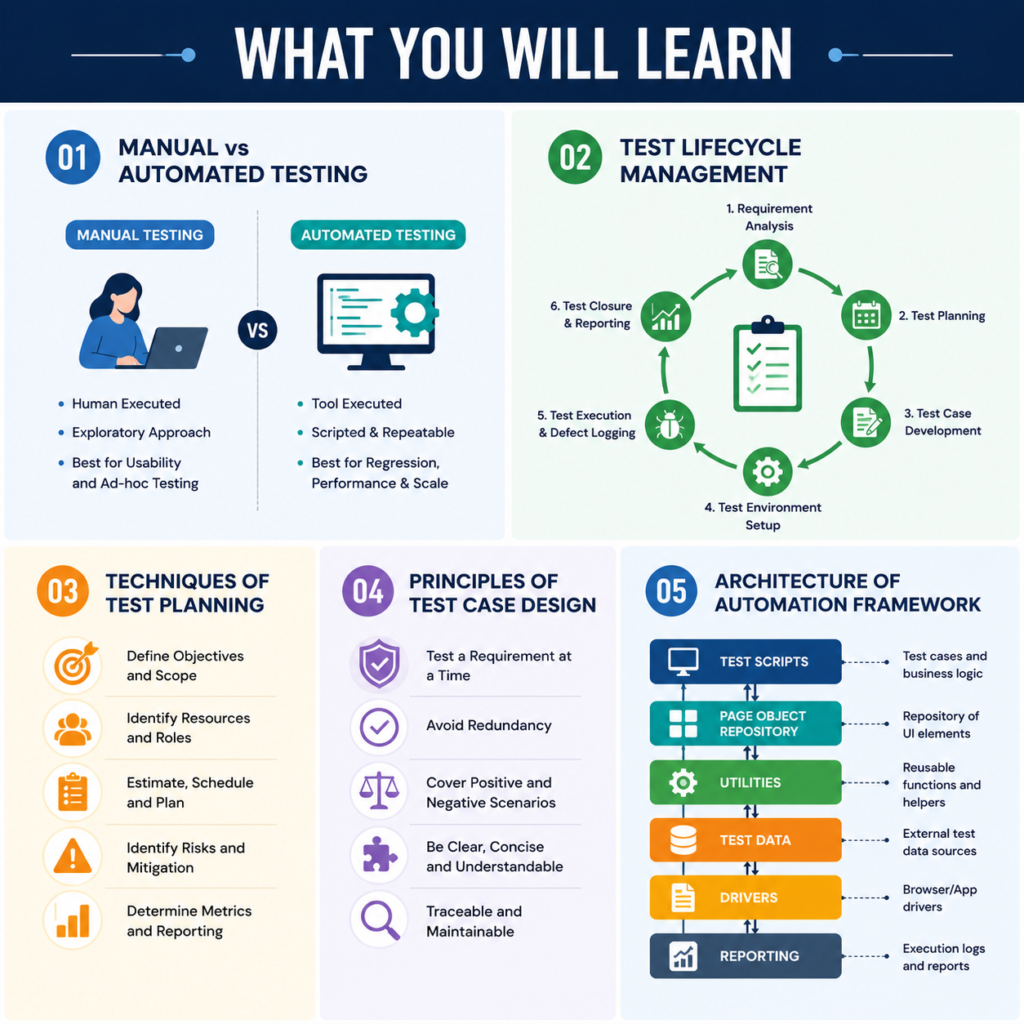
Learn the Basics of Test Automation
Most of the quality Playwright Course Online programs begin with the basics of automation testing before moving on to coding.
What you will learn:
- Manual vs Automated Testing
- Test lifecycle management
- Techniques of test planning
- Principles of test case design
- Architecture of automation framework
This background is important because automation is not just writing scripts. It is about having solid testing processes.
Setting Up Playwright
The first practical exercise is usually setting up the Playwright Course Online environment.
You will work with:
- Installing Node.js
- Playwright configuration
- VS Code Setup
- Setup of project structure
- Managing and installing browsers
It might sound simple but getting comfortable with the set up process builds confidence quickly.
Learning Playwright Automation From Beginning
Writing your first test script
And this is where it starts to get interesting.
In a typical Playwright Course Online you will learn to:
Browsers open
- Browse web pages
- Click on items
- Fill out forms
- Push buttons
- Drop-downs management
For example you might automate the login process of an e commerce application and verify if the users are able to successfully login to their accounts.
These are the very real-world scenarios you will encounter in a QA role.
Locators and Selectors Usage
One of the common challenges in automation testing is correct identification of page elements.
You’ll see how Playwright Course Online uses:
- CSS selectors
- XPath
- Text locators
- Role based locators
- Selectors (Custom)
Many beginners overlook this topic, but seasoned testers know that stable locators are often the difference between reliable automation and constant maintenance headaches.
Advanced Skills of Browser Automation
Cross Browser Testing
Users today use multiple browsers to access apps.
A good Playwright Course Online explains how to test applications across:
- Chrome
- MS Edge
- Firefox (Mozilla)
- Safari (WebKit)
You’ll see how Playwright Course Online can make this easier for you with a single API, instead of writing a separate script for each browser.
Working with Dynamic Web Elements
Today’s applications are highly interactive.
You’ll work on the automation of:
- Dynamic tables
- AJAX Calls
- Pop-ups
- Notifications
- Frames
- Multiple tab scenarios
- Pages with infinite scrolling
Some of the skills that are usually tested by employers on automation testing interviews are:
Playwright Test API
A big driver of the recent acceleration of Playwright Course Online adoption has been API testing.
Many modern QA teams need testers who can test UI and backend services.
You will learn:
- Making API requests
- GET, POST, PUT, DELETE methods
- Verification of Answers
- testing authentication
- API chaining
Consider testing an online shopping application. You can verify the backend API response instead of just checking if the “Order Successful” page appears.
That gives a lot more confidence to application quality.
Frameworks for Building Automation
This is often when automation professionals start to move into higher paying roles, developing frameworks.
An online quality Playwright Course Online will usually include:
Page Object Model(POM)
This common design pattern is useful for creating maintainable test automation frameworks.
You will learn:
- Types of pages
- Methods that can be reused
- Repositories of objects
- Organization of the framework
Testing Based on Data
Hardcoded values are seldom used in real world testing.
You will work on:
- json files
- Data in Excel
- Test datasets external
- Testing with parameters
The techniques are commonly used in enterprise testing environments.
Test Reporting and Debugging
Writing tests is only half of the job.
You’ll also learn how to:
- Produce test reports
- Take Screenshots
- Create videos
- Failures analysis
- Troubleshoot automation scripts
One thing I see a lot in the workplace is that debugging skills tend to be what separates junior testers from senior automation engineers.
The DevOps practices and CI/CD Integration
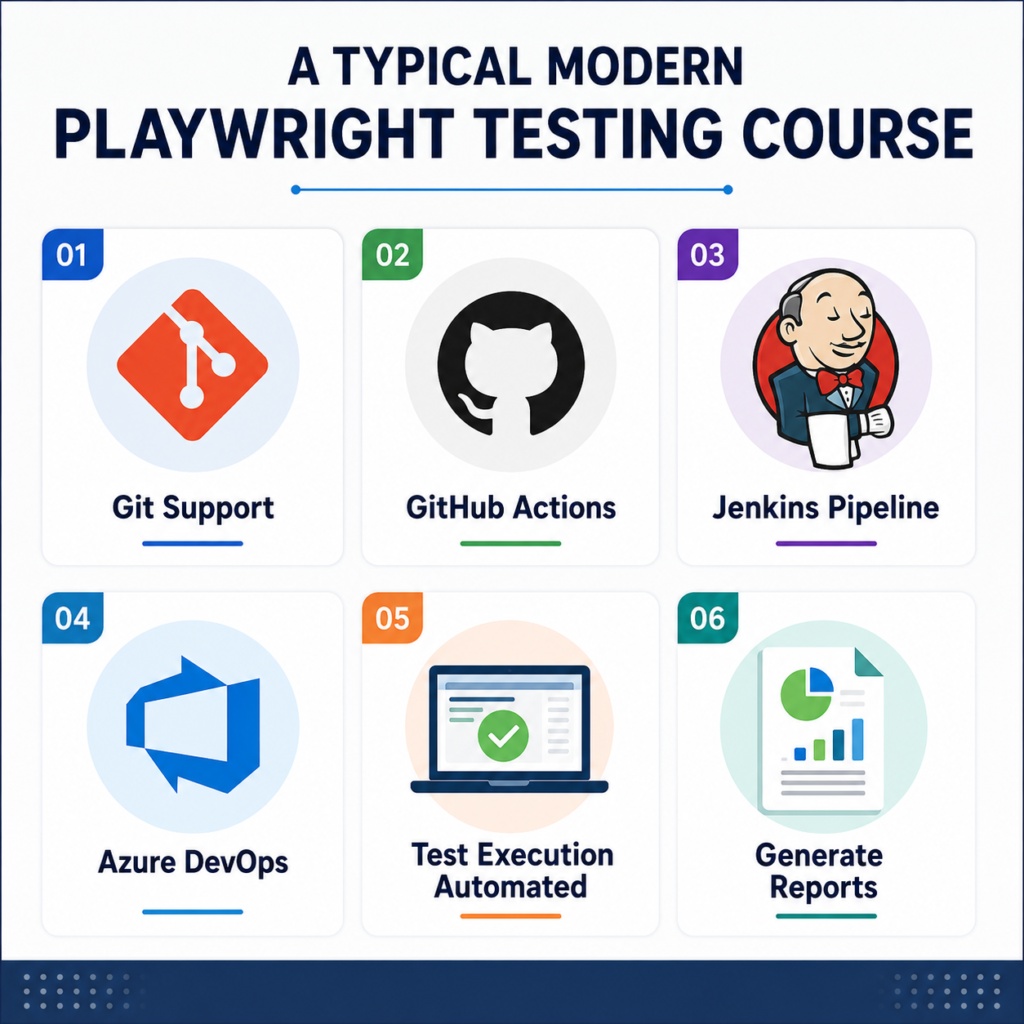
2026 is the year automation testing and DevOps are tightly linked together.
Most organisations expect that automation tests will run automatically when code changes are deployed .
A typical modern playwright testing course includes:
- Git support
- GitHub Actions
- Jenkins pipeline
- Azure DevOps
- Test execution automated
This knowledge can significantly enhance your employability, as companies are increasingly looking for people who understand testing and deployment workflows.
Projects you will work on in the real world
The best way to learn is by doing projects.
At H2K Infosys students typically get to see scenarios like:
- Testing of E-Commerce applications
- Workflows for banking applications
- Validation of healthcare portal
- Insurance platform automation
- Testing user authentication
These project experiences help bridge the gap between theory and real-world workplace expectations.
Skills You’ll Acquire After Completing a Playwright Course
At the end of a structured program you will typically be able to:
- Build automated UI tests
- Test API
- Develop automation frameworks
- Perform cross-browser testing
- Include testing in CI/CD pipelines
- Produce professional reports
- Troubleshoot and maintain automation suite(s)
- Ability to work in Agile teams
These skills are in line with what hiring managers look for in automation testing candidates today.
Career Opportunities After Learning Playwright
As companies accelerate the software delivery cycle, the need for automation professionals is only rising.
Some typical positions are:
- Test Automation Engineer
- Automation QA Engineer
- SDET (Software Development Engineer for Testing)
- Architect Test Automation
- QA Analyst
- Test/Dev Engineer
Industry salary surveys repeatedly show substantially higher pay for those with automation skills over manual testers alone, particularly with knowledge of frameworks, APIs and CI/CD integration in 2025 and 2026.
Mistakes That Newbies Make
I have seen many new joiners making the same mistakes while Playwright Course Online .
- moving too fast into advanced concepts
- Ignoring the basics of automation
- Skipped framework design principles
- Not working on real world projects
- Memorising code over understanding workflows
Avoid these pitfalls with a structured learning path.
Why H2K Infosys for Playwright Training?
There are lots of online courses these days but not all of them are based on real-world job requirements.
H2K Infosys’s areas of focus are:
- Live instructor-led training
- Real time project experience
- Curriculum relevant to Industry
- Interview training
- Help with your resume
- Job placement assistance
For learners who are looking to move into an automation testing career and not just complete a course, this practical approach can make a big difference.
If you are serious about building a career in test automation, structured training coupled with hands-on projects will considerably shorten your learning curve.
Related Topics You May Explore
You may want to look into furthering your skills in automation testing :
- Selenium or Playwright: Which Automation Tool Should You Learn in 2026?
- API Testing for QA Engineers: A Complete Beginner’s Guide
- Test Automation Experts for CI/CD Pipelines
These topics combined form a strong automation testing learning path and content cluster.
FAQ
Is Playwright Better Than Selenium 2026?
Playwright provides faster execution, auto-waiting out of the box and modern browser support. Many organisations are adopting it for new automation projects. But Selenium is still widely used.
Is Playwright easy for beginners to learn?
Yes. A well-structured Playwright Course Online starts with automation basics and then moves on to scripting, framework design and advanced testing concepts.
How long does it take to learn Playwright?
Most students achieve working proficiency in 6-12 weeks of consistent practice and hands-on projects.
Is Playwright popular ?
Yes. The demand for automation engineers with Playwright Course Online skills is still growing as organisations modernise their testing frameworks and DevOps pipelines.
Do I need any coding experience for Playwright testing course?
Some basic programming knowledge is helpful, but many training programs teach coding concepts as part of automation testing skills.
Final Thoughts
Learning playwright online course is no longer an optional upgrade for testers, it’s becoming a valuable career skill for anyone involved in software quality. Get hands-on knowledge that is immediately applicable to the needs of today’s industry in a comprehensive Playwright Course Online that covers everything from browser automation and API testing to framework development and CI/CD integration.
The next best thing is to pick a program that offers expert instruction, real-world projects, and career support. And that’s where H2K Infosys comes in. It offers the practical experience employers want in today’s competitive automation testing market, instead of just teaching concepts.
If you are beginning your QA journey or considering moving into automation engineering, investing in a professional playwright course today can unlock better job opportunities, higher salaries, and long-term career growth.