At H2K Infosys, we believe the Best AI and Generative AI Certification for beginners in 2026 are Google Cloud Generative AI Leader for business-focused learners, AWS Certified AI Practitioner for broad cloud and AI knowledge, and the IBM Generative AI Engineering Professional Certificate for people who want practical development experience.
That said, the “best” course depends on what you are actually trying to do. A marketing professional who wants to use AI at work needs a very different learning path from a junior developer planning to build a retrieval-augmented chatbot.
And yes, that distinction matters more than the logo on the certificate.
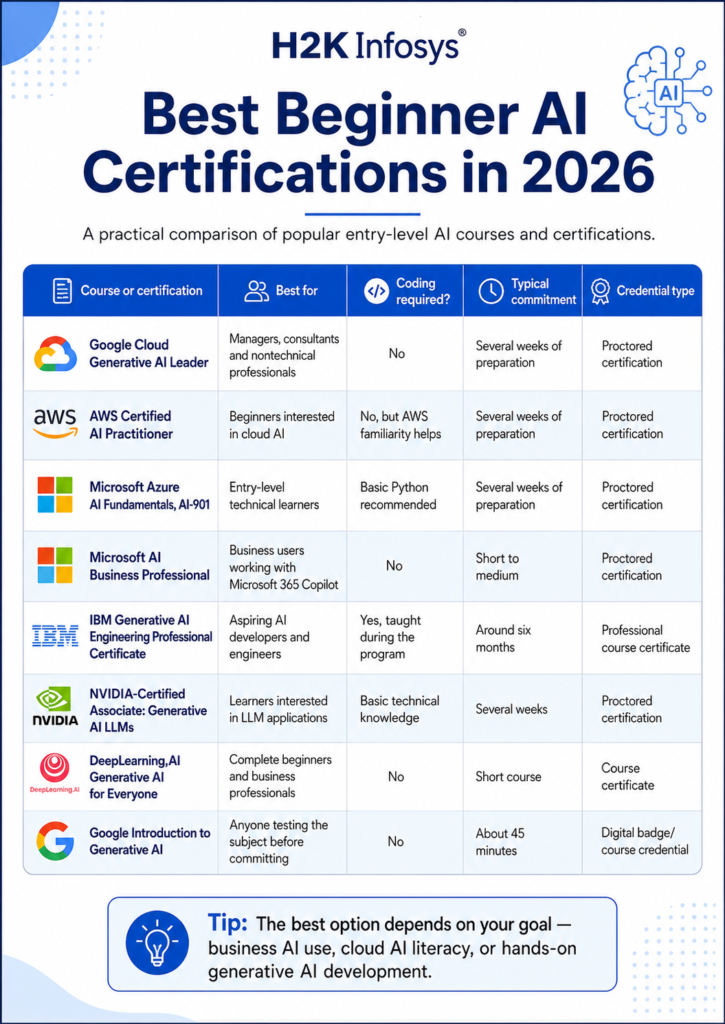
The Best Beginner AI certification courses for beginners at a Glance
| Course or certification | Best for | Coding required? | Typical commitment | Credential type |
|---|---|---|---|---|
| Google Cloud Generative AI Leader | Managers, consultants and nontechnical professionals | No | Several weeks of preparation | Proctored certification |
| AWS Certified AI Practitioner | Beginners interested in cloud AI | No, but AWS familiarity helps | Several weeks of preparation | Proctored certification |
| Microsoft Azure AI Fundamentals, AI-901 | Entry-level technical learners | Basic Python recommended | Several weeks of preparation | Proctored certification |
| Microsoft AI Business Professional | Business users working with Microsoft 365 Copilot | No | Short to medium | Proctored certification |
| IBM Generative AI Engineering Professional Certificate | Aspiring AI developers and engineers | Yes, taught during the program | Around six months | Professional course certificate |
| NVIDIA-Certified Associate: Generative AI LLMs | Learners interested in LLM applications | Basic technical knowledge | Several weeks | Proctored certification |
| DeepLearning.AI Generative AI for Everyone | Complete beginners and business professionals | No | Short course | Course certificate |
| Google Introduction to Generative AI | Anyone testing the subject before committing | No | About 45 minutes | Digital badge/course credential |
A quick clarification before we go further: a certification normally requires you to pass a formal, often proctored exam. A course certificate usually confirms that you completed a learning program.
Both can be useful. They simply do not carry the same signal.
What Has Changed in Generative AI Training in 2026?
A couple of years ago, many Best AI and Generative AI Certification were essentially long prompt-writing tutorials. You learned how to rephrase a request, assign the model a role and ask for a table instead of a paragraph.
Useful? Sure. Enough for a career credential? Not anymore.
Current Best AI and Generative AI Certification increasingly cover:
- AI agents and tool use
- Retrieval-augmented generation, or RAG
- Model evaluation and hallucination control
- Multimodal AI
- Responsible AI and data governance
- Business-process automation
- The limitations and operating costs of AI systems
That shift is visible in current course material. Microsoft’s updated AI-901 pathway includes generative AI applications and agents, while IBM’s engineering program now covers RAG, LangChain, model evaluation and AI agents.
This gives beginners a useful filter: avoid paying serious money for a course that stops at basic prompting. Prompting is still important, but it should be one part of the syllabus, not the whole syllabus.
1. Google Cloud Generative AI Leader
Best for: Business professionals, consultants, project managers and aspiring AI strategists
Coding requirement: None
Exam length: 90 minutes
Google Cloud’s Generative AI Leader certification is probably the cleanest starting point for a nontechnical professional who wants a formal, recognizable AI credential.
The certification covers four practical areas:
- Generative AI fundamentals
- Google Cloud’s generative AI products
- Methods for improving model output
- Business strategies for implementing generative AI
Google states that the certification is open to people in any job role, with or without hands-on technical experience. The exam has no prerequisites and the credential remains valid for three years.
Why it stands out
This is not a disguised programming exam. It is built around identifying use cases, understanding capabilities and making sensible decisions about AI adoption.
Picture a product manager deciding whether a support assistant should use a general-purpose model, company data or a retrieval system. That is closer to the level of thinking tested here than writing Python code.
The limitation
The certification is tied to the Google Cloud ecosystem. You will learn transferable concepts, but some questions naturally focus on Google products and terminology.
Who should choose it?
Choose this certification when you want to:
- Discuss generative AI confidently with technical teams
- Evaluate business use cases
- Work in consulting, operations, sales or product management
- Earn a formal credential without becoming a developer
Verdict: The best all-round beginner certification for nontechnical professionals.
2. AWS Certified AI Practitioner
Best for: Beginners who want a broad introduction to AI in a cloud environment
Coding requirement: No
Exam length: 90 minutes
The AWS Certified AI Practitioner is a foundational Best AI and Generative AI Certification covering artificial intelligence, machine learning and generative AI concepts.
It is designed for people who use or discuss AI solutions but do not necessarily build them. AWS specifically identifies roles such as business analyst, marketer, IT support professional, product manager, project manager and sales professional as suitable candidates. The exam contains 65 questions and the certification remains valid for three years.
Why it stands out
The syllabus is broader than prompt engineering. You will need to understand:
- Differences between AI, machine learning and generative AI
- Appropriate AI use cases
- Foundation models
- Responsible AI
- Security and governance
- Relevant AWS services
That makes it useful for someone who keeps hearing terms such as Amazon Bedrock, embeddings and foundation models in meetings but has never had the time to connect the dots.
The limitation
Complete cloud beginners may find the AWS terminology heavy at first. AWS itself recommends starting with Cloud Practitioner Essentials or AWS Technical Essentials when you have no IT or AWS background.
A practical scenario
Suppose you work in customer experience and your company is considering an AI assistant. This certification will not teach you to build the full application from scratch. It should, however, help you understand why the assistant needs security controls, what data it may access and which AWS services might support it.
Verdict: A strong option for beginners who want both AI literacy and cloud credibility.
3. Microsoft Azure AI Fundamentals, AI-901
Best for: Students, junior developers and entry-level technical professionals
Coding requirement: Basic Python knowledge is recommended
Difficulty: Beginner, but more technical than the name suggests
Microsoft Azure AI Fundamentals remains an entry-level credential, but the current AI-901 exam is not purely nontechnical.
Microsoft expects candidates to understand basic Python syntax, Azure resources, software development concepts, REST APIs, SDKs and command-line interfaces. The English version of the exam was updated on April 15, 2026.
That is worth highlighting because older articles may still point AI certification courses for beginners toward the previous AI-900 material. In 2026, make sure the course you select prepares you for the current AI-901 objectives.
What you will learn
The learning pathway introduces:
- Core AI concepts
- Generative AI and foundation models
- AI applications and agents
- Language and vision workloads
- Azure AI services
- Basic implementation concepts
Why it stands out
It creates a bridge between AI literacy and actual development work. You are not expected to be an experienced software engineer, but you will move beyond “What is generative AI?” into “How would an AI service fit inside an application?”
That makes AI-901 particularly useful for computer science students, technical support professionals and developers moving into AI.
The limitation
This may not be the easiest first certification for someone who has never coded or used a cloud platform. A short Python fundamentals course beforehand can save a lot of frustration.
Verdict: The best beginner choice for learners who want a technical foundation without jumping straight into advanced machine learning.
4. Microsoft Certified: AI Business Professional
Best for: Microsoft 365 users, administrators and business teams
Coding requirement: None
Relevant exam: AB-730
The Microsoft AI Business Professional certification is designed around using generative AI in everyday business workflows rather than building AI applications.
Candidates are expected to work with tools such as Microsoft 365 Copilot, Researcher and Analyst. The focus is on improving decisions, producing business content and managing routine work across applications such as Outlook, Word, Teams, PowerPoint and Excel. No coding or app development is required.
Why it feels more practical than many introductory courses
The course material maps neatly to work people already do:
- Drafting and reviewing emails
- Researching a market or competitor
- Summarizing meetings and documents
- Creating presentations
- Analyzing spreadsheet information
- Producing reports
- Using AI responsibly with company data
For an HR coordinator, operations manager or executive assistant, these skills may produce more immediate value than learning the architecture of a transformer model.
The limitation
Its value is highest in organizations already using Microsoft 365 Copilot. Someone working mainly with AWS, Google Workspace or independent AI-development tools may prefer a broader certification.
Verdict: The most relevant beginner certification for business users in a Microsoft-heavy workplace.
5. IBM Generative AI Engineering Professional Certificate
Best for: Aspiring AI developers and career changers who want portfolio projects
Coding requirement: Yes, but the program is beginner-level
Estimated duration: Around six months at six hours per week
The IBM Generative AI Engineering Professional Certificate is the most substantial learning program on this list.
It is a 16-course series that teaches learners to build and deploy AI applications, agents and chatbots. Current topics include Python, machine learning, deep learning, natural language processing, prompt engineering, model fine-tuning, RAG, LangChain and responsible AI.
Why it stands out
You do not just memorize terminology for an exam. You work on applications and guided projects that can be discussed in interviews.
The hands-on components include:
- Generating text, images and code
- Building generative AI applications with Python
- Deploying applications using Flask
- Working with NLP systems
- Creating chatbots and agents
- Using retrieval-augmented generation
- Evaluating and improving model output
This matters because a certificate alone rarely convinces an engineering recruiter. A working project, even a modest one, gives the conversation somewhere useful to go.
A realistic beginner project
You might build an internal question-answering assistant that reads a small collection of company policies and responds with grounded answers.
That project gives you a reason to discuss document loading, chunking, embeddings, retrieval, prompt design, evaluation and hallucination risk. Suddenly, “I completed a course” becomes “I built and tested a system.”
Much better.
The limitation
Six months is a serious commitment. It is also a course-based professional certificate rather than a single vendor certification exam.
Verdict: The Artificial intelligence certificate online who want practical development skills and portfolio material.
6. NVIDIA-Certified Associate: Generative AI LLMs
Best for: Technical beginners interested in LLM applications and NVIDIA technologies
Coding requirement: Basic technical understanding is helpful
Exam length: One hour
The NVIDIA-Certified Associate Generative AI LLMs credential is an entry-level certification focused on developing, integrating and maintaining applications powered by generative AI and large language models.
The remotely proctored exam contains approximately 50 to 60 multiple-choice questions. NVIDIA recommends having a basic understanding of generative AI and LLMs before attempting it, and the credential remains valid for two years.
Why it stands out
NVIDIA sits close to the infrastructure layer of modern AI. This Best AI and Generative AI Certification is useful for learners who are curious about how generative AI systems actually run, not only how end users interact with them.
It can also serve as a stepping stone toward more technical study in model deployment, inference and AI infrastructure.
The limitation
This is not the ideal first choice for a completely nontechnical business learner. It makes more sense after completing a basic AI course and experimenting with at least a few LLM applications.
Verdict: A credible entry-level credential for technically inclined beginners.
7. DeepLearning.AI Generative AI for Everyone
Best for: Complete beginners who want to understand the field before choosing a specialization
Coding requirement: None
Instructor: Andrew Ng
Generative AI for Everyone explains what generative AI can and cannot do, how businesses identify useful projects and how professionals can use AI responsibly.
The course includes practical exercises, workplace use cases and prompt-engineering guidance, but it does not require coding or previous AI knowledge.
Why it stands out
The course spends time on limitations, project selection and business impact. Those topics are easy to skip when someone is excitedly testing every new AI tool that appears in their social feed.
Understanding when not to use generative AI is a surprisingly valuable skill.
For example, an LLM may be useful for drafting a customer-service response. It should not automatically make an irreversible decision about a customer’s account without appropriate rules, verification and human oversight.
The limitation
This is an educational Best AI and Generative AI Certification for beginners rather than a high-stakes proctored certification. Treat it as a foundation, not the final line on an AI résumé.
Verdict: The best first course for someone who wants clarity before spending money on a larger program.
8. Google Introduction to Generative AI
Best for: Curious beginners who have less than an hour
Coding requirement: None
Duration: About 45 minutes
Google’s Introduction to Generative AI is a short microlearning course covering what generative AI is, how it differs from traditional machine learning and how Google’s tools can support generative AI applications.
The course was recently updated and offers a badge on completion.
Why it belongs on this list
Not everyone needs to begin with a six-month program.
A short introductory course can help you answer a basic but important question: Do I actually want to study this subject, or am I responding to the current wave of AI hype?
Forty-five minutes is a sensible way to find out.
The limitation
It is an orientation course, not enough preparation for an AI-related job on its own.
Verdict: The best free or low-commitment starting point before selecting a full certification path.
Which Generative AI Certification Should You Choose?
Here is the simplest way to decide.
Choose Google Cloud Generative AI Leader when:
You work in consulting, management, product, sales or operations and need to understand AI strategy without becoming a programmer.
Choose AWS Certified AI Practitioner when:
You want an entry-level credential covering AI, generative AI and cloud services, particularly in an AWS environment.
Choose Microsoft AI-901 when:
You are comfortable learning some Python and want to move toward AI development or cloud engineering.
Choose Microsoft AI Business Professional when:
Your day-to-day work already happens in Outlook, Teams, Word, Excel and PowerPoint.
Choose IBM Generative AI Engineering when:
You want to build applications, develop a portfolio and pursue a more technical role.
Choose NVIDIA NCA-GENL when:
You have basic AI knowledge and want a technical, exam-based LLM credential.
Choose DeepLearning.AI or Google’s introductory course when:
You are still exploring and do not yet know which path fits you.
A Sensible Beginner Learning Roadmap
A certification works best when it sits on top of actual practice. Passing an exam after memorizing definitions may produce a badge, but it rarely produces confidence.
A more useful roadmap looks like this:
Stage 1: Build AI literacy
Complete a short Ai Training Courses, such as Generative AI for Everyone or Google’s Introduction to Generative AI.
Learn the language of the field: tokens, context windows, hallucinations, foundation models, embeddings, RAG, agents and responsible AI.
Stage 2: Use AI for a real task
Choose something small and measurable.
You might:
- Create a research workflow
- Turn meeting transcripts into action items
- Compare several documents
- Build a basic FAQ assistant
- Analyze customer-feedback themes
- Generate and evaluate marketing variations
Do not merely produce an output. Check whether the output is accurate and useful.
Stage 3: Select a role-aligned certification
Pick Google or Microsoft for business applications, AWS for broad cloud AI knowledge, or IBM and NVIDIA for technical development.
Stage 4: Create evidence of skill
Document one or two projects. Explain the problem, your approach, the tools used, the limitations you encountered and how you evaluated the result.
That final part evaluation is often what separates a thoughtful AI project from a flashy demo.
What to Look for in Gen AI Certification Courses
Before enrolling, inspect the syllabus rather than relying on the course title.
A worthwhile 2026 program should cover most of the following:
Current concepts
Look for agents, RAG, multimodal models, evaluation, governance and responsible AI. A course built entirely around basic prompting is probably behind the market.
Practical exercises
Watching videos can create the illusion of understanding. Labs, quizzes and projects reveal what you actually know.
Clear credential type
Check whether you are earning a proctored certification, professional certificate, skill badge or certificate of completion.
Transparent prerequisites
“Beginner” does not always mean “no technical knowledge.” Microsoft AI-901, for instance, expects some Python and Azure familiarity.
Regular updates
AI tools and services change quickly. Look for a visible update date, current exam guide or recently revised learning path.
Skills that transfer across tools
Product knowledge helps, but concepts such as evaluation, data privacy, retrieval and responsible deployment remain valuable even when the software changes.
Are Generative AI Certifications Worth It?
They are worth it when the Best AI and Generative AI Certification supports a clear professional goal.
A credential can help you:
- Structure your learning
- Demonstrate baseline knowledge
- Prepare for an internal AI project
- Move into a cloud or AI-adjacent role
- Add credibility to existing business or technical experience
It cannot replace practical ability.
Think of a Best AI and Generative AI Certification as evidence that you have studied a defined body of knowledge. Your projects, decisions and explanations show whether you can use that knowledge.
The combination is stronger than either one alone.
Frequently Asked Questions
What is the best generative AI certification for a complete beginner?
Google Cloud Generative AI Leader is one of the strongest choices for nontechnical beginners. AWS Certified AI Practitioner is a better fit when you also want cloud knowledge. Complete beginners may want to take a short introductory course before preparing for either exam.
Can I learn generative AI without coding?
Yes. Google Cloud Generative AI Leader, Microsoft AI Business Professional and DeepLearning.AI’s Generative AI for Everyone do not require programming. Coding becomes more important when you want to build, integrate or deploy AI applications.
Which certification is best for getting an AI developer job?
The IBM Generative AI Engineering Professional Certificate provides the most extensive development practice among the beginner programs covered here. However, a certificate should be supported by Python skills, projects and a public portfolio.
Is Microsoft AI-900 still the current beginner exam?
Beginners researching Microsoft credentials should check the current AI-901 exam materials. Microsoft’s AI-901 exam page reflects the updated Azure AI Fundamentals requirements for 2026.
Are free generative AI courses useful?
Yes, particularly for learning terminology and testing your interest. Google and NVIDIA both provide short no-coding courses. NVIDIA’s Generative AI Explained course, for example, is free, self-paced and approximately two hours long.
How long does it take to earn a generative AI certification?
A foundational exam may require a few weeks of part-time study, depending on your existing knowledge. A broader professional program such as IBM’s certificate may take around six months at six hours per week.
Final Recommendation
For most nontechnical beginners, start with DeepLearning.AI’s Generative AI for Everyone, then prepare for either Google Cloud Generative AI Leader or AWS Certified AI Practitioner.
For an aspiring developer, begin with Python fundamentals and move into the IBM Generative AI Engineering Professional Certificate. After building a few projects, consider Microsoft AI-901 or NVIDIA’s associate-level LLM certification.
The important thing is not to collect five nearly identical badges. Choose one learning path, apply it to a real problem and produce evidence that you understand both the possibilities and the limitations of generative AI.