Introduction
Short answer? Yeah, it can. But only if the Data Analyst Course Online teaches the kind of work companies actually expect you to handle once you’re hired.
That sounds obvious, but a surprising number of online programs still focus too heavily on theory. You finish a bunch of modules, maybe pass a quiz or two, and then suddenly realize you’ve never worked with a messy spreadsheet, built a dashboard from scratch, or explained findings like a real analyst would in a meeting.
That gap matters.
A proper Data Analyst Course Online should make you feel uncomfortable in a good way sometimes like you’re solving actual business problems, not just memorizing definitions from slides.
I’ve talked to people who spent months watching random YouTube tutorials and still froze during interviews because nobody ever taught them how to think through a business scenario. On the flip side, I’ve also seen career changers land analyst roles after structured training because they had project experience, confidence, and something real to show recruiters.
That’s honestly the difference.
Why So Many People Are Choosing Data Analytics Right Now
The field has grown way beyond tech companies.
Banks use analytics. Retail stores use analytics. Hospitals use analytics. Even logistics companies are hiring analysts now because they’re drowning in operational data.
And in 2026, there’s another shift happening: AI tools are automating basic reporting tasks, so employers want analysts who can actually interpret data instead of just exporting spreadsheets.
That’s why companies are paying more attention to practical skills.
A solid Data Analyst Course Online program can help you build those skills faster than trying to piece everything together on your own.
Not because online learning is magically better it’s just more focused when done correctly.
What Employers Actually Want From Entry-Level Data Analysts
This part gets misunderstood constantly.
Most employers are not expecting junior analysts to know everything.
They do expect candidates to:
- Understand SQL basics
- Work comfortably with Excel
- Build reports or dashboards
- Explain trends clearly
- Handle messy data without panicking
- Think logically through business problems
That last one matters more than people realize.
A hiring manager once described it pretty perfectly during a webinar I watched earlier this year. He said:
“We can teach tools. We can’t easily teach curiosity and analytical thinking.”
That stuck with me.
So… Will Data Analyst Course Online Really Prepare You?
If the training includes hands-on work, yes.
If it’s just passive video lessons? Probably not enough.
The strongest Data analyst online classes usually combine technical learning with project-based work.
For example, instead of simply teaching SQL syntax, good programs might give students a business case like:
“Sales dropped in the Northeast region during Q3. Find out why.”
Now suddenly you’re querying datasets, comparing trends, identifying anomalies, and presenting insights.
That’s much closer to what analysts do at work.
And honestly, this is where structured platforms like tend to help beginners more than scattered free resources.
The guided projects, mentoring, and interview preparation make the learning process feel connected to actual hiring expectations.
The Skills That Matter Most in 2026
The industry keeps evolving, but a few tools still show up in almost every job posting.
SQL
If you want to work with Data Analyst Course Online professionally, SQL is hard to avoid.
You’ll use it to pull information from databases, filter records, join tables, and answer business questions.
A lot of beginners are intimidated by SQL at first. Then after a few weeks, it suddenly clicks.
That happens more often than you’d think.
Excel Is Still Everywhere
People love predicting the death of Excel.
Meanwhile, companies continue using it daily.
Realistically, analysts still spend time:
- Cleaning spreadsheets
- Creating reports
- Building pivot tables
- Validating datasets
- Automating repetitive tasks
Ignoring Excel because it feels “too basic” is honestly a mistake.
Power BI and Tableau
Visualization tools are huge now.
Managers don’t want giant raw datasets thrown at them anymore. They want dashboards they can understand quickly.
Good analysts know how to turn confusing data into something visual and useful.
That’s one reason many employers actively search for candidates with dashboard experience.
Python Is Becoming More Valuable
Not always required for entry-level roles, but definitely valuable.
Python helps with:
- Data cleaning
- Automation
- Large datasets
- Predictive analysis
- AI-assisted workflows
More companies are integrating AI analytics tools now, so even basic Python knowledge gives candidates an edge.
One Thing Most Courses Don’t Teach Well Enough
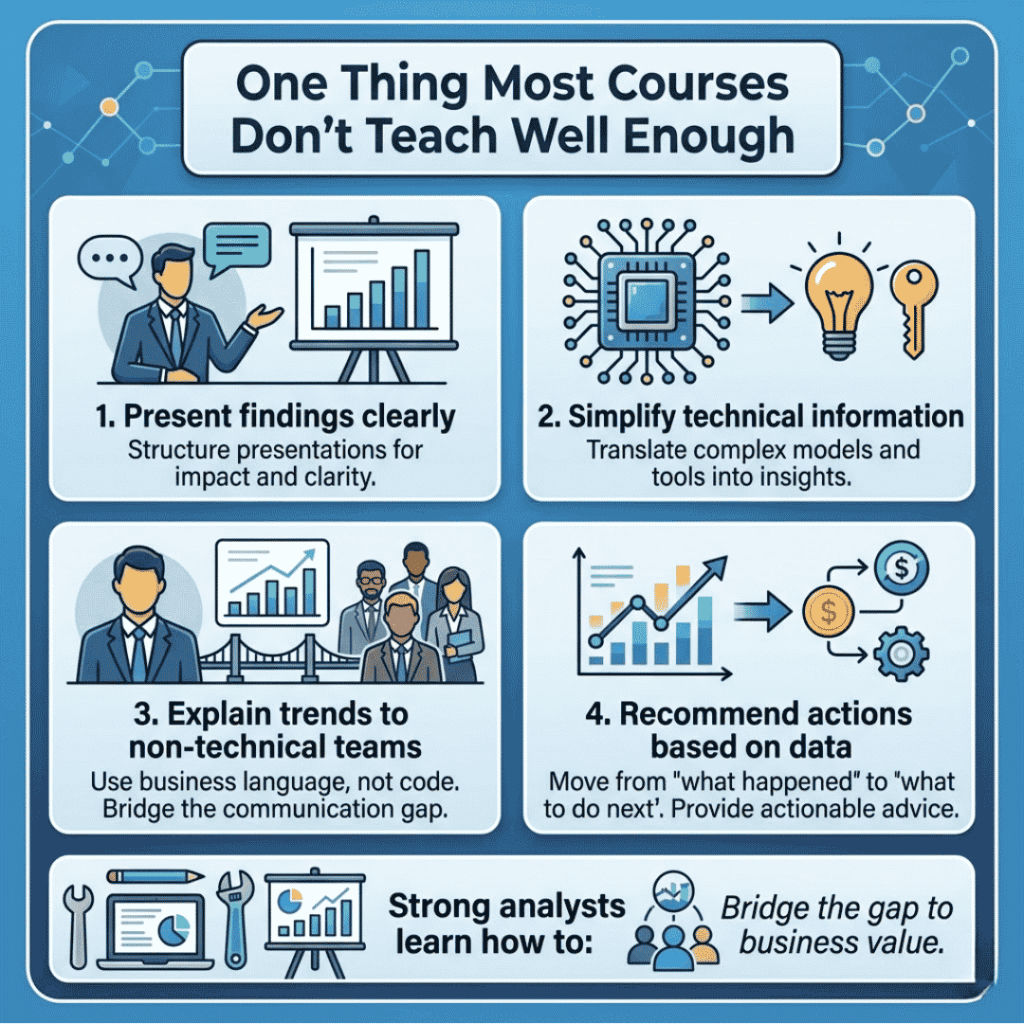
Communication.
Seriously.
A lot of learners think analytics is just numbers.
But imagine spending three days finding an important business insight… and then explaining it so poorly nobody understands the point.
That happens.
Strong analysts learn how to:
- Present findings clearly
- Simplify technical information
- Explain trends to non-technical teams.
- Recommend actions based on data.
Data Analyst Course Online that include presentation-style projects usually prepare students much better for real work environments.
A Realistic Example of What Analysts Actually Do
Let’s say an online retailer notices that mobile app purchases have suddenly dropped.
An analyst might:
- Pull transaction data using SQL.
- Compare user activity before and after an app update.
- Identify where users are abandoning purchases.
- Build a dashboard showing conversion changes.
- Present recommendations to the product team
That’s the kind of workflow companies care about.
Not memorizing textbook definitions.
A good Data Analyst Course Online should expose students to these kinds of practical scenarios instead of only teaching isolated technical concepts.
Common Mistakes Beginners Make
Watching Too Much, Building Too Little
This is probably the biggest one.
People spend weeks consuming tutorials but never create projects.
Then interviews happen and there’s nothing concrete to discuss.
Projects matter because they prove you can apply skills.
Even small projects help.
A sales dashboard. A customer churn report. A KPI tracker.
Those things become portfolio material.
Trying To Learn Everything at Once
New learners sometimes jump between the following:
- Python today
- Machine learning tomorrow
- Cloud analytics next week
- Then back to Excel
It becomes chaotic fast.
Structured learning paths usually work better because they build skills in a logical order.
That’s one reason many career-switchers prefer guided programs like this instead of trying to self-manage everything from scratch.
Ignoring Interview Preparation
A lot of technically capable learners still struggle in interviews.
Not because they lack knowledge.
Because they haven’t practiced explaining their thinking.
Mock interviews, resume reviews, and real scenario discussions can make a huge difference.
And honestly, confidence grows when you’ve already worked through realistic business problems during training.
Career Opportunities After Completing a Data Analyst Certification Online
There’s a pretty wide range of career paths now.
Some common roles include:
- Data Analyst
- Reporting Analyst
- Business Intelligence Analyst
- Operations Analyst
- Product Analyst
- Junior Data Engineer
Salaries vary depending on experience and location, obviously, but entry-level analysts in the U.S. are still seeing strong demand in 2026.
Candidates with SQL, Power BI, and project experience usually stand out faster during hiring.
And companies increasingly value practical portfolios over purely academic qualifications.
That trend has become really noticeable recently.
Why Structured Training Often Helps Faster
Could you teach yourself everything for free online?
Technically, yes.
But most people struggle with:
- Lack of direction
- No accountability
- Outdated tutorials
- No feedback
- No interview preparation
- No real project review
Structured Data Analyst Course Online solve a lot of those problems.
Programs like are designed more around job readiness than passive learning, which is important when the goal is actually getting hired.
Especially for career changers.
How To Know If a Data Analyst Course Online Is Worth It
Before enrolling anywhere, check whether the Data Analyst Course Online includes:
- Live sessions
- Hands-on projects
- SQL training
- Dashboard tools like Power BI
- Resume assistance
- Interview preparation
- Real business case studies
- Mentorship or instructor access
If the Data Analyst Course Online only offers recorded videos and quizzes, that’s probably not enough anymore.
The market is more competitive now than it was a few years ago.
FAQs
Is a Data Analyst Course Online enough to get hired?
It can be, especially when paired with strong projects and interview preparation. Employers mainly want proof that you can apply the skills.
Can beginners learn Data Analyst Course Online?
Yes. Many successful analysts started with zero technical background before moving into structured online training.
Which tool should I learn first?
Most beginners start with Excel and SQL, then move into Power BI or Tableau.
Do companies accept online certifications?
Yes. Skills, projects, and practical experience matter far more than whether the training was online.
How long does it take to become job-ready?
For many learners, around 4–8 months of consistent learning and project work is enough to start applying.
Related Topics You Can Also Explore
If you’re building a long-term analytics career, these topics are worth reading next:
- How To Build a Data Analyst Portfolio That Recruiters Notice
- Top SQL Interview Questions for Beginners
- Power BI vs Tableau for Entry-Level Analysts
- How AI Is Changing Data Analytics Jobs in 2026
These subjects naturally connect together and help build stronger topical authority if you’re creating an analytics learning roadmap.
Final Thoughts
A Data Analyst Course Online can absolutely prepare you for real jobs, but only when it focuses on practical experience instead of just theory.
The people who succeed usually do three things well:
- Learn consistently
- Build