Business analysts’ roles are rapidly changing as companies begin to employ more AI tools to automate their day-to-day work. Business analysts will be gathering requirements and writing documents in 2026 but they will also be using the technology to understand data, optimise processes and enable smarter business decisions. Staying up-to-date with the latest AI and Automation Trends for Business Analysts will help professionals understand how the role is evolving and which skills are becoming more valuable.
Many business analysts are exploring AI tools to improve productivity, like assistance in requirement analysis, drafting of documents, extracting insights from data and reducing repetitive work. Training programs such as H2K Infosys’ Business Analyst Training provide learners with exposure to practical BA concepts, as well as the latest tools and techniques that are used in real project settings. These changes are a sign of how AI and Automation Trends for Business Analysts are being integrated into the daily business operations.
Automation is also enabling business analysts to spend more time solving business problems rather than on manual activities that occupy most of their time. Knowing about things like process automation, data analysis, and AI-based solutions will allow BAs to better communicate with both business and technical teams. As technology continues to advance, professionals who adopt these AI and Automation Trends for Business Analysts will be more equipped to seize future opportunities in the industry.
The Business Analyst Role Looks Very Different in 2026
A few years ago, many BAs spent huge chunks of their day writing requirement documents, updating spreadsheets, sitting through stakeholder meetings, and manually creating reports.
Those responsibilities still exist, obviously. But AI and Automation Trends for Business Analysts now handle a surprising amount of repetitive work.
For example, many organizations use AI assistants inside platforms like Jira, Microsoft Teams, Slack, or ServiceNow to summarize meetings automatically, pull action items, identify workflow bottlenecks, and even draft requirement documentation.
That doesn’t mean analysts became unnecessary.
It means the job evolved.
Companies now need professionals who can verify AI-generated insights, question assumptions, understand business context, and communicate recommendations clearly to leadership teams.
That “human interpretation” layer became incredibly valuable.
I spoke with one senior BA recently who works in healthcare operations, and she said something that stuck with me:
“AI gives us faster answers, but Business Analysts still decide whether those answers actually make sense.”
That’s probably the simplest way to explain where the industry is heading.
The Biggest AI and Automation Trends for Business Analysts in 2026
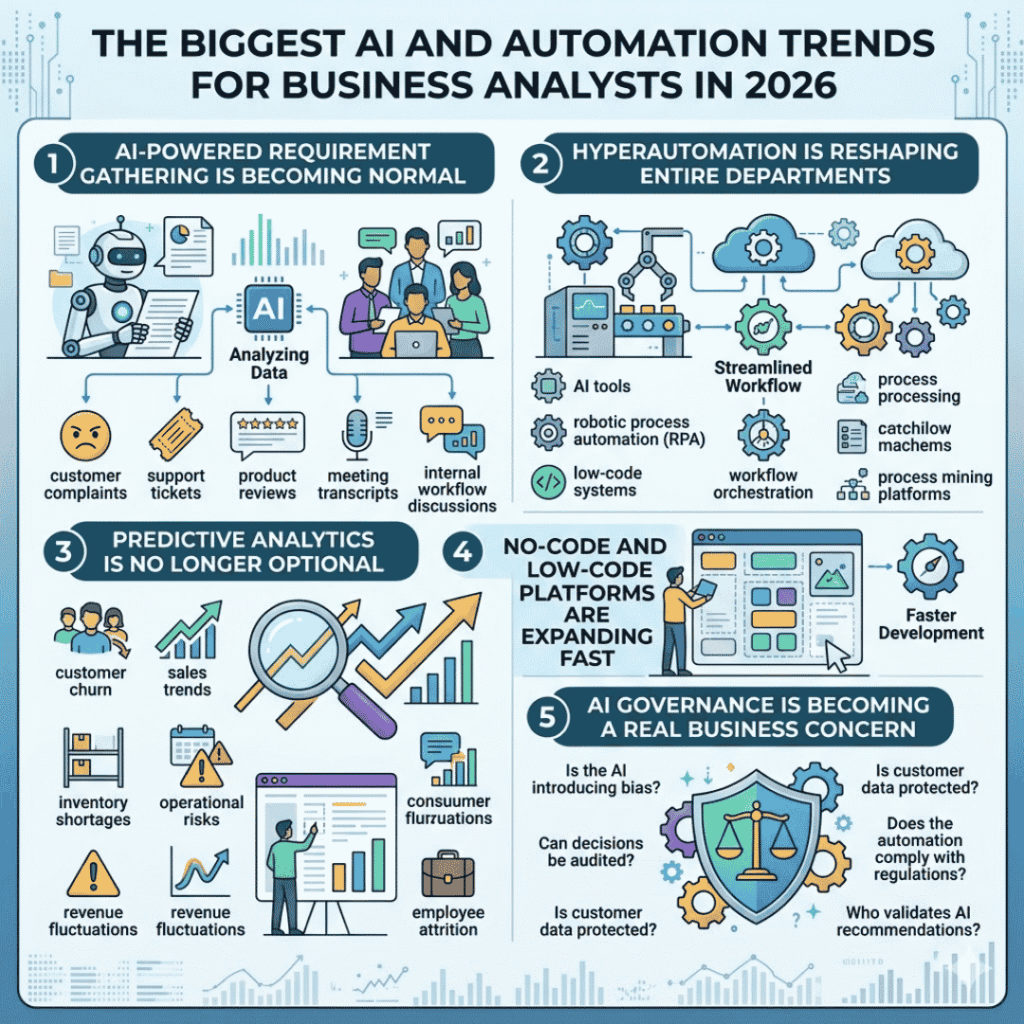
The Biggest AI and Automation Trends for Business Analysts in 2026 are reshaping how professionals gather requirements, analyze data, and improve business processes. From generative AI to workflow automation, these technologies are helping business analysts work faster and make more informed decisions. Understanding the latest AI and Automation Trends for Business Analysts can help you stay relevant, build in-demand skills, and prepare for the future of business analysis.
1. AI-Powered Requirement Gathering Is Becoming Normal
This trend is moving quickly- AI and Automation Trends for Business Analysts
Instead of manually documenting every stakeholder discussion, many teams now use AI-driven collaboration tools that capture conversations and generate draft requirements automatically.
A retail company, for instance, might use AI to analyze:
- customer complaints
- support tickets
- product reviews
- meeting transcripts
- internal workflow discussions
…and then convert all of that into structured requirement suggestions.
A few years ago, that would’ve sounded futuristic.
Now it’s becoming routine.
But here’s the thing people outside the industry sometimes miss: AI-generated requirements still need serious human review.
AI can miss business risks, misunderstand exceptions, or oversimplify workflows. Experienced analysts are still responsible for validating logic, clarifying edge cases, and aligning everything with business goals.
That’s why employers increasingly prefer candidates who have completed practical business analyst certification course programs instead of purely theoretical training.
Hands-on project exposure matters a lot now.
2. Hyperautomation Is Reshaping Entire Departments
“Automation” used to mean automating one repetitive task.
Now companies are automating entire chains of operations.
That’s where hyperautomation comes in.
Businesses are combining AI and Automation Trends for Business Analysts:
- AI tools
- robotic process automation (RPA)
- low-code systems
- workflow orchestration
- process mining platforms
…into connected ecosystems that run with very little manual intervention.
One logistics company recently shared how they reduced shipment delays using AI-driven forecasting tied directly into automated warehouse workflows. The system identifies demand spikes, predicts supply gaps, and automatically triggers operational responses.
Business Analysts sit right in the middle of projects like that.
They translate operational needs into technical requirements while helping teams understand where automation actually creates value.
That’s one reason modern business analyst classes now include exposure to tools like:
- Power BI
- Tableau
- UiPath
- ServiceNow
- Jira
- SQL platforms
The expectation today is that analysts understand both business operations and automation ecosystems.
3. Predictive Analytics Is No Longer Optional
AI and Automation Trends for Business Analysts- This one changed hiring expectations dramatically.
Companies don’t just want reports explaining what already happened anymore.
They want forecasts.
Business Analysts are increasingly expected to help teams predict:
- customer churn
- sales trends
- inventory shortages
- operational risks
- revenue fluctuations
- employee attrition
What’s interesting is that predictive analytics used to feel reserved for massive enterprises with huge budgets.
That’s not true anymore.
AI-powered analytics platforms became cheaper, faster, and easier to implement over the past couple of years. Mid-sized businesses now use forecasting tools regularly.
A hiring manager from a fintech company recently described it this way:
“Reporting skills get interviews. Predictive thinking gets hired.”
Honestly, that sums up the market pretty well right now.
4. No-Code and Low-Code Platforms Are Expanding Fast
This trend caught many traditional analysts off guard.
AI and Automation Trends for Business Analysts no longer have to rely entirely on development teams to prototype workflows or test business ideas.
Low-code platforms allow analysts to create automation flows, dashboards, approval systems, and lightweight applications with minimal coding.
Tools like Microsoft Power Apps, Zapier, and Airtable are becoming common in business operations.
I’ve seen teams build internal workflow systems in days that previously would’ve taken months.
That speed matters.
Especially for companies trying to adapt quickly in competitive markets.
And from a career perspective, analysts who understand low-code environments are becoming significantly more valuable.
5. AI Governance Is Becoming a Real Business Concern
This is one of the newer areas gaining attention in 2026 AI and Automation Trends for Business Analysts.
As companies integrate AI into hiring systems, customer support, banking operations, healthcare workflows, and financial forecasting, concerns around ethics and compliance are growing fast.
Businesses are asking questions like:
- Is the AI introducing bias?
- Can decisions be audited?
- Is customer data protected?
- Does the automation comply with regulations?
- Who validates AI recommendations?
Business Analysts are increasingly involved in documenting governance frameworks and identifying operational risks tied to AI systems.
A few years ago, this barely appeared in BA training conversations.
Now it’s becoming a specialized career advantage.
Why Employers Want AI-Aware Business Analysts
There’s AI and Automation Trends for Business Analysts a practical reason demand is rising.
Most organizations are overwhelmed with data.
They have dashboards everywhere. Automation tools everywhere. AI-generated reports everywhere.
But many companies still struggle to connect all of that information to actual business decisions.
That’s where skilled analysts step in.
Businesses need professionals who can:
- interpret data properly
- communicate insights clearly
- collaborate with technical teams
- understand operations
- improve workflows
- Identify automation opportunities
- support strategic planning
And honestly, recruiters can usually tell pretty quickly whether someone has real project exposure or only theoretical knowledge.
That’s why practical learning programs are becoming more important than generic certification prep alone.
Platforms like H2K Infosys have gained attention because their training focuses heavily on live instruction, project-based learning, interview preparation, Agile workflows, and real-world business analysis scenarios.
That practical element matters a lot in the current hiring market.
A Real-World Example of AI Changing BA Workflows
Let’s take e-commerce as an example.
Before AI integration was the norm:
- Sales data are reviewed by analysts manually.
- Teams created reports within spreadsheets.
- Customer complaints were manually categorised.
- Forecasts for inventories were heavily based on static models.
Now the workflow looks very different.
AI systems can:
- predict product demand automatically
- analyze customer sentiment in real time
- Detect unusual buying behavior.
- generate inventory alerts, instantly
- trigger automated supplier workflows
The business analyst’s role shifts from “collecting information” to helping leadership teams make better decisions faster.
That’s a huge transformation compared to how the role looked even five years ago.
Skills Business Analysts Should Focus on in 2026
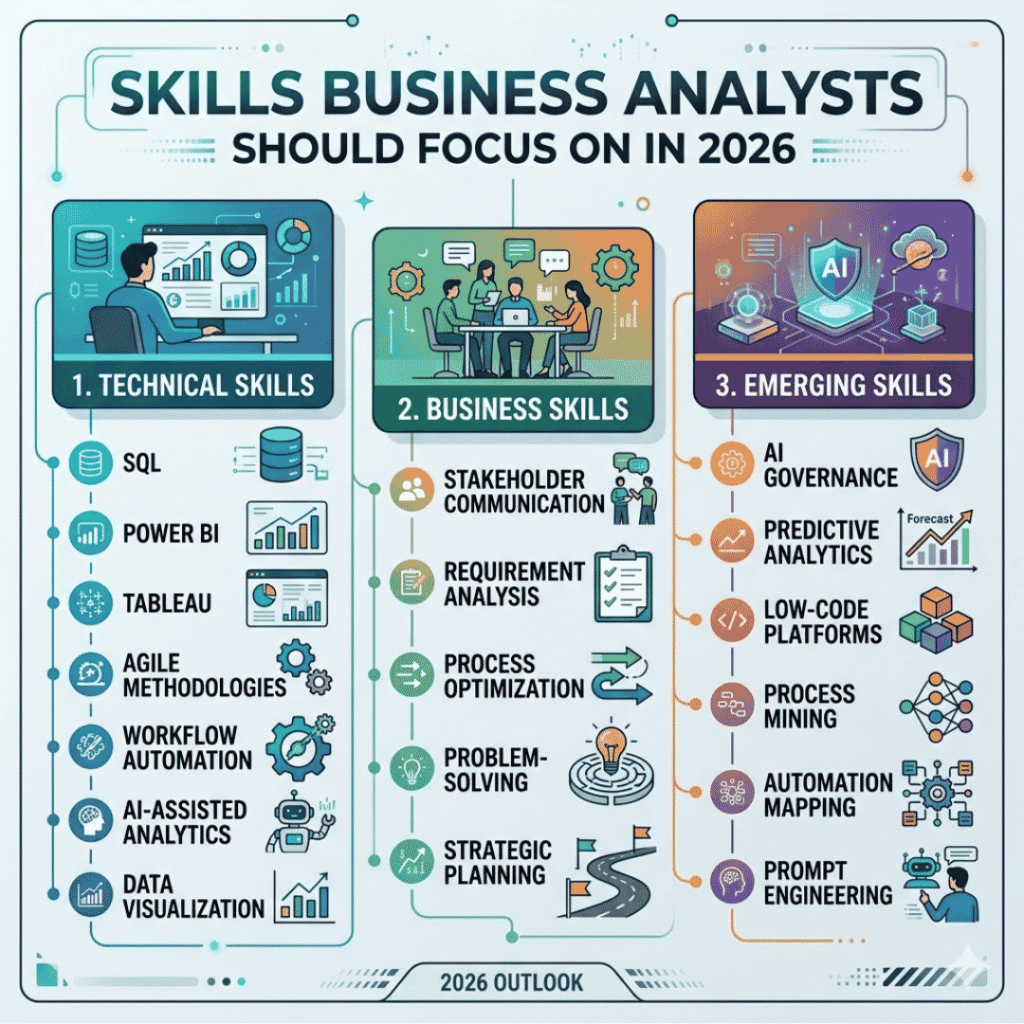
The strongest AI and Automation Trends for Business Analysts today usually combine technical skills with communication and strategic thinking.
Technical Skills
- SQL
- Power BI
- Tableau
- Agile methodologies
- workflow automation
- AI-assisted analytics
- data visualization
Business Skills
- stakeholder communication
- requirement analysis
- process optimization
- problem-solving
- strategic planning
Emerging Skills
- AI governance
- predictive analytics
- low-code platforms
- process mining
- automation mapping
- prompt engineering
This is exactly why so many professionals are searching for a structured business analyst course online that combines technical training with realistic business case studies.
Companies want analysts who can contribute immediately.
Are Online Business Analyst Courses Worth It in 2026?
For most working professionals, yes.
The flexibility alone makes online learning attractive, especially for people transitioning from QA, support, operations, finance, or non-technical backgrounds.
But not every course delivers the same value.
The stronger programs usually include:
- live projects
- mentorship
- mock interviews
- Agile simulations
- automation case studies
- resume guidance
- placement assistance
That’s one reason many learners prefer career-focused platforms instead of generic prerecorded tutorials.
The business analyst course online offered through H2K Infosys Business Analyst Training is often discussed among career switchers because it combines live training with practical project experience and job-oriented preparation.
And honestly, that hands-on approach aligns much better with what employers expect in 2026.
Final Thoughts
The role of the business analyst is changing rapidly, but it is by no means going away.
Explore the latest AI and automation trends for business analysts in 2026, including AI tools, emerging skills, and how technology is transforming the analyst’s craft, not killing it.
You still need people who understand business problems, who can talk to stakeholders, who can evaluate risk, who can interpret the insights generated by AI and Automation Trends for Business Analysts, and who can guide strategic decisions.
In many ways, the role became more powerful.
Those who become experts in automation, analytics, AI-assisted workflows, and business strategy will likely have a big leg up in the next few years. AI and Automation Trends for Business Analysts
And with businesses still investing heavily in digital transformation, demand for trained analysts isn’t going to slow down anytime soon.
If you are thinking of moving into this field, then attending practical business analyst classes, enrolling in a quality online business analyst course, or completing a hands-on business analyst certification course can open many doors to career opportunities in 2026 and beyond.
FAQs: AI and Automation Trends for Business Analysts
How is AI changing the role of business analysts in 2026?
AI is helping business analysts automate repetitive tasks, analyze large datasets, generate insights, improve requirement gathering, and make faster data-driven decisions.
What are the top AI trends for business analysts in 2026?
The top AI trends include generative AI for documentation, AI-powered data analytics, automated requirements analysis, predictive analytics, process automation, and AI-assisted decision-making.
How can business analysts use generative AI in their daily work?
Business analysts can use generative AI to create user stories, summarize meetings, prepare business requirements documents, analyze data, generate reports, and improve communication with stakeholders
What skills do business analysts need to stay relevant with AI?
Business analysts should develop skills in data analytics, AI fundamentals, prompt engineering, automation tools, SQL, business intelligence, process improvement, and stakeholder management.
What is the future of business analysis with AI and automation?
The future of business analysis will involve more AI-assisted decision-making, intelligent automation, predictive insights, and analysts acting as strategic partners between business teams and technology teams.