As Artificial Intelligence becomes increasingly integrated into enterprise and corporate systems, many professionals are seek an Artificial Intelligence Certified Course that combines theoretical knowledge with practical implementation. Live instructor-led are often preferred by working professionals because they provide structured learning, expert guidance, real-time interaction, and hands-on experience with industry-standard tools. Institutions such as H2K Infosys offer instructor-led training environments where learners can engage with experienced mentors, work on practical projects, and gain exposure to real-world AI workflows commonly used in enterprise settings.
Artificial Intelligence is becoming popular in enterprise systems, and many professionals are looking for an advantages of joining an AI course that provides them with academic knowledge and practical implementation. Hence, working professionals who are looking for accountability, expert supervision and hands-on experience with industry technologies generally prefer live instructor-led AI training programs.
What is AI Course with Live Instructor-led Training?
An advantages of joining an AI course with live instructor-led training is a formal educational program in which participants attend pre-determined classes taught by qualified instructors. Sessions are often conducted online and include lectures, demonstrations, practical laboratories, assignments and conversations.
Live training gives learners the chance to: unlike recorded courses
- Ask questions in sessions
- Get instant clarification
- Take part in guided workouts
- Real projects
- Collaborate with coworkers
- Receive feedback tailored just for you
Such programs often include:
- The Basics of Artificial Intelligence
- Machine Learning Deep Leearning
- Natural Language Processing (NLP)
- Generative AI
- Large Language Models (LLM)
- Deploying AI models
- MLOps practices
What is the difference between self-paced learning and live instructor-led AI training?
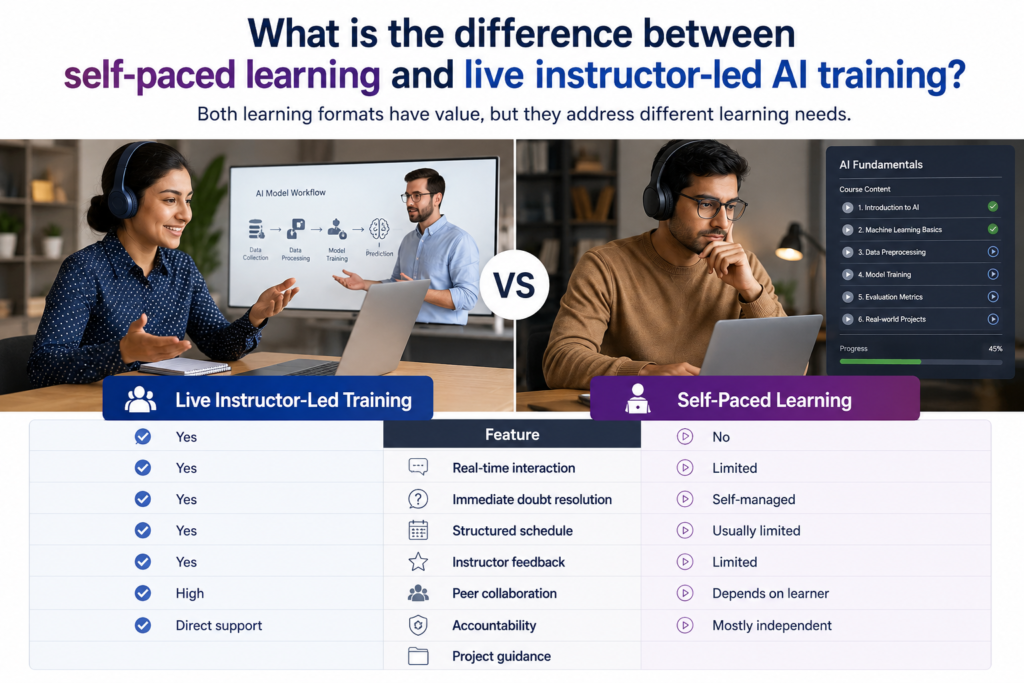
Both learning formats have value, but they address different learning needs.
| Feature | Live Instructor-Led Training | Self-Paced Learning |
|---|---|---|
| Real-time interaction | Yes | No |
| Immediate doubt resolution | Yes | Limited |
| Structured schedule | Yes | Self-managed |
| Instructor feedback | Yes | Usually limited |
| Peer collaboration | Yes | Limited |
| Accountability | High | Depends on learner |
| Project guidance | Direct support | Mostly independent |
Working professionals often find that live instruction helps them stay consistent and overcome learning obstacles more efficiently.
Why Should Working Professionals Enrol in an AI Course with Live Instructor-led Training?
A lot of people in the workforce are getting degrees while working full time. AI concepts can grow complicated when moving from theory to application.
Live instruction helps professionals:
Learning Discipline Construction
Classes are scheduled and provide an organised environment to learn. This might be helpful when you are juggling numerous duties.
Understand Complicated Ideas Faster
Topics such as:
- Neural nets
- Gradient descent algorithm
- Transformer architecture
- RL (Reinforcement Learning)
- Vector data bases
oftentimes demand thorough explanations and demonstrations.
An instructor may illustrate concepts through practical examples and give instant answers to enquiries.
Link Theory and Practical Business Applications
Professionals can understand how AI solutions are deployed in enterprise situations instead of merely studying algorithms.
What Are the Best Benefits of Taking an AI Course with Live Instructor-led Training?
1. Immediate Access to Industry Experts
One of the main advantages is getting direct access to qualified instructors.
Learners can pose questions like:
- Why is the accuracy of the model going down?
- What to do about missing data?
- What machine learning algorithm is suitable for a particular use case?
- How to install AI models securely?
Such chats can often give practical insights that you can’t get from recorded content.
2. Immediate Doubt Resolution
AI learning includes arithmetic, programming, statistics and system design.
Common learner challenges include:
- Data pre-processing mistakes
- Confusion around feature engineering
- Issues tweaking the model
- Python exercises
- Deployment difficulties
This decreases learning lag and avoids misconceptions from becoming persistent.
By having live classes the instructors can discuss some of these problems as they arise.
3. Practical Learning with Guided Labs
Enterprise AI implementation expertise are required.
An effective AI course generally consists of practical tasks involving:
| Area | Practical Activities |
| Data Analysis | Cleaning and transforming datasets |
| Machine Learning | Building predictive models |
| Deep Learning | Training neural networks |
| NLP | Text classification and sentiment analysis |
| Generative AI | Prompt engineering and LLM applications |
| Deployment | Model serving and monitoring |
Guided laboratories assist students to grasp how theoretical topics are applied in practice.
4. Industry Standard AI Tools Exposure
The AI development of today relies on a large ecosystem of technologies.
Common AI Tools Covered
| Category | Tools |
| Programming | Python |
| Data Analysis | Pandas, NumPy |
| Visualization | Matplotlib, Seaborn |
| Machine Learning | Scikit-learn |
| Deep Learning | TensorFlow, PyTorch |
| NLP | Hugging Face Transformers |
| MLOps | MLflow, Kubeflow |
| Cloud AI | AWS, Azure AI, Google Cloud AI |
| Generative AI | OpenAI APIs, LangChain, Vector Databases |
Live teachers often show how these technologies work together in production-style workflows.
5. Improved Understanding of Real-World AI Project Workflows
Many learners grasp algorithms but find it difficult to understand enterprise implementation.
An instructor live can take you through the whole AI lifecycle.
Typical Enterprise AI Workflow
- Business problem identification
- Data collection
- Data cleaning
- Feature engineering
- Model selection
- Model training
- Model evaluation
- Deployment
- Monitoring
- Continuous improvement
Understanding this workflow is essential for professional AI roles.
6. Hands-On Project Experience
Good AI education involves project-based learning.
Example Enterprise AI Projects
Customer Churn Prediction
Objectives:
- Analyze customer behavior
- Identify churn indicators
- Build predictive models
Fraud Detection
Objectives:
- Detect suspicious transactions
- Reduce financial risks
- Improve security controls
Intelligent Document Processing
Objectives:
- Extract information from documents
- Automate business workflows
- Improve operational efficiency
Generative AI Chatbots
Objectives:
- Create conversational systems
- Integrate Large Language Models
- Support customer service operations
Live mentorship during projects helps learners understand project architecture, implementation challenges, and best practices.
7. Personalised Feedback and Performance Appraisal
AI learning is very useful.
Learners gain from instructor input in:
- The quality of the code
- Modelling design
- Methods of data handling
- Project architecture Deployment tactics
This feedback typically speeds up skill improvement.
8. Better Problem Solving Skills
Enterprise AI projects rarely look like textbook examples.
Teams often face:
- Low data quality
- Model drift
- Bias Problems
- Infrastructure constraints
- Security needs
Live discussions expose learners to real-world challenges.
It encourages critical thinking and troubleshooting skills.
How Does AI Work in Real-World IT Projects?
Artificial intelligence systems discover patterns from past data and utilise those patterns to produce predictions, classifications, recommendations or automated judgements.
Real-World Example: Automate Customer Support
Step 1: Data Collection
Sources may include:
- Support tickets
- Emails
- Chat transcripts
Step 2: Data Preparation
Tasks include:
- Cleaning text
- Removing duplicates
- Standardizing formats
Step 3: Model Training
Machine learning or NLP models are trained using historical interactions.
Step 4: Deployment
Models are integrated into:
- Web applications
- Customer portals
- Chat systems
Step 5: Monitoring
Teams continuously evaluate:
- Accuracy
- Response quality
- User satisfaction
Live instructor-led training often demonstrates these workflows through practical exercises.
What Skills Are Required to Learn an Artificial Intelligence Certified Course?
Advanced experience is not needed for most beginner-friendly programs.
However learners benefit from basic understanding of the following.
| Skill Area | Importance |
| Basic Programming | High |
| Python Fundamentals | High |
| Statistics | Moderate |
| Mathematics | Moderate |
| Problem Solving | High |
| Data Analysis | High |
| Logical Thinking | High |
Professionals from diverse backgrounds often enter AI training programs, including:
- Software developers
- QA engineers
- Business analysts
- Data analysts
- Cloud engineers
- System administrators
How is AI Being Used in Enterprise Environments?
Organisations employ AI to increase productivity, automate processes, and boost decision-making.
Common Enterprise Applications
Predictive Analytics
Used for:
- Demand forecasting
- Sales prediction
- Capacity planning
Intelligent Automation
Used for:
- Process automation
- Workflow optimization
- Task scheduling
Cybersecurity
Used for:
- Threat detection
- Anomaly identification
- Risk assessment
Customer Experience
Used for:
- Recommendation engines
- Personalized experiences
- Virtual assistants
Healthcare
Used for:
- Medical image analysis
- Clinical decision support
- Predictive diagnostics
Enterprise adoption typically requires strong governance, security controls, scalability planning, and model monitoring.
What Job Roles Use AI Daily?
AI skills are increasingly integrated into many technical and business roles.
Role-to-Skill Mapping
| Job Role | AI Skills Commonly Used |
| AI Engineer | Model development, deployment |
| Machine Learning Engineer | Training and optimization |
| Data Scientist | Predictive analytics |
| Data Analyst | Data exploration and reporting |
| NLP Engineer | Language model development |
| MLOps Engineer | Model deployment and monitoring |
| Business Intelligence Analyst | AI-driven insights |
| Cloud AI Engineer | AI infrastructure management |
These professionals often work with AI platforms, cloud services, and enterprise data systems.
What Are The Job Opportunities After Doing An AI Course?
Previous experience and specialisation determine career chances.
Entry-Level Opportunities
- Junior AI Engineer
- Data Analyst
- Machine Learning Associate
- AI Support Specialist
Mid-Level Opportunities
- Machine Learning Engineer
- Data Scientist
- NLP Engineer
- AI Consultant
Advanced Opportunities
- AI Architect
- MLOps Architect
- AI Product Manager
- Director of AI Solutions
Many employers evaluate candidates based on practical skills, project experience, and demonstrated problem-solving capabilities.
What Challenges Do Professionals Face When Learning AI Independently?
Self-study can be effective, but several common obstacles exist.
Lack of Guidance
Learners may struggle to determine:
- Which topics to prioritize
- Which tools are industry relevant
- How concepts connect
Information Overload
Thousands of tutorials, frameworks, and resources are available.
Choosing an effective learning path can be difficult.
Limited Feedback
Without expert review, mistakes may go unnoticed.
Project Complexity
Real-world AI projects involve:
- Multiple technologies
- Deployment pipelines
- Data engineering
- Infrastructure considerations
Live instructors can help learners navigate these complexities.
Frequently Asked Questions (FAQ)
Are live instructor-led AI training superior than recorded courses?
Both have their merits. Live training provides the opportunity for real-time contact and feedback, mentorship, and structured learning, all of which many professionals find advantageous for complicated topics.
Do I need to know coding to join AI training programs?
It’s good to have a basic knowledge of programming, especially Python. Many starter programs begin with basic ideas.
What tools are taught in AI classes?
Typical tools include Python, Scikit-learn, TensorFlow, PyTorch, Pandas, NumPy, MLflow, LangChain, and cloud AI platforms.
Are live AI classes available for working professionals?
Yes Many instructor-led programs are tailored for professionals who are juggling their work and learning commitments.
What is an AI Certified Course?
An artificial intelligence certified course is a systematic training program that teaches AI ideas, tools, and real-world applications, and provides certification upon successful completion.
Are projects important in AI learning?
Yes. Projects allow learners to apply concepts, develop portfolios, understand procedures and gain practical experience through real world settings.
How long does AI learn?
The time frame depends on your previous experience, how quickly you learn and what you want to specialise in. Foundational skills can take a few months, while advanced expertise takes practice and project effort.
Conclusion
Live instructor-led Artificial intelligence Certified Course is a combination of structured learning, hands-on application, mentorship and exposure to real-world projects. This kind of learning helps many professionals link theory and application in the workplace.
Key Takeaways
- With live AI training you get direct access to the experts and their expert help.
- Real-time doubt resolution boosts learning efficiency.
- Hands-on projects that help trainees grasp enterprise AI workflows.
- Industry standard tools and platforms are often discussed.
- Personalised feedback aids practical skill development.
- AI talents can be used to many technical and business professions.
- Project based learning is necessary to apply AI concepts in real situations.
H2K Infosys AI courses offer hands-on exposure with industry-relevant tools, procedures and projects.
Join H2K Infosys advantages of joining an AI course to get hands-on AI skills that boost your professional development and long-term career advancement.