Yes. Most Flexible Online AI Courses now offer flexible learning schedules and employment services, including resume checks, interview preparation, project mentorship, and placement aid. These programs are designed for working professionals who need to juggle their education with their current job duties while building hands-on skills in artificial intelligence, machine learning, data analysis, and AI-powered business applications.
The Best Artificial Intelligence courses for Beginners tend to incorporate core theories, hands-on projects, industry tools and career help features. Some providers also give coaching, mock interviews, and opportunities to network with employers to assist learners get a foot in the door for AI-related roles.
What Is an Artificial Intelligence Course?
An AI Courses offers the principles, tools and strategies for building systems that can do things that ordinarily need human intelligence.
These tasks may include:
- Pattern spotting
- Analytics Predictive
- Natural language processing
- vision computer
- Recommender Systems
- Conversational AI
- Process automation
Contemporary Flexible Online AI Courses incorporate theoretical foundations as well as practical implementation with industry standard technologies.
Core Topics Typically Covered
| Topic | Purpose |
|---|---|
| Python Programming | Primary language for AI development |
| Machine Learning | Building predictive models |
| Deep Learning | Neural network architectures |
| Data Science Fundamentals | Data preparation and analysis |
| Natural Language Processing | Understanding human language |
| Computer Vision | Image and video analysis |
| Generative AI | AI content generation and automation |
| MLOps | Model deployment and monitoring |
Why are Flexible AI Courses Important for Working Professionals?
Many who are involved in AI Courses education are already working in IT, software development, business analysis, testing, cloud or data related positions.
Benefits of flexible online learning include:
- Self-paced study options
- Weekend and evening classes
- Recorded sessions
- Remote access to labs
- Mentorship support
- Project-based learning
This flexibility means that professionals can upskill without leaving full-time jobs.
Common Learner Profiles
- Software Developers
- QA Engineers
- Data Analysts
- Business Analysts
- Cloud Engineers
- DevOps Professionals
- Recent Graduates
- Career Changers
AI literacy is important across technical and business functions, as organisations increasingly require professionals to know AI-powered workflows.
How Does Artificial Intelligence Work in Real-World IT Projects?
Artificial intelligence systems discover patterns from historical data and utilise these patterns to produce predictions, classifications, or recommendations.
A typical enterprise AI pipeline includes:
- Data Gathering
- Data Processing
- Feature engineering
- Model training Model evaluation Deployment
- Tracking and Optimisation
- Automating Customer Support
A corporation can get thousands of support tickets a day.
A company may receive thousands of support tickets daily.
An AI solution could:
- Categorize tickets automatically
- Identify urgent requests
- Suggest responses
- Route issues to appropriate teams
Workflow
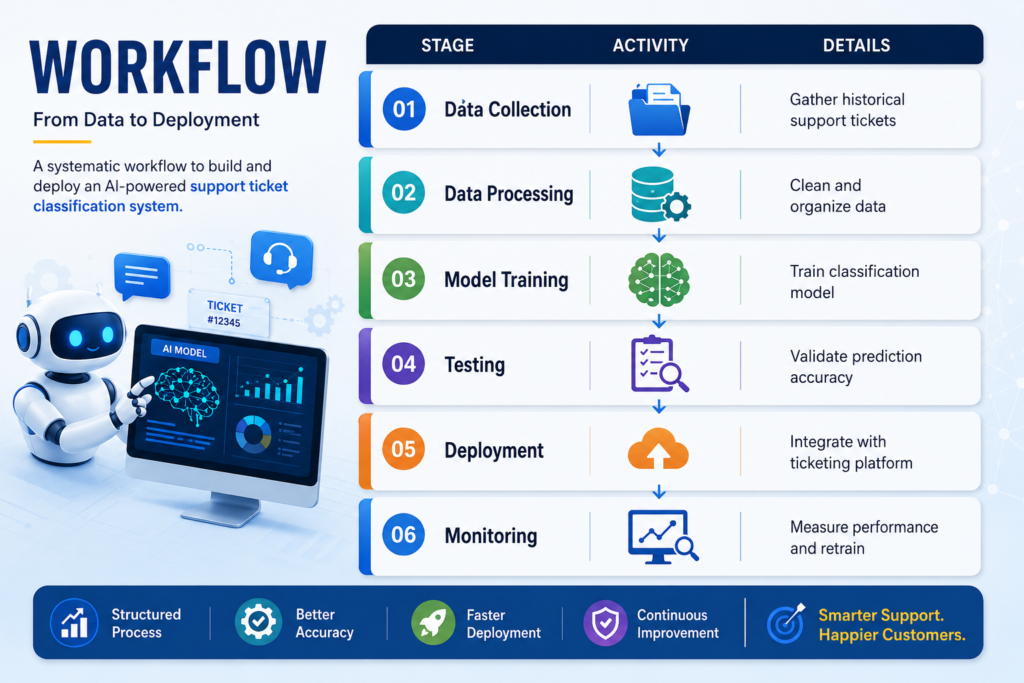
| Stage | Activity |
| Data Collection | Gather historical support tickets |
| Data Processing | Clean and organize data |
| Model Training | Train classification model |
| Testing | Validate prediction accuracy |
| Deployment | Integrate with ticketing platform |
| Monitoring | Measure performance and retrain |
This workflow demonstrates how AI projects move from experimentation to production environments.
What Skills Required To Learn Artificial Intelligence Course?
Advanced experience is not a prerequisite for signing up for most AI Courses at the beginning level.
But there are some core abilities that might help students go on more effectively.
Technical Skills
Programming Fundamentals
Python continues to be the most popular language for AI development.
Important concepts include:
- Variables
- Functions
- Loops
- Data structures
- Object-oriented programming
Mathematics Basics
Learners benefit from understanding:
- Linear algebra
- Statistics
- Probability
- Calculus fundamentals
Most beginner-focused programs teach applied mathematics rather than purely academic theory.
Data Analysis
Understanding data is essential because AI systems depend on high-quality datasets.
Common activities include:
- Data cleaning
- Visualization
- Feature selection
- Statistical analysis
What Should Beginners Look for in an Artificial Intelligence Course?
Choosing the right program involves more than reviewing a AI Courses syllabus.
Important Evaluation Criteria
Curriculum Depth
Look for coverage of:
- Machine learning
- Deep learning
- NLP
- Generative AI
- MLOps
Hands-On Projects
Practical experience is critical.
Examples include:
- Chatbot development
- Recommendation engines
- Fraud detection systems
- Image classification projects
Industry Tool Exposure
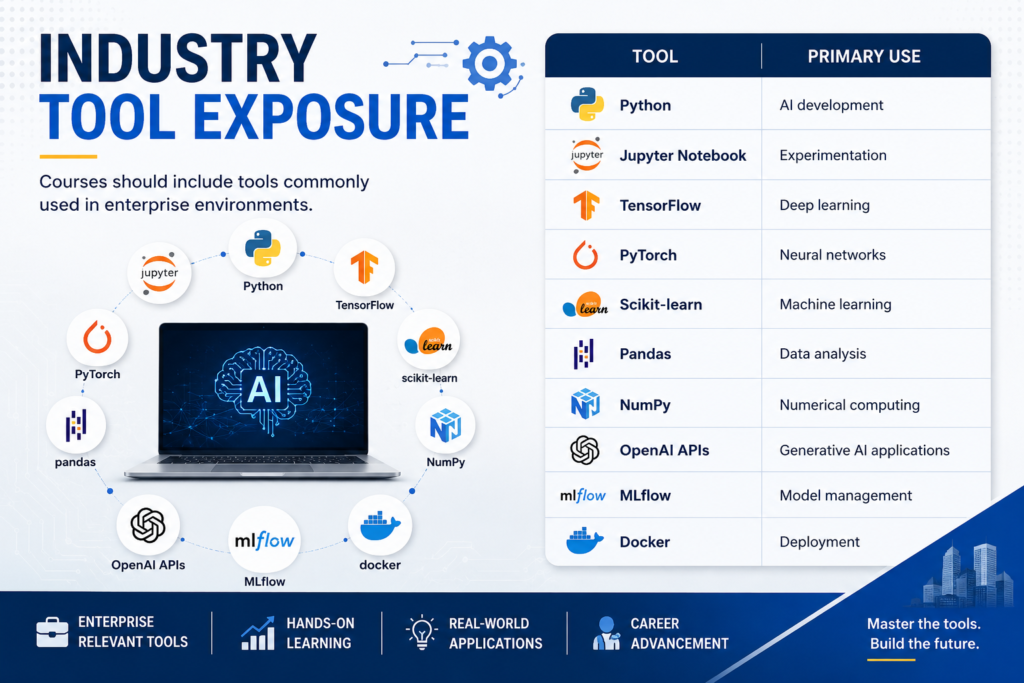
Courses should include tools commonly used in enterprise environments.
| Tool | Primary Use |
| Python | AI development |
| Jupyter Notebook | Experimentation |
| TensorFlow | Deep learning |
| PyTorch | Neural networks |
| Scikit-learn | Machine learning |
| Pandas | Data analysis |
| NumPy | Numerical computing |
| OpenAI APIs | Generative AI applications |
| MLflow | Model management |
| Docker | Deployment |
Placement Support Services
Useful services may include:
- Resume preparation
- LinkedIn profile reviews
- Interview coaching
- Technical assessments
- Job referrals
- Career mentoring
How Is Artificial Intelligence Used in Enterprise Environments?
AI has moved beyond research laboratories and is now integrated into many business operations.
Financial Services
Applications include:
- Fraud detection
- Credit risk analysis
- Customer segmentation
- Trading analytics
Healthcare
Common uses include:
- Medical imaging analysis
- Patient risk prediction
- Clinical decision support
Retail
AI supports:
- Demand forecasting
- Inventory optimization
- Personalized recommendations
Manufacturing
Organizations use AI for:
- Predictive maintenance
- Quality control
- Production optimization
Cybersecurity
AI systems help identify:
- Network anomalies
- Malware patterns
- Threat intelligence indicators
Enterprise implementations require careful consideration of:
- Data security
- Regulatory compliance
- Scalability
- Model governance
- Performance monitoring
What Does Placement Support Usually Include?
Placement support can vary significantly among training providers.
It is important to understand that Flexible Online AI Courses is not the same as guaranteed employment.
Common Career Services
Resume Development
Professionals learn how to present:
- AI projects
- Technical skills
- Certifications
- Business impact
Interview Preparation
Typical preparation includes:
- Technical questions
- Coding exercises
- Machine learning concepts
- Behavioral interviews
Portfolio Development
A strong AI portfolio may include:
- GitHub repositories
- Capstone projects
- End-to-end machine learning applications
- Documentation and reports
Career Mentoring
Mentors often provide guidance on:
- Role selection
- Skill gaps
- Industry expectations
- Learning roadmaps
What Job Roles Use Artificial Intelligence Daily?
AI skills are increasingly valuable across multiple job functions.
AI Engineer
Responsibilities:
- Build AI applications
- Deploy machine learning models
- Optimize performance
Machine Learning Engineer
Responsibilities:
- Design ML pipelines
- Train predictive models
- Manage model deployment
Data Scientist
Responsibilities:
- Analyze complex datasets
- Generate business insights
- Develop predictive solutions
Data Analyst
Responsibilities:
- Visualize trends
- Support decision-making
- Perform statistical analysis
NLP Engineer
Responsibilities:
- Build language models
- Develop chatbots
- Create text-processing systems
Computer Vision Engineer
Responsibilities:
- Image recognition
- Video analytics
- Object detection systems
How Do AI Professionals Apply Their Skills in Real Projects?
Practical implementation is a major focus of modern AI education.
Example Project: Predictive Customer Churn Analysis
Step 1: Data Collection
Gather customer records from CRM systems.
Step 2: Data Preparation
Clean missing values and standardize formats.
Step 3: Feature Engineering
Create useful indicators such as:
- Customer tenure
- Product usage frequency
- Support interactions
Step 4: Model Development
Train machine learning models using:
- Random Forest
- XGBoost
- Logistic Regression
Step 5: Evaluation
Measure:
- Precision
- Recall
- Accuracy
- F1 Score
Step 6: Deployment
Deploy the model through APIs or cloud platforms.
Step 7: Monitoring
Track model performance and retrain when necessary.
This mirrors the lifecycle commonly used in production environments.
What Learning Path Should Beginners Follow?
A structured progression helps learners avoid confusion and build skills systematically.
Recommended Learning Roadmap
| Phase | Focus Area |
| Phase 1 | Python Fundamentals |
| Phase 2 | Statistics and Probability |
| Phase 3 | Data Analysis |
| Phase 4 | Machine Learning |
| Phase 5 | Deep Learning |
| Phase 6 | NLP and Generative AI |
| Phase 7 | MLOps and Deployment |
| Phase 8 | Capstone Projects |
| Phase 9 | Interview Preparation |
Following this sequence helps learners understand how individual concepts connect within complete AI systems.
What Challenges Do Beginners Commonly Face?
Learning AI involves both technical and practical challenges.
Data Quality Issues
Real-world datasets often contain:
- Missing values
- Duplicate records
- Inconsistent formats
Model Overfitting
Models may perform well during training but poorly in production.
Best Practice
Use:
- Cross-validation
- Regularization
- Independent test datasets
Deployment Complexity
Building a model is only part of the process.
Organizations also need:
- APIs
- Monitoring tools
- Infrastructure management
- Security controls
Understanding these challenges prepares learners for enterprise projects.
What Careers Are Possible After Learning an Artificial Intelligence Course?
Career opportunities depend on prior experience, technical background, and project exposure.
Entry-Level Opportunities
- Junior Data Analyst
- Associate AI Engineer
- Machine Learning Intern
- Business Intelligence Analyst
Mid-Level Opportunities
- Data Scientist
- Machine Learning Engineer
- AI Developer
- NLP Specialist
Advanced Opportunities
- AI Architect
- Lead Data Scientist
- AI Product Manager
- MLOps Engineer
Role-to-Skill Mapping
| Role | Core Skills |
| Data Analyst | SQL, Python, Visualization |
| Data Scientist | Statistics, ML, Data Modeling |
| AI Engineer | Deep Learning, Deployment |
| MLOps Engineer | CI/CD, Cloud, Monitoring |
| NLP Engineer | Language Models, Text Analytics |
| AI Architect | Enterprise AI Strategy |
Frequently Asked Questions (FAQ)
Are AI courses suitable for beginners?
Yes. Many programs are designed as an Flexible Online AI Courses and start with programming, data analysis, and machine learning fundamentals before advancing to more complex topics.
How long does it take to learn AI?
The timeline varies depending on prior experience. Many learners spend between 6 and 12 months developing practical AI skills through structured coursework and projects.
Do AI courses require a programming background?
Not always. However, basic familiarity with programming concepts can accelerate learning. Most beginner-friendly courses teach Python fundamentals.
Is placement support the same as a job guarantee?
No. Placement support typically includes career services such as resume reviews, interview preparation, mentorship, and employer networking. It does not guarantee employment.
Which programming language is most commonly used in AI?
Python is the most widely used language because of its extensive ecosystem of AI and machine learning libraries.
What projects should beginners build?
Recommended projects include:
- Chatbots
- Recommendation systems
- Customer churn prediction
- Sentiment analysis
- Image classification
- Fraud detection
Are certifications important for AI careers?
Certifications can demonstrate structured learning, but employers often place significant value on practical projects, technical skills, and problem-solving abilities.
Can working professionals learn AI part-time?
Yes. Flexible Online AI Courses with recorded sessions, weekend classes, and self-paced learning options are specifically designed to support working professionals.
Conclusion
Flexible Online AI Courses that include placement support provide a structured pathway for professionals seeking to develop practical artificial intelligence skills while maintaining existing work commitments. The most effective programs combine foundational knowledge, hands-on projects, industry-standard tools, mentorship, and career preparation resources.
As AI adoption continues across industries, learners who understand machine learning, data analysis, deep learning, and deployment workflows can contribute to a wide range of enterprise initiatives.
Key Takeaways
- Flexible AI courses allow working professionals to learn without leaving their jobs.
- A strong artificial intelligence course for beginners should include both theory and practical projects.
- Placement support often includes resume reviews, interview preparation, and career mentoring.
- Enterprise AI projects require skills in data preparation, model development, deployment, and monitoring.
- Common AI career paths include Data Scientist, AI Engineer, Machine Learning Engineer, and MLOps Engineer.
- Hands-on experience with industry tools is critical for real-world success.
- Building a project portfolio significantly improves career readiness.
Explore H2K Infosys Artificial intelligence Engineer Course to gain hands-on experience with industry-relevant tools, projects, and learning workflows.
Enroll in H2K Infosys courses to strengthen your AI skills, build practical project experience, and support your long-term career growth