Introduction
If you’re just getting started with a Data Analytics Course, don’t worry too much about Python or fancy AI tools on day one. The first thing you really need to understand is how data is used to solve actual business problems. That sounds simple, but honestly, it changes the way you learn everything else.
A lot of beginners make the mistake of chasing tools first. They learn dashboards and memorize SQL syntax, maybe even try machine learning tutorials before they understand why companies analyze data in the first place. Then interviews happen, and someone asks, “How would you figure out why customer retention dropped last quarter?” Suddenly the technical stuff alone isn’t enough.
That’s why the order of learning matters more than people think.
Today, businesses are drowning in data. Retail companies track customer behavior almost in real time. Hospitals analyze patient outcomes more aggressively than they did even three years ago. Streaming platforms study viewing habits minute by minute. With AI becoming deeply integrated into analytics workflows in 2026, companies don’t just want employees who can create reports; they want people who can interpret patterns and explain what those patterns mean.
And that’s exactly where a good Data Analytics Course can make a huge difference.
Start With the Basics of Data Before Anything Else
This sounds obvious, but many people skip it.
Before touching Power BI, Tableau, or Python, learn:
- What data actually represents
- The difference between structured and unstructured data
- How businesses collect data
- Why data quality matters
- How decisions are made using analytics
Structured data is the easy stuff: rows, columns, databases, and spreadsheets.
Unstructured data is where things get messy. Think customer emails, support chats, social media comments, product reviews, and videos. Companies are investing heavily in analyzing this type of information now because AI tools have made it more accessible.
A small example.
An online shopping brand might notice sales declining for a product. The spreadsheet alone won’t explain why. But when analysts look through customer reviews and support tickets, they may discover shipping complaints or product quality issues.
That’s analytics too.
A strong Data Analytics Course teaches you how to think through situations like that instead of only focusing on software.
Learn Excel Earlier Than You Think You Need To
People love to call Excel outdated.
Then they get their first analyst job and realize half the reporting team still lives inside spreadsheets.
That’s just reality.
Even now, in 2026, Excel remains one of the most commonly used tools in business analytics because it’s fast, flexible, and easy for teams to share.
If you can clean messy data in Excel confidently, you’re already ahead of many beginners.
Important Excel Skills to Learn
- Pivot Tables
- XLOOKUP and VLOOKUP
- Conditional formatting
- Sorting and filtering
- Basic dashboards
- Charts and trend analysis
- Data cleaning techniques
I remember talking to a junior analyst last year who said the first time analytics finally “clicked” for her was during an Excel exercise. She cleaned a terrible sales spreadsheet and suddenly understood how raw business data actually looks in companies.
Not glamorous. Very useful.
SQL Is One of the Most Important Skills in Data Analytics
Once you understand spreadsheets, SQL should probably be your next major focus.
And honestly, SQL tends to intimidate people way more than it should.
At its core, SQL is simply a way to ask questions from a database.
Questions like:
- Which customers purchased more than twice last month?
- Which region had the highest cancellation rate?
- Which products are underperforming?
That’s everyday analytics work.
Beginner SQL Topics Worth Learning First
- SELECT statements
- WHERE conditions
- GROUP BY
- JOIN operations
- Aggregate functions
- Sorting and filtering
One thing employers consistently care about? SQL.
A surprising number of entry-level analyst interviews revolve around SQL basics because companies need people who can retrieve and organize data quickly.
And with businesses generating larger datasets than ever before, database skills continue to grow in importance.
Don’t Treat Data Visualization Like Decoration
This happens constantly.
Beginners build dashboards with twenty charts, glowing colors, complicated filters… and nobody understands the actual insight.
Good visualization is about clarity.
Not showing off.
Tools like:
- Power BI
- Tableau
- Google Looker Studio
are incredibly valuable because businesses rely on visual reporting every single day.
But simple dashboards usually perform better than overloaded ones.
Managers typically want answers to a few practical questions:
- What changed?
- Why did it happen?
- What should we do next?
That’s it.
A clean chart explaining customer churn often beats an advanced dashboard filled with unnecessary visuals.
Statistics Matters More Than Most Beginners Expect
The word “statistics” scares people before they even begin a data analytics course.
The good news? You don’t need advanced mathematics to start working in analytics.
What you do need is enough statistical understanding to avoid making bad conclusions.
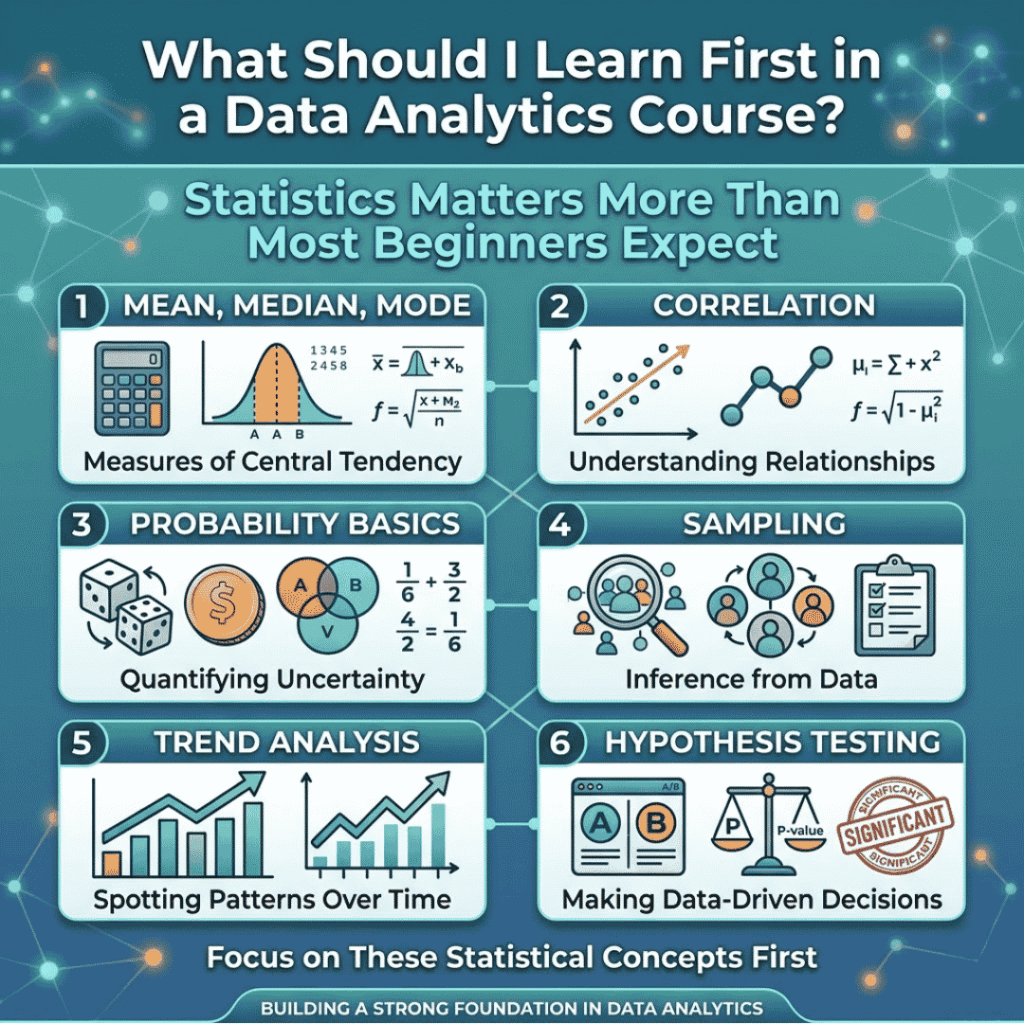
Focus on These Statistical Concepts First
- Mean, median, mode
- Correlation
- Probability basics
- Sampling
- Trend analysis
- Hypothesis testing
Here’s a real-world example.
Imagine a company launches a marketing campaign and sales jump 15%.
A beginner might immediately assume the campaign worked.
But experienced analysts ask more questions.
Was there a seasonal trend? Did competitors raise prices? Was there a holiday sale happening?
Statistics helps analysts avoid misleading interpretations.
That analytical mindset becomes extremely valuable over time.
Learn Python After You Understand the Workflow
Python is powerful. No question.
But a lot of learners rush into coding too early because social media makes it seem like the most important analytics skill.
But many entry level analyst jobs still stress in practice:
- Excel
- SQL
- Visualisation
- Business correspondence
Python becomes easier when you already know data workflows
Beginners’ Useful Python Skills
- numpy
- pandas
- Data cleaning
- Simple automation
- Data visualisation libraries
Companies now use Python extensively for automation and predictive analytics, especially in the finance, healthcare, cybersecurity, and SaaS industries.
AI-assisted analytics tools are also becoming common, but analysts still need to validate outputs and interpret results properly.
That human judgment piece hasn’t disappeared.
If anything, it matters more now.
Communication Skills Quietly Make a Huge Difference
This part surprises many students.
The best analyst in a company is not always the strongest coder.
Sometimes it’s the person who can explain complex findings in simple language.
A business executive usually doesn’t care how elegant your SQL query was.
They care about:
- What the data means
- What risks exist
- What action should be taken
I’ve personally seen analysts with average technical skills outperform stronger programmers simply because they communicated insights clearly during meetings.
That’s why strong Data Analytics Course include presentations, business case studies, and real-world projects instead of focusing only on technical exercises.
Common Mistakes Beginners Make
Trying To Learn Everything at Once
This happens constantly.
People try learning:
- Python
- SQL
- Tableau
- Machine learning
- Cloud platforms
- AI tools
all at the same time.
It usually creates confusion.
Learning gradually works better.
Watching Tutorials Without Practicing
Passive learning feels productive, but it doesn’t build confidence.
The real growth happens when you work on projects yourself.
Try analyzing:
- Netflix datasets
- Retail sales data
- Sports analytics
- Customer churn reports
- Financial trends
Real projects expose gaps in understanding quickly.
Ignoring Business Context
Analytics isn’t about charts alone.
Every report should answer a business question.
That mindset separates professional analysts from people who simply know software.
Why Structured Training Helps Many Beginners
Self-learning absolutely works for some people.
But many beginners eventually hit a wall because they don’t know what to learn next or how the skills connect together.
That’s where a structured Data analyst course online becomes useful.
A good program usually provides:
- Step-by-step learning paths
- Real industry projects
- Mentorship
- Resume guidance
- Interview preparation
- Exposure to business scenarios
Training providers like focus heavily on practical learning, which matters because employers increasingly expect candidates to demonstrate hands-on experience rather than only certifications.
And honestly, having guided projects helps reduce the overwhelm beginners often feel during the first few months.
Career Opportunities After Completing a Data Analytics Course
Data analytics course continue to grow across industries.
Healthcare organizations analyze patient trends. Banks monitor fraud patterns. Retailers study customer behavior. Logistics companies optimize delivery operations.
Pretty much every industry relies on data now.
Common Job Roles
- Data Analyst
- Reporting Analyst
- Business Analyst
- BI Analyst
- Product Analyst
- Junior Data Scientist
Companies are also increasingly hiring analysts who understand AI-supported reporting environments.
That doesn’t mean AI is replacing analysts.
Mostly, it’s changing the tools analysts use daily.
Skills Employers Commonly Look For
- SQL
- Excel
- Dashboarding tools
- Communication skills
- Problem-solving ability
- Data storytelling
If you’re serious about building a long-term analytics career, structured learning combined with consistent project work can really speed things up.
Practical Tips for Beginners Starting a Data Analytics Course Online
Build a Portfolio Early
Don’t wait until the course ends.
Even beginner projects matter.
Learn One Tool Deeply First
It’s better to know SQL well than to know five tools superficially.
Follow Industry Trends
Analytics changes fast.
Stay tuned for:
- Analytics with AI assistance
- Dashboards en vivo
- Predictive modelling
- Data management.
- Laws for data protection
Practice Explaining Results
Imagine you are presenting findings to a manager who is not technical.
That skill becomes incredibly valuable during interviews.
Related Articles You May Also Like
You can also dive into topics like to develop deeper expertise:
- How to become a Data Analyst without a technical background
- Should a Beginner Learn SQL or Python First for Data Analytics?
- “Best Projects to Do While Learning Data Analytics”
These topics fit together seamlessly to form a stronger data analytics learning path and help build a complete knowledge base
FAQs
What is the first thing beginners should learn in data analytics?
Start with data fundamentals and Excel basics before moving into SQL, visualization, or Python. Understanding how businesses use data is essential early on.
Is coding required for a Data Analytics Course?
Not initially. Many beginner-level analytics tasks start with Excel and SQL. Python usually comes later as your skills grow.
Which is better: SQL or Python for beginners?
SQL is generally easier and more immediately useful for entry-level analyst roles. Python becomes valuable once you start handling larger datasets and automation.
How long does it take to become job-ready in data analytics?
With consistent practice and structured training, many learners become job-ready within 4–8 months, depending on their background and learning pace.
Are Data Analytics Course worth it in 2026?
Yes especially programs that include projects, mentorship, and career support. Employers increasingly care about practical skills and portfolio work more than theory alone.
Final Thoughts
Starting a Data Analytics Course can feel overwhelming at first because there’s so much to learn. But the smartest approach is usually the simplest one: build strong foundations before chasing advanced tools.
Learn how data works. Practice with real business problems. Get comfortable with Excel and SQL. Then grow into visualization, Python, and advanced Data Analytics Course step by step.
That gradual progression works far better than trying to master everything in a weekend binge-watch session which, honestly, a lot of beginners attempt.
And if your goal is to move into a serious data analytics course career with practical industry exposure, mentorship, and project-based learning, programs from H2K Infosys are worth exploring.
The important thing is to start. Once you begin working with real data, things start clicking much faster than you expect.