AI Online Training in USA through H2K Infosys has shifted quite a bit by 2026. It’s no longer just about learning algorithms or watching theory-heavy lectures. Most serious AI programs now lean heavily toward industry use cases, hands-on implementation, cloud tooling, and the kind of workflows companies actually use in production environments.
The Best AI Courses Online usually blend machine learning, deep learning, generative AI, MLOps, Python, and cloud AI services into one practical learning path. Instead of stopping at “how models work,” they walk learners through how models are built, deployed, monitored, and maintained in real business systems. That difference matters more than people sometimes realize.
A lot of modern artificial intelligence online programs are also designed with working professionals in mind. So rather than focusing purely on academic research or dense mathematical theory, they emphasize job-ready skills things you’d realistically use on an enterprise project or inside an AI engineering team.
A strong, industry-aligned AI Online Training in USA today often includes real datasets, enterprise frameworks, deployment workflows, governance concepts, and exposure to tools like TensorFlow, PyTorch, OpenAI APIs, Azure AI, AWS SageMaker, and LangChain. Employers in 2026 increasingly expect AI professionals to understand the full lifecycle not just model development, but deployment, monitoring, security, and responsible AI practices too.
What Is AI Online Training in USA?
AI online training refers to structured learning programs that teach Artificial Intelligence concepts, tools, workflows, and implementation practices through virtual learning environments. Depending on the program, that can include:
- Live instructor-led sessions
- Self-paced learning modules
- Hands-on lab environments
- Capstone projects
- Cloud-based experimentation
- Certification preparation
Most AI Online Training in USA programs try to balance foundational concepts with practical implementation. And honestly, that practical side is what many employers care about first.
Common Topics Covered in AI Training
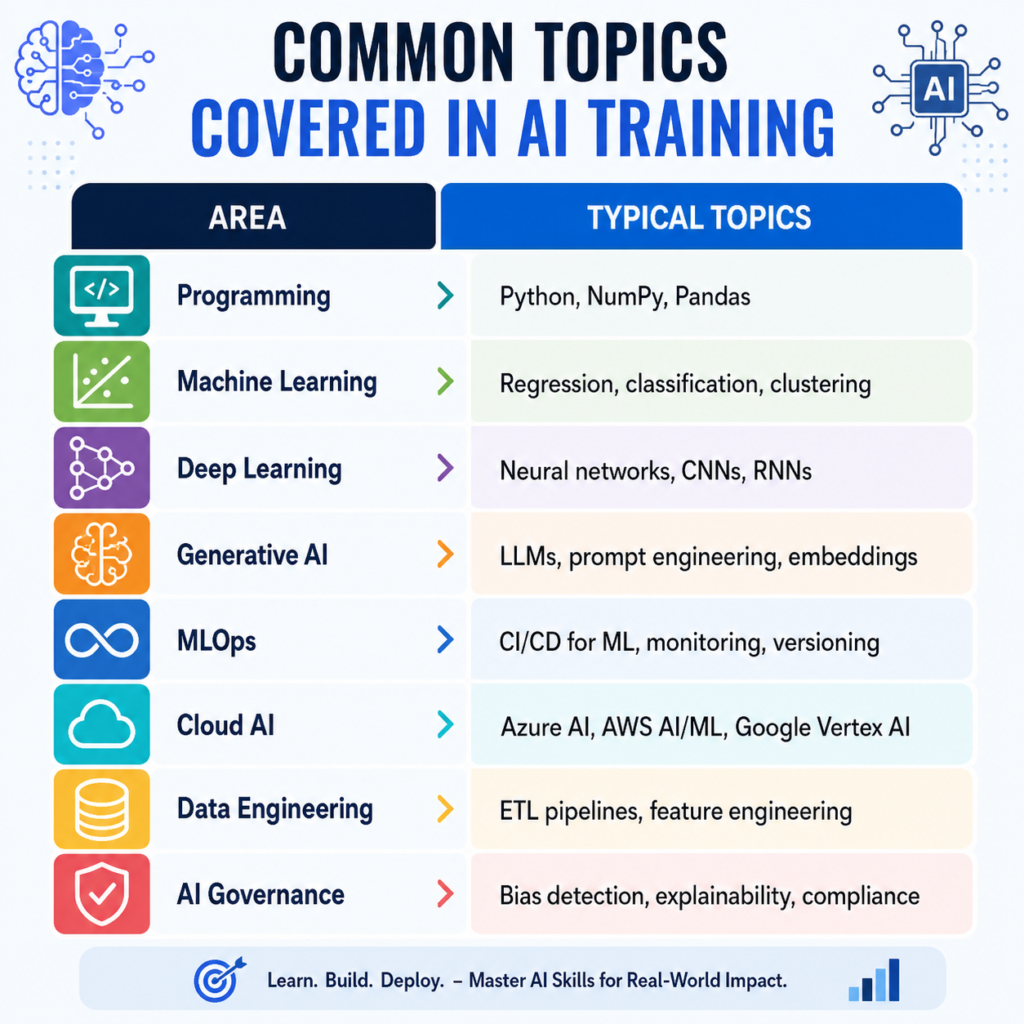
| Area | Typical Topics |
|---|---|
| Programming | Python, NumPy, Pandas |
| Machine Learning | Regression, classification, clustering |
| Deep Learning | Neural networks, CNNs, RNNs |
| Generative AI | LLMs, prompt engineering, embeddings |
| MLOps | CI/CD for ML, monitoring, versioning |
| Cloud AI | Azure AI, AWS AI/ML, Google Vertex AI |
| Data Engineering | ETL pipelines, feature engineering |
| AI Governance | Bias detection, explainability, compliance |
Some programs go surprisingly deep into deployment now, especially with generative AI becoming part of mainstream enterprise systems.
What Makes an AI Course Industry-Aligned in 2026?
Industry alignment basically means the curriculum reflects how AI is actually used inside organizations not just in research papers or isolated notebook experiments.
1. Real Enterprise Tool Usage
Good AI programs expose learners to production-oriented tools such as:
- TensorFlow
- PyTorch
- Hugging Face
- OpenAI APIs
- LangChain
- Vector databases
- MLflow
- Docker
- Kubernetes
- Apache Spark
The goal isn’t memorizing tools for the sake of it. It’s understanding how these technologies fit together in real workflows.
2. Project-Based Learning
Employers usually want proof that someone can build things, not just explain concepts.
That’s why effective AI programs often include projects like:
- Chatbot development
- Predictive analytics systems
- Recommendation engines
- NLP pipelines
- AI automation workflows
- End-to-end deployment projects
And honestly, building messy real-world projects teaches lessons that polished tutorials never do.
3. Cloud Platform Integration
Modern AI systems are heavily cloud-driven now. Most enterprise deployments rely on scalable infrastructure and managed AI services.
Industry-focused programs commonly include:
| Cloud Platform | AI Services |
|---|---|
| Microsoft Azure | Azure OpenAI, Azure ML |
| AWS | SageMaker, Bedrock |
| Google Cloud | Vertex AI |
| Databricks | ML pipelines, Lakehouse AI |
4. MLOps and Deployment Skills
A lot of AI Online Training in USA still stop after model training. Enterprise teams don’t.
Operational AI skills now matter a lot:
- Model versioning
- CI/CD pipelines
- Drift monitoring
- API deployment
- Scalability optimization
- Security controls
That operational layer is where many production AI systems either succeed or quietly fail.
Why Is Artificial Intelligence Important for Working Professionals?
AI is becoming embedded in business operations almost everywhere healthcare, finance, logistics, cybersecurity, retail, software engineering, you name it.
Working professionals often pursue AI Online Training in USA because they want to:
- Transition into AI-focused roles
- Automate repetitive processes
- Improve analytical decision-making
- Support digital transformation initiatives
- Understand enterprise AI adoption strategies
Some people enter AI because of career growth. Others just don’t want to get left behind as workflows evolve. Both are valid reasons.
Enterprise Drivers Behind AI Adoption
Organizations commonly implement AI for things like:
- Process automation
- Customer support systems
- Fraud detection
- Predictive maintenance
- Intelligent document processing
- Conversational AI
- Data-driven decision-making
These systems require professionals who understand both technical implementation and business workflows. That combination is becoming increasingly valuable.
How Does Artificial Intelligence Work in Real-World IT Projects?
Most enterprise AI systems follow a fairly consistent lifecycle:
| Stage | Description |
|---|---|
| Data Collection | Gather structured and unstructured data |
| Data Preparation | Clean and transform datasets |
| Feature Engineering | Create meaningful inputs |
| Model Training | Train ML or deep learning models |
| Validation | Evaluate metrics and accuracy |
| Deployment | Publish APIs or applications |
| Monitoring | Track drift, latency, performance |
In reality, though, the workflow is rarely perfectly clean. Data issues, infrastructure bottlenecks, security reviews those things tend to show up fast in production environments.
Example: AI-Powered Customer Support
A common enterprise implementation looks something like this:
- A customer submits a question
- An NLP model interprets intent
- Vector search retrieves relevant information
- An LLM generates a response
- Escalation occurs if confidence is low
- Logs are stored for retraining and monitoring
Typical technologies involved include:
- Python
- FastAPI
- OpenAI APIs
- Pinecone or FAISS
- LangChain
- Azure OpenAI Service
This kind of workflow is now included in many of the AI Online Training in USA because it reflects practical implementation patterns companies actually use.
What Skills Are Required to Learn Artificial Intelligence?
AI learning usually combines programming, data analysis, systems thinking, and some mathematical understanding.
| Skill Area | Importance |
|---|---|
| Python Programming | Essential |
| Data Analysis | High |
| Statistics | High |
| Machine Learning Concepts | Essential |
| SQL | Important |
| APIs and Integration | Important |
| Cloud Fundamentals | Increasingly important |
People transition into AI from all sorts of backgrounds:
- Software development
- DevOps
- Data analytics
- QA automation
- Cloud engineering
- Business intelligence
You don’t necessarily need research-level mathematics for applied AI work either. Generative AI roles especially tend to emphasize implementation and workflow integration more than advanced theory.
What Should Professionals Look for in the Best AI Courses Online?
The strongest AI programs in 2026 usually combine conceptual understanding with practical production skills.
Curriculum Relevance
Look for programs covering:
- Generative AI
- Prompt engineering
- Retrieval-Augmented Generation (RAG)
- MLOps
- Cloud AI services
- Responsible AI
Hands-On Labs
Practical labs help learners understand:
- Deployment workflows
- API integration
- Dataset preprocessing
- Model tuning
- Monitoring systems
Instructor Experience
Programs taught by professionals with real enterprise experience often provide more useful context than purely academic instruction. That practical perspective makes a difference.
Capstone Projects
Strong capstones usually demonstrate competency in:
- AI architecture design
- Data pipeline creation
- End-to-end deployment
- Performance optimization
Hiring managers often pay close attention to project portfolios now, especially for AI roles.
How Is Artificial Intelligence Used in Enterprise Environments?
Enterprise AI looks very different from small demo projects.
| Industry | AI Use Case |
|---|---|
| Healthcare | Medical imaging analysis |
| Banking | Fraud detection |
| Retail | Recommendation engines |
| Manufacturing | Predictive maintenance |
| Cybersecurity | Threat detection |
| HR | Resume screening |
| Customer Support | Conversational AI |
Enterprise Constraints AI Teams Face
Security
Organizations frequently restrict:
- Sensitive data exposure
- Public API access
- Unapproved deployments
Scalability
Production systems must handle:
- High request volumes
- Distributed infrastructure
- Real-time inference
Governance
Enterprise AI governance often includes:
- Bias mitigation
- Explainability requirements
- Audit logging
- Compliance controls
These operational realities are increasingly included in advanced AI Online Training in USA because they’re unavoidable in production environments.
What Tools Are Commonly Taught in AI Programs?
Modern AI training usually spans multiple layers of tooling.
| Category | Common Tools |
|---|---|
| Programming | Python, Jupyter |
| ML Frameworks | TensorFlow, PyTorch |
| Data Processing | Pandas, Spark |
| NLP | Hugging Face, spaCy |
| Generative AI | OpenAI, Anthropic APIs |
| Deployment | Docker, Kubernetes |
| MLOps | MLflow, Kubeflow |
| Vector Databases | Pinecone, ChromaDB |
Tool diversity matters because enterprise AI teams rarely rely on one framework alone. Real-world environments are messy, interconnected, and constantly evolving.
How Do Generative AI and LLMs Fit Into AI Training?
Generative AI has become a major focus area in 2026.
Prompt Engineering
Learners often practice:
- Prompt optimization
- Context handling
- Role-based prompting
- Output validation
Retrieval-Augmented Generation (RAG)
RAG systems combine:
- Vector search
- Enterprise document retrieval
- LLM-based generation
AI Agents
Many programs now include:
- Workflow automation
- Tool calling
- Multi-step orchestration
- Agent memory handling
A typical generative AI workflow usually looks something like this:
| Step | Action |
|---|---|
| Input | User submits request |
| Embedding | Query converted to vectors |
| Retrieval | Relevant documents fetched |
| Context Injection | Data added to prompt |
| Generation | LLM produces response |
| Validation | Output checked for quality |
What Job Roles Use Artificial Intelligence Daily?
AI responsibilities now show up across both technical and business functions.
| Role | Primary Responsibilities |
|---|---|
| AI Engineer | Build AI applications |
| ML Engineer | Train and optimize models |
| Data Scientist | Analyze and model data |
| NLP Engineer | Build language systems |
| MLOps Engineer | Manage deployment pipelines |
| AI Product Manager | Coordinate AI strategy |
| BI Analyst | Use AI-enhanced analytics |
Even adjacent roles increasingly interact with AI systems now:
- Software developers
- Cloud architects
- QA engineers
- DevOps teams
- Cybersecurity professionals
That trend is only accelerating.
What Careers Are Possible After Learning AI?
Career paths vary depending on background and specialization.
| Background | Potential AI Path |
|---|---|
| Software Developer | AI Engineer |
| Data Analyst | Data Scientist |
| Cloud Engineer | MLOps Engineer |
| Business Analyst | AI Solutions Analyst |
| QA Engineer | AI Test Automation Specialist |
Mid-Level AI Career Areas
AI Application Development
Focuses on:
- Generative AI apps
- API integrations
- Workflow automation
Machine Learning Engineering
Includes:
- Model optimization
- Feature engineering
- Training pipelines
AI Operations and Governance
Covers:
- Compliance
- Monitoring
- Responsible AI frameworks
How Long Does It Take to Learn Artificial Intelligence?
Learning timelines vary a lot depending on prior experience and consistency.
| Experience Level | Estimated Timeline |
|---|---|
| Beginner | 8–12 months |
| IT Professional | 4–8 months |
| Experienced Developer | 3–6 months |
A typical progression often looks like:
- Python fundamentals
- Data analysis
- Machine learning basics
- Deep learning
- Generative AI
- MLOps and deployment
- Enterprise projects
Most working professionals prefer structured AI Online Training in USA because the guided progression saves time and reduces confusion.
What Challenges Do AI Teams Face in Production?
Enterprise AI introduces both technical and organizational challenges.
Technical Challenges
Data Quality Issues
Poor datasets can lead to:
- Biased predictions
- Reduced accuracy
- Unstable models
Infrastructure Complexity
Teams often deal with:
- GPU provisioning
- Distributed workloads
- Real-time latency
Model Drift
Production data changes over time. Models that worked six months ago can gradually lose effectiveness if nobody monitors them carefully.
Organizational Challenges
| Challenge | Description |
|---|---|
| Skill Gaps | Limited AI expertise |
| Governance | Compliance and auditing |
| Integration | Legacy system compatibility |
| Cost Management | GPU and cloud spending |
Good industry-aligned training introduces these realities early instead of pretending AI projects run perfectly.
Academic AI Programs vs Industry-Oriented AI Training
There’s a noticeable difference between academic and applied AI education.
| Area | Academic Programs | Industry-Oriented Programs |
| Focus | Theory and research | Practical implementation |
| Projects | Research-driven | Enterprise workflows |
| Deployment | Limited emphasis | Strong emphasis |
| Tool Exposure | Often narrower | Broad enterprise stack |
| MLOps | Sometimes minimal | Frequently included |
Both approaches have value. But many working professionals prioritize applied skills because they map more directly to day-to-day responsibilities.
How Can Professionals Practice AI Skills Effectively?
Hands-on repetition matters more than passive learning.
Build Realistic Projects
Examples include:
- Resume screening tools
- Forecasting systems
- Chatbots
- Document summarization applications
Use Public Datasets
Popular sources include:
- Kaggle
- UCI Machine Learning Repository
- Hugging Face datasets
Practice Deployment
A lot of learners stop at notebook experiments. Real growth usually happens when you start dealing with:
- API deployment
- Containerization
- Logging
- Monitoring
That operational layer teaches patience quickly, honestly.
FAQ: Best AI Courses Online and Artificial Intelligence Online Programs
Which AI online training programs work best for professionals?
Programs with flexible schedules, instructor support, hands-on labs, and project-based learning are generally well suited for working professionals.
Are coding skills required?
Basic programming knowledge especially Python is extremely helpful. Some beginner-friendly programs teach programming fundamentals before moving into advanced AI topics.
What programming language is most used in AI?
Python remains the dominant language because of its massive ecosystem of AI and ML libraries.
Do AI courses include Generative AI in 2026?
Most modern AI programs now include:
Prompt engineering
LLM integration
RAG architectures
AI agents
Vector databases
Which industries hire AI professionals?
Industries actively hiring AI talent include:
Healthcare
Banking
Retail
Manufacturing
Cybersecurity
Telecommunications
Logistics
Is cloud knowledge important for AI careers?
Yes. Cloud infrastructure is now central to scalable AI deployment and model hosting.
What is MLOps?
MLOps refers to operational practices used to deploy, monitor, version, and maintain machine learning systems in production environments.
Can non-technical professionals learn AI?
Yes, although technical AI roles usually require stronger programming and analytical skills. Business-oriented AI roles may focus more on workflow strategy and AI adoption planning.
Key Takeaways
The best AI courses online in 2026 are increasingly centered around enterprise implementation, not just theory. Modern Artificial Intelligence online Programs typically include machine learning, generative AI, cloud AI services, MLOps, and deployment workflows tied to real production environments.
Industry-aligned AI Online Training in USA puts heavy emphasis on hands-on projects, operational constraints, scalability, governance, and practical tool integration. That’s where the market has clearly moved.
For working professionals, the most valuable programs are usually the ones that combine flexibility, guided progression, practical labs, and realistic enterprise workflows not just polished demos or surface-level tutorials.
Explore H2K Infosys AI Online Training in USA to gain hands-on exposure to enterprise AI tools, workflows, and project-based learning aligned with modern industry practices.
Learn AI Online Training in USA through practical online training designed to support technical skill development and long-term career growth.