


Modern software applications evolve fast, and so should the way we test them. As systems grow in complexity with frequent releases, feature additions, and UI changes, test automation becomes essential. But automation is only effective when it is structured, reusable, and easily maintainable. This is where the Page Object Model (POM) shines.
POM is one of the most widely adopted design patterns in automation testing. Whether you’re learning through Quality analyst courses understanding POM is a core skill that sets strong testers apart.
In this blog, we’ll explore what POM is, why it matters, how to implement it, and how it transforms testing efficiency across projects.
Introduction: Why Automation Needs Better Design
Imagine you are testing a web application like an e commerce website. You automate login, product search, checkout, and profile update features. Everything runs smoothly until the UI changes.
A single button name change, a new locator, or a modified layout may break dozens of test scripts. You now spend hours fixing broken code scattered throughout your framework.
This is the biggest challenge of poorly structured automation.
The solution
A model where UI elements live in one place, tests stay clean, and changes are easy to manage.
That solution is the Page Object Model.
What Is Page Object Model (POM)?
The Page Object Model (POM) is a design pattern used in test automation frameworks that creates a separate class for each web page or screen of an application. Each page class contains:
- Web elements
- Page actions or methods
- Page level logic
In simple terms, Page Object Model acts as a UI repository where each page is represented as an object.
Example Simplified
class LoginPage { WebElement usernameField; WebElement passwordField; WebElement loginButton; void login(String user, String pass) { usernameField.sendKeys(user); passwordField.sendKeys(pass); loginButton.click(); } }
Here, the LoginPage class contains:
- All elements related to the login screen
- The login action
- A clean way to interact with the page
Your test script simply calls:
loginPage.login(“user123”, “abc123”);
This keeps your tests highly readable and easy to update.
Why Page Object Model Matters in Modern Test Automation
Page Object Model solves several key problems automation engineers face daily. Let’s explore its benefits.
Increased Maintainability
Changes to UI elements need updates only in one place, the corresponding page class.
If the login button ID changes, you update it only inside LoginPage.java instead of fixing dozens of scripts.
This saves hours of rework.
Better Code Reusability
Common actions like login, navigation, search, and logout become reusable methods.
Multiple test cases can reuse the same functions without rewriting code.
Example:
- login as admin
- login as user
- login as guest
All use the same login method.
Enhanced Readability and Structure
POM promotes clean separation:
- Page Classes control UI interactions
- Test Scripts control business logic and validations
Your test scripts remain simple and expressive:
loginPage.login("admin", "admin123");
dashboard.verifyWelcomeText();
This makes your automation framework easier for new testers to understand, especially helpful for learners in quality analyst courses.
Reduces Code Duplication
Without POM, the same locators and actions appear every time across multiple scripts.
In Page Object Model, duplication is eliminated resulting in:
- Cleaner code
- Faster execution
- Fewer failures
Easier Scalability for Large Applications
As projects grow, you simply keep adding page classes.
No need to redesign your entire framework.
This is why many companies prefer candidates who understand POM, especially those who completed a Testing software course or hands on QA training.
How Page Object Model Works: Structure Overview
A typical POM framework includes:
Page Classes
Each class represents a webpage or component.
Example:
- LoginPage
- HomePage
- CartPage
- ProfilePage
Each page contains:
- Locators
- Page actions
- Helper functions
Test Classes
These hold the test logic, such as:
- Validations
- Navigation
- Assertion checks
Example:
@Test
public void testValidLogin() {
    loginPage.login("validUser", "validPass");
    homePage.verifyDashboardLoaded();
}
Includes reusable components:
Utility or Helper Classes
- Screenshot utility
- Browser management
- Reporting
- Excel or CSV readers
- Configuration files
Base Class
Handles framework level activities like:
- WebDriver initialization
- Browser setup
- Test teardown
- Global properties
- Types of Page Object Models
POM is flexible and can be enhanced based on framework needs.Standard POM
Locators and methods are stored inside page classes.
Best for beginners.
POM with Page Factory Selenium
Uses annotations like @FindBy to simplify locator handling.
Example:
@FindBy(id=”username”) WebElement userName;
Benefits:
- Lazy initialization
- Improved readability
- Faster execution
Page Object Model with Data Driven Framework
Test data comes from:
- Excel sheets
- CSV files
- Databases
- JSON
Perfect for real time applications where multiple input sets are needed.
Page Object Model with Hybrid Framework
Combines:
- POM
- Data driven
- Modular approach
- Keyword driven methods
This is used in large automation suites in enterprise applications.Real World Example: POM in Selenium
Let’s walk through a common scenario testing an ecommerce login.
LoginPage.java
public class LoginPage {

    @FindBy(id="email")
    WebElement emailInput;

    @FindBy(id="password")
    WebElement passwordInput;

    @FindBy(id="loginBtn")
    WebElement loginButton;

    public void login(String email, String password) {
        emailInput.sendKeys(email);
        passwordInput.sendKeys(password);
        loginButton.click();
    }
}
TestLogin.java
public class TestLogin extends BaseTest {

    @Test
    public void validateUserLogin() {
        LoginPage loginPage = new LoginPage(driver);
        loginPage.login("testuser@example.com", "pass123");
        Assert.assertTrue(homePage.isDashboardVisible());
    }
}
This is clean, maintainable, and reusable.
Common Mistakes Beginners Make with POM
Even though POM is simple, many beginners make avoidable mistakes.
Here are common pitfalls.
Mixing Test Logic with Page Logic
Page class is only for UI logic.
Test class is for business rules.
Never write assertions inside page classes.
Overcrowding Page Classes
Avoid adding too many unrelated methods.
Stick to the Single Responsibility Principle SRP.
Using Complex Locator Strategies
Use stable locators like:
- ID
- Name
- CSS
Use XPath only when required.
Not Handling Dynamic Elements
Modern applications use:
- AJAX
- React
- Angular
In such cases, use:
- Explicit waits
- Fluent waits
- ExpectedConditions
This prevents flaky tests.
Best Practices to Follow in POM
To get the best out of POM, adopt these practices.
Keep Locators Private
Prevent direct access from test classes.
2. Use Meaningful Names
Bad:
btn1
txt2
Good:
loginButton
searchInput
Reuse Common Methods
Examples:
- login
- logout
- searchProduct
Keep Page Methods Simple
Each method should perform one activity.
Use Consistent Naming Conventions
Helps teams collaborate easily.
Why Page Object Model Is Essential for Future QA Professionals
Automation is no longer optional. It is a necessity.
Companies expect testers to handle:
- Selenium
- API automation
- CI CD
- Version control
- GitHub
- Cloud execution BrowserStack or Sauce Labs
Understanding POM is a must have skill for:
- QA Engineers
- Automation Testers
- SDETs
- Test Leads
Enrolling in well structured quality analyst courses or a comprehensive Testing software course gives you hands on experience in POM and modern automation frameworks.
Where POM Fits in a Complete Automation Framework
POM integrates well with:
- Selenium WebDriver
- TestNG
- JUnit
- Cucumber BDD
- Maven or Gradle
- Jenkins CI CD pipeline
In BDD frameworks, POM supports step definitions to keep code clean and organized.
Sample Framework Folder Structure
src/main/java
    pages
        LoginPage.java
        HomePage.java
        ProfilePage.java
    utils
        DriverFactory.java
        ConfigReader.java
        ExcelUtil.java
    base
        BaseTest.java

src/test/java
    testcases
        LoginTest.java
        LogoutTest.java
    resources
This is the structure used in professional projects and QA team environments.
Advantages of Using POM in Agile and CI CD
Faster Test Execution
Scripts run smoothly with fewer failures.
Low Maintenance Across Sprints
UI changes don’t break the entire suite.
Developer Testers Collaboration
Developers and testers can work together because:
- Code is cleaner
- Framework follows design patterns
- Easier code reviews
High ROI in Test Automation
Companies invest in automation to reduce:
- Time
- Cost
- Human error
POM delivers on these goals.
POM in BDD Automation Frameworks Cucumber
In Cucumber, we write:
Given user enters valid login credentials
When user clicks login
Then dashboard should appear
POM stores the locators and actions while step definitions call page methods.
This avoids repetition and keeps code clean.
Implementation of Project Object Model:
We will see how to implement the page object model, as per the design we have separate classes for all the pages and where the objects are stored for each web page there should be a separate page class.
Consider an example suppose we need to create page object for google search page. Firstly we have to create a page class for each web page like Google search page and create a class for search button and text box and store locators separately.
- Right click on the test file -> New-> package
- Create class by right click on pages -> New-> class
- Write the code to identify the web object separately to text box as well search button.
- In the test case write the code where we are passing driver as a instance to open the class googlesearchpage.java
- For google search button we have to write the test code.
Here we are referring the objects from one page class to another. There will be a lot of flexibility in how page objects should be designed. There are some rules for getting the desired maintainability of our test code.Page objects should not make any verifications and assertions. This is always a part of our test and it should be within the test code. The page object will contain the representation of the page and therefore the services the page provides via methods but no code associated with what’s being tested should be within the page object.
Conclusion
The Page Object Model is more than just an automation design pattern. It is the backbone of scalable, maintainable, and future ready test automation. Whether you are just starting your journey through upgrading your skills in a QA Testing software course, mastering POM makes you a more efficient and industry ready automation professional.
POM helps testers:
- Reduce maintenance
- Improve test stability
- Enhance reusability
- Scale automation easily
- Build cleaner frameworks
As automation testing continues to evolve, Page Object Model remains a must have skill for QA careers.
























10 Responses
Page Object Model advantages:
Reusability
Maintainability
Readability
The Page Object model is a kind of design pattern which is popular in test automation for increasing the test maintenance and reducing the code duplication. The page object is an object-oriented class which serves as an interface to a page of AUT. The Page class consists of web elements and methods to interact with web elements. When automating the test cases, we create objects of page classes and interact by calling methods.
The advantages are of Page Object Model:
*Reusability
*Maintainability
*Readability
Page Object Model, also known as POM, is a design pattern in Selenium that creates an object repository for storing all web elements. It is useful in reducing code duplication and improves test case maintenance. The Page class consists of web elements and methods to interact with web elements. When automating the test cases, we create objects of page classes and interact by calling methods.
The advantages are of Page Object Model
1.Reusability- We can reuse the page class for different tests if needed, that is we don’t have to write code again and again for identifying the code elements and also methods for interactions with them for every test.
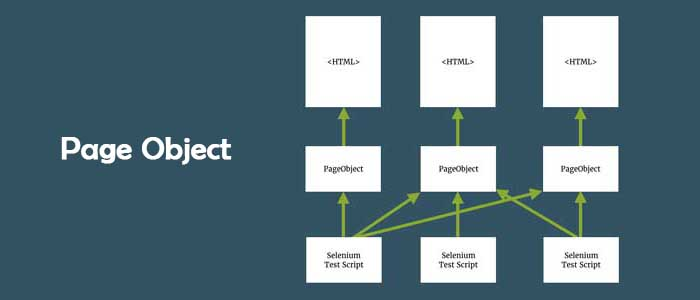
2.Maintainability-The above picture shows that the test case and page class are different from each other which means we can update code if any web element is added or the one which is existing is updated.
3.Readability- As in the above picture, the page code is separated from the test code in turn which helps in code readability improvement.
Page Object Mode is also known as POM ,is a design pattern which is very popular in Selenium Test Automation. It is useful in reducing code duplication and improves test cases maintenance. The page object is an object-oriented class which serves as an interface to a page of AUT. The Page class consists of web elements and methods to interact with web elements. When automating the test cases, we create objects of page classes and interact by calling methods. The benefit is when UI changes for that page the test doesn’t need to change, but the code within that page object needs to change.
The advantages are of Page Object Model:
1.Reusability
2. Maintainability
3. Readability
Page object model – Design pattern popular in test automation for increasing the test maintenance and reducing the code duplication. Interface to the page AUT. Consists of web elements and methods to interact with the web elements. When UI changes for the page, the test doesn’t need to change but the code within that page object needs to change.
Advantages :
Reusability – can reuse the page class for different tests
Maintainability – can update code if any web element is added or the one which is existing is updated
Readaptability – Code readaptability improvement
Page object model:
Page object model is popular in test automation. It is type of design pattern. It is used for increasing test maintenance and to reduce code duplication. I t consists of object oriented class. It also consists of web elements and methods to interact with the web interface.
The design pattern is generally used in selenium where web pages are represented by corresponding classes and web elements are represented by variables of classes. The interaction happens through the methods.
Adavantages of page object model are reusability, maintainability , readability
The page object is an object-oriented class which serves as an interface to a page of AUT. The Page class consists of web elements and methods to interact with them.
The advantages are of Page Object Model
1.Reusability- We can reuse the page class for different tests if needed, that is we don’t have to write code again and again for identifying the code elements and also methods for interactions with them for every test.
2.Maintainability-The above picture shows that the test case and page class are different from each other which means we can update code if any web element is added or the one which is existing is updated.
3.Readability- As in the above picture, the page code is separated from the test code in turn which helps in code readability improvement.
In order to automate the test cases,first we create objects of page classes and interact with them by calling methods. In order to to implement the page object model, as per the design we have separate classes for all the pages and where the objects are stored for each web page there should be a separate page class.
The Page Object model is a kind of design pattern which is popular in test automation for increasing the test maintenance and reducing the code duplication. The page object is an object-oriented class which serves as an interface to a page of AUT. The Page class consists of web elements and methods to interact with web elements. When automating the test cases, we create objects of page classes and interact by calling methods.
The advantages are of Page Object Model:
*Reusability
*Maintainability
*Readability
The Page Object model is a kind of design pattern which is popular in test automation for increasing the test maintenance and reducing the code duplication. The page object is an object-oriented class which serves as an interface to a page of AUT. The Page class consists of web elements and methods to interact with web elements. When automating the test cases, we create objects of page classes and interact by calling methods. The benefit is when UI changes for that page the test doesn’t need to change, but the code within that page object needs to change.
The Design Pattern:
The design pattern is probably used in the selenium where web pages are represented by corresponding class and web elements which are represented by variables of the class; possibly interactions happen through the methods.
The advantages are of Page Object Model:
There is a clear separation between a test code and page specific code like locators and layout. The single repository for the services and operations offered by the page other than having these services scattered throughout the test.
Reusability, we can reuse the page class for different tests if needed, that is we don’t have to write code again and again for identifying the code elements and also methods for interactions with them for every test.
Maintainability, the above picture shows that the test case and page class are different from each other which means we can update code if any web element is added or the one which is existing is updated.
Readability, as in the above picture, the page code is separated from the test code in turn which helps in code readability improvement.
The Page Object model is a design pattern that is popular in test automation for increasing test maintenance and reducing code duplication. The page object is an object-oriented class that serves as an interface to a page of AUT. When automating the test cases, we create objects of page classes and interact by calling methods. The benefit is when UI changes for that page the test doesn’t need to change, but the code within that page object needs to change.
The advantages of the Page Object Model are Reusability, Maintainability, and Readability.