A few years ago, people were still skeptical about online tech training. Especially in cyber security. There was this idea that you had to sit in a classroom, work in a physical lab, or already have an IT background to break into the industry.
That’s not really how things work anymore.
Today, online cyber security training and job placement programs at H2K Infosys are everywhere in the USA, and some of them are surprisingly effective. In fact, many hiring managers now expect candidates to come from bootcamps, remote labs, certification tracks, or virtual internship programs rather than traditional computer science degrees.
The cyber security talent shortage has become too large to ignore. According to recent industry reports in 2025 and 2026, U.S. companies are still struggling to fill thousands of open security roles. Banks, healthcare providers, insurance firms, retailers, and even small startups are actively hiring junior analysts and support-level security professionals.
That demand created a huge market for cyber security training with job placement support.
And honestly, some programs do a much better job than colleges when it comes to preparing people for actual entry-level work.
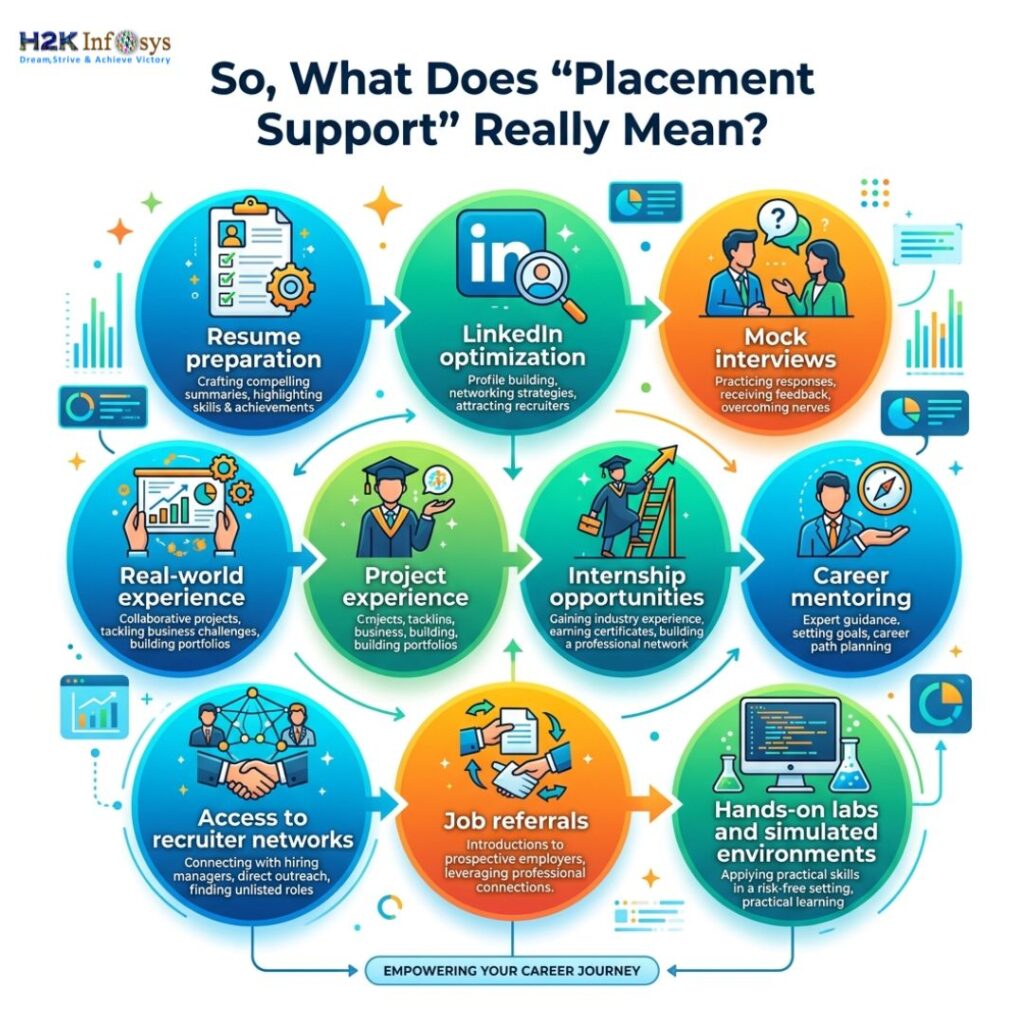
So, What Does “Placement Support” Really Mean?
This is important because a lot of training institutes throw around the word “placement” pretty loosely.
Real placement support usually includes:
- Resume preparation
- LinkedIn optimization
- Mock interviews
- Real-world project experience
- Internship opportunities
- Career mentoring
- Access to recruiter networks
- Job referrals
- Hands-on labs and simulated environments
Some programs even help students prepare for live SOC analyst interviews using real SIEM tools and incident response scenarios.
That matters a lot.
I’ve seen candidates with certifications struggle badly in interviews because they only memorized theory. Employers can tell almost immediately when somebody has never touched Splunk, Wireshark, Sentinel, or basic Linux troubleshooting.
The better cyber security jobs with training programs focus heavily on practical exposure.
Why Online Cyber Security Training Became So Popular in the USA
Part of it came from remote work culture. Another part came from the speed of the cyber threat landscape itself.
Security changes fast.
Ransomware attacks evolve.
Cloud security tools evolve.
AI-driven phishing attacks evolve.
Traditional academic programs often move too slowly to keep up.
Online cyber security training providers adapted faster because they could update labs, modules, and case studies in real time. That flexibility became a major advantage.
A lot of professionals now prefer learning online because they can:
- Keep their current jobs
- Learn evenings or weekends
- Access virtual labs anytime
- Build certification paths faster
- Practice on cloud environments remotely
For working adults, career switchers, veterans, and international students in the USA, this format is honestly much more practical.
What Makes Some Programs Better Than Others?
This is where people need to be careful.
Not every online cyber security training and job placement program is legitimate or useful. Some are mostly marketing with recycled videos and zero mentorship.
The strongest programs usually include:
1. Live Instructor-Led Training
Recorded videos alone rarely work for beginners.
Cyber security can get confusing quickly especially networking concepts, SIEM tools, IAM policies, threat detection workflows, and cloud security architecture.
Live instructors make a huge difference because students can ask questions in real time.
2. Hands-On Labs
This is non-negotiable now.
If a program doesn’t offer labs, SOC simulations, vulnerability assessments, log analysis practice, or cloud security projects, it’s probably not enough for today’s job market.
Hiring managers increasingly ask practical questions during interviews.
Things like:
- “How would you investigate a phishing alert?”
- “What would you check first during a brute force attack?”
- “Explain how MFA reduces risk.”
- “Show how you analyzed logs.”
Hands-on exposure helps candidates answer naturally instead of sounding rehearsed.
3. Certification-Focused Training
Most solid cyber security programs usually align their training with certifications employers actually recognize. Things like:
- CompTIA Security+
- CEH
- AWS Security Specialty
- CySA+
- Splunk certifications
- Azure Security certifications
Now, certifications by themselves won’t magically land someone a job. I think most people in tech know that by now. Still, they do help quite a bit when recruiters are sorting through hundreds of resumes. In many cases, certifications are what get your profile noticed first before the technical interview even happens.
And honestly, for beginners, preparing for certs also gives some structure. Cyber security can feel overwhelming at the start because there’s just so much to learn.
4. Actual Placement Support Matters
This is one area where programs like H2K Infosys started getting attention from career changers across the USA.
A lot of online training providers basically hand students a bunch of prerecorded videos and disappear after enrollment. That approach rarely works well in cyber security, especially for beginners trying to break into the field for the first time.
One thing that stands out with H2K Infosys is their focus on practical project environments and interview preparation. That combination tends to help beginners feel less overwhelmed during the actual hiring process.
And honestly, confidence matters more than people realize in cyber security interviews.
Which Cyber Security Roles Are Beginners Getting After Training?
Most freshers won’t start as “ethical hackers” right away, despite what flashy ads sometimes promise.
The more realistic entry-level paths are:
- SOC Analyst Level 1
- Cyber Security Support Analyst
- Information Security Analyst
- IAM Analyst
- Vulnerability Management Associate
- Cloud Security Support
- GRC Analyst
- Security Operations Coordinator
Many of these roles are available remotely or in hybrid format across the USA.
I’ve also noticed companies becoming more open to candidates from non-IT backgrounds if they demonstrate practical skills and consistency during training.
That’s a pretty big shift from even five years ago.
The Rise of AI and Why Cyber Security Careers Are Still Growing
People ask this constantly now:
“Will AI replace cyber security jobs?”
From what industry professionals are seeing in 2026, AI is actually increasing the demand for security professionals in many areas.
Why?
Because attackers are using AI too.
Phishing campaigns became more sophisticated.
Deepfake scams increased.
Automated attacks scaled faster.
Companies now need analysts who understand both security fundamentals and AI-driven threat behavior.
That’s one reason cyber security training with job placement continues growing rapidly in the USA.
Security isn’t slowing down anytime soon.
A Realistic Timeline for Beginners
This part matters because many ads create unrealistic expectations.
A complete beginner typically needs:
- 4–8 months of consistent training
- Lab practice several times weekly
- Certification preparation
- Resume building
- Interview practice
Some people transition faster if they already have networking, help desk, cloud, or system administration experience.
Others take longer.
And honestly, that’s normal.
Cyber security is broad. Nobody learns everything immediately.
What Should You Look For Before Joining Any Online Program?
Before enrolling anywhere, check these things carefully:
- Do they offer live training?
- Are projects hands-on or theoretical?
- Is placement support actually included?
- Are instructors industry experienced?
- Do students share genuine success stories?
- Is there mentorship after course completion?
- Are labs updated for current tools and threats?
Also small observation here programs that spend more time explaining their curriculum than showing student outcomes are sometimes a red flag.
The better institutes usually have detailed project workflows, alumni feedback, and interview preparation structures clearly outlined.
Final Thoughts
Yes, online cyber security training and job placement programs are definitely available across the USA, and honestly, a lot more people are using them now than even a few years ago. Plenty of professionals are breaking into cyber security training with placement without coming from traditional computer science backgrounds or four-year tech degrees.
The hiring landscape has shifted quite a bit. Employers care more about whether you can actually work through real security problems than where you went to school. Practical skills, certifications, lab exposure, project work, those things tend to stand out faster during interviews than academic theory alone.
From what I’ve seen, the programs that really help beginners are the ones that mix live instruction with hands-on labs, career mentoring, mock interviews, and structured placement support. That combination usually gives people more confidence when they start applying for jobs, especially if they’re switching careers.
H2K Infosys is one of the training providers that comes up pretty often in these conversations, mainly because of its project-based learning approach and the way it focuses on real interview preparation instead of only pushing certification exams. For beginners trying to understand how cyber security works in actual job environments, that kind of practical exposure can make a noticeable difference.