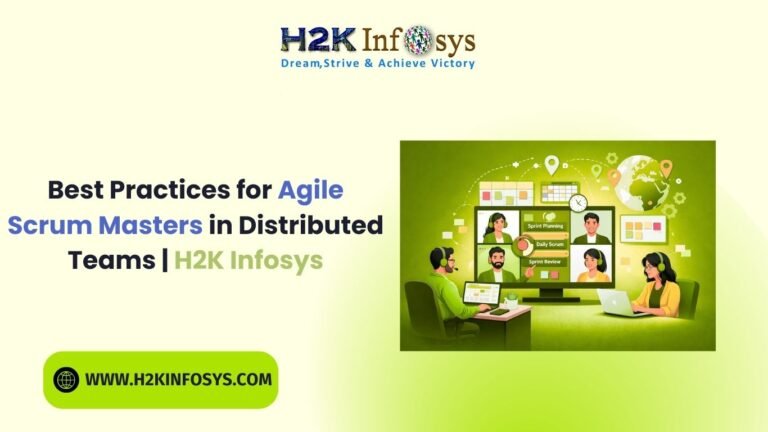
Best Practices for Agile Scrum Masters in distributed teams refer to structured methods Scrum Masters use to enable collaboration, transparency, and predictable delivery when team members work across locations and time zones. These practices focus on communication discipline, tool standardization, facilitation consistency, and alignment with Agile principles despite physical separation. In modern IT environments, applying these practices is essential to maintain sprint predictability, product quality, and team accountability.
What are Best Practices for Agile Scrum Masters in Distributed Teams?
Best Practices for Agile Scrum Master‘s in distributed teams are proven operational guidelines that help Scrum Masters coordinate Agile ceremonies, manage dependencies, and support self-organizing teams when face-to-face interaction is limited.
Distributed Agile teams typically operate across:
- Different geographic regions
- Multiple time zones
- Varied cultural and organizational contexts
In this environment, Scrum Masters must adapt traditional Scrum practices while preserving the framework’s core principles:
- Transparency
- Inspection
- Adaptation
The goal is not to change Scrum rules, but to apply Best Practices for Agile Scrum Masters that ensure Scrum remains effective under real-world constraints.
How does the Agile Scrum Master role work in real-world IT projects?

In enterprise IT projects, the Agile Scrum Master functions as a process facilitator, delivery enabler, and risk mitigator. This role is especially critical when teams are distributed.
Key responsibilities include:
- Facilitating Scrum events (Sprint Planning, Daily Scrum, Review, Retrospective)
- Removing impediments that block progress
- Ensuring adherence to Scrum principles
- Supporting Product Owners with backlog refinement
- Coaching teams on Agile behaviors
In distributed setups, Best Practices for Agile Scrum Masters emphasize consistency and clarity. Meetings must be structured, artifacts must be visible, and communication protocols must be explicit to avoid misalignment.
Why are Best Practices for Agile Scrum Masters important for working professionals?
For working professionals transitioning into Agile roles, understanding Best Practices for Agile Scrum Masters is essential because most modern organizations operate with partially or fully remote teams.
Common challenges professionals face include:
- Reduced informal communication
- Delayed feedback loops
- Dependency management across teams
- Inconsistent sprint execution
Applying Best Practices for Agile Scrum Masters helps professionals:
- Maintain delivery cadence
- Reduce sprint spillover
- Improve cross-team collaboration
- Support predictable releases
These practices are commonly covered in structured agile and scrum training programs designed for real enterprise environments.
What skills are required to learn Agile Scrum Master practices effectively?
Learning and applying Best Practices for Agile Scrum Masters requires both technical understanding and professional skills.
Core Scrum Knowledge
- Scrum roles, artifacts, and events
- Sprint lifecycle and backlog management
- Definition of Done and acceptance criteria
Facilitation and Communication Skills
- Running structured virtual meetings
- Managing time-boxed discussions
- Encouraging participation in remote settings
Tool Proficiency
- Jira, Azure DevOps, or Rally for backlog tracking
- Confluence or SharePoint for documentation
- Collaboration tools such as MS Teams or Slack
Most agile scrum classes focus on these skill areas with hands-on simulations to reflect distributed team realities.
How are Best Practices for Agile Scrum Masters applied in distributed Scrum ceremonies?
Sprint Planning
Best Practices for Agile Scrum Masters in Sprint Planning include:
- Pre-refined backlog items
- Shared sprint goals documented before the meeting
- Capacity planning adjusted for time zones
Daily Scrum
In distributed teams:
- Meetings are time-boxed strictly
- Cameras are encouraged for engagement
- Updates focus on sprint goals, not status reporting
Sprint Review
- Demos are recorded when stakeholders cannot attend live
- Feedback is documented immediately
- Product increments are shared via accessible environments
Retrospective
- Anonymous digital boards encourage honest feedback
- Action items are tracked like backlog items
- Follow-ups are reviewed in the next sprint
These ceremony adaptations reflect Best Practices for Agile Scrum Masters commonly observed in enterprise Agile environments.
How is Agile Scrum Master work supported by enterprise tools?
Distributed Agile teams rely heavily on tooling. Applying Best Practices for Agile Scrum Masters requires consistent tool usage.
Common Tool Stack
| Purpose | Tools Commonly Used |
|---|---|
| Backlog & Sprint Tracking | Jira, Azure DevOps |
| Documentation | Confluence, SharePoint |
| Communication | MS Teams, Slack |
| Whiteboarding | Miro, MURAL |
| Reporting | Jira Dashboards, Power BI |
These tools support transparency and enable Scrum Masters to enforce Best Practices for Agile Scrum Masters across locations.
How do Scrum Masters manage dependencies in distributed teams?
Dependency management is a major challenge in scaled Agile environments.
Best Practices for Agile Scrum Masters include:
- Visualizing dependencies on shared boards
- Coordinating with other Scrum Masters or Release Train Engineers
- Aligning sprint timelines across teams
- Escalating risks early using factual data
In organizations pursuing agile software certification standards, these practices are often audited as part of Agile maturity assessments.
How does the Scrum Master role align with the Scrum Project Manager role?
While Scrum does not define a “scrum project manager,” enterprises often blend responsibilities.
| Aspect | Scrum Master | Scrum Project Manager |
|---|---|---|
| Focus | Process & team enablement | Delivery coordination |
| Authority | Servant leadership | Often hierarchical |
| Metrics | Flow, predictability | Schedule, scope |
Understanding Best Practices for Agile Scrum Masters helps professionals navigate hybrid role expectations without compromising Scrum principles.
What job roles use Agile Scrum Master skills daily?
Skills derived from Best Practices for Agile Scrum Masters are used across multiple roles:
- Agile Scrum Master
- Scrum Project Manager
- Delivery Manager
- Agile Coach
- Product Operations Lead
Professionals in these roles frequently pursue Scrum master training to standardize their approach and improve delivery consistency.
How are Best Practices for Agile Scrum Masters applied at scale?
In large enterprises:
- Multiple Scrum teams work on shared products
- Coordination occurs through Scrum of Scrums or SAFe ceremonies
- Governance and compliance requirements exist
Best Practices for Agile Scrum Masters in these environments emphasize:
- Alignment with enterprise Agile frameworks
- Clear escalation paths
- Consistent metrics across teams
These practices are commonly included in scrum master training and placement programs focused on real enterprise scenarios.
What careers are possible after learning Agile Scrum Master practices?
Professionals who master Best Practices for Agile Scrum Masters can progress into:
- Senior Scrum Master roles
- Agile Program Management
- Enterprise Agile Coaching
- Product Delivery Leadership
Career progression depends on:
- Depth of Agile knowledge
- Experience with distributed teams
- Exposure to enterprise-scale delivery
Frequently Asked Questions (FAQ)
Do Best Practices for Agile Scrum Masters change Scrum rules?
No. They adapt execution methods while preserving Scrum principles and framework integrity.
Are these practices relevant only for remote teams?
They are most critical for distributed teams but also improve co-located team effectiveness.
Is certification necessary to apply these practices?
Certification is not mandatory but helps standardize understanding, especially in regulated enterprises.
Can beginners apply these practices?
Yes. Most practices are introduced progressively in structured Agile learning paths.
Key Takeaways
- Best Practices for Agile Scrum Masters enable predictable delivery in distributed environments
- Tool consistency and ceremony discipline are critical
- Real-world Agile requires adaptation without compromising principles
- These practices support multiple Agile and delivery-focused career paths
To build hands-on expertise, explore structured Agile Scrum Master learning paths at H2K Infosys.
Practical training helps professionals apply enterprise-ready Scrum practices with confidence.