
Yes. Beginners can absolutely join cyber security training with placement assistance, even if they have no previous IT experience. Many modern programs are designed specifically for fresh graduates, career switchers, and people starting from scratch by combining practical learning, hands-on labs, and career support that helps bridge the gap between learning and getting hired.
A few years ago, the usual question people asked was, “Do I need years of technical experience before entering cybersecurity?” Lately, the conversation sounds different. Now people ask, “Can I realistically get a job if I start from zero?”
That shift is interesting because it reflects what is happening in the industry itself. Companies are hiring for practical skills more than they used to. Employers still value degrees and certifications, of course, but they also want people who can recognize threats, analyze security incidents, understand basic networking, and work with real tools. Training providers like H2K Infosys have also adapted to this shift by creating learning paths that focus more on practical exposure, real-world scenarios, and career readiness rather than only classroom theory.
And honestly, I’ve seen beginners surprise themselves.
Someone joins with almost no background, struggles during the first couple of weeks with terms like IP addressing or vulnerability scanning, then somewhere around month two things suddenly begin connecting. It happens more often than people think.
Why Beginners Are Entering Cyber security training with placement Faster Than Before
Cybersecurity used to feel like an advanced field that sat behind years of IT experience. Today, training models have changed.
Organizations face increasing security risks, cloud adoption keeps expanding, and companies need more skilled people entering the field. Because of this, structured learning paths have become more beginner-friendly.
I noticed something while speaking with learners and watching hiring patterns recently. Recruiters are becoming less focused on whether someone “started in cyber security training with placement” and more interested in whether they can demonstrate practical ability.
Can you investigate a suspicious login event?
Can you understand a basic security alert?
Can you explain how phishing works?
These small things matter.
This is exactly where cyber security training and job placement programs have become valuable. Rather than leaving learners with only theory, good training programs try to build skills that map directly to entry-level roles.
What Beginners Usually Learn First
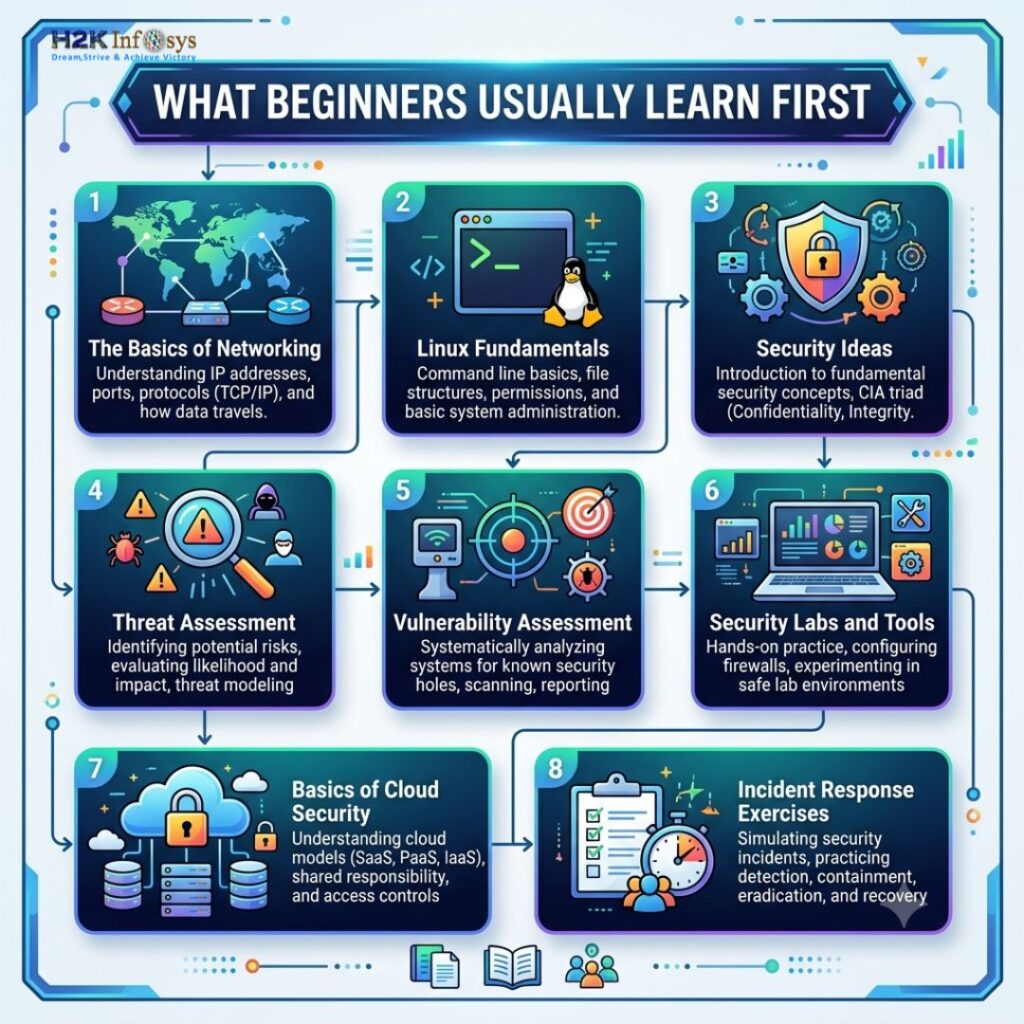
Most people imagine cybersecurity as hacking screens and dramatic movie scenes. Reality is quieter than that.
It usually looks more like this at the beginning:
- The basics of networking
- Linux fundamentals
- Security ideas
- Threat Assessment
- Vulnerability assessment
- Security labs and tools
- Basics of Cloud Security
- Incident Response Exercises
Some students are initially worried because they hear words like penetration testing and think they need to know how to code.
Not necessarily.”
Some specialised roles will eventually require more advanced technical skills, but many entry-level pathways are focused on learning the basics first.
Think of it like learning to drive. Nobody starts on a racing track.
The Placement Assistance Part Actually Matters
This is where many beginners make mistakes.
People often compare course fees, class timings, and certification lists while completely overlooking career support.
Training alone does not automatically lead to employment.
The strongest cyber security training with placement programs usually include things like:
- Resume building
- Interview preparation
- Real-world projects
- Mock interviews
- Hands-on labs
- Employer connections
- Career guidance
I’ve seen learners finish technical modules confidently and then suddenly become nervous during interviews.
Oddly enough, explaining a security project to an interviewer can feel harder than building the project itself.
Placement support helps close that gap.
A Real-World Beginner Scenario
Imagine a recent graduate named Rahul.
Rahul completed a degree outside of computer science and wanted to move toward technology roles. Initially, he believed cyber security training with placement was only for experienced professionals.
He joined structured training, started learning networking and security fundamentals, worked on simulated labs, practiced incident scenarios, and built small projects.
The first few weeks were rough. Too many new terms. Too many tools.
Then things started making sense.
A few months later he was able to discuss attack patterns, explain security concepts, and participate in interviews with confidence.
Stories like this are becoming more common because cyber security jobs with training opportunities are creating clearer pathways into the industry.
The interesting thing is that many successful candidates do not begin as experts.
They become experts later.
Why H2K Infosys Stands Out for Beginners
For beginners looking for structured learning and career direction, H2K Infosys has become a recognizable option because the focus extends beyond theory-based instruction.
A lot of training providers teach concepts and leave learners to figure out the rest on their own. H2K Infosys takes a more complete approach by combining instructor-led learning, practical projects, real-world scenarios, and career-oriented support.
That matters because employers increasingly want candidates who can discuss actual experience, even if that experience comes from simulated projects and hands-on training environments.
The training approach is designed around helping learners move toward cyber security training with placement outcomes rather than simply completing a course and receiving a certificate.
For beginners especially, that difference can become important.
Current Industry Trends Beginners Should Know
Cybersecurity hiring continues evolving in interesting ways.
Cloud security skills are gaining attention because companies continue moving workloads into cloud environments.
Artificial intelligence is also spawning new security debates. Businesses are using more AI tools and security teams are becoming increasingly concerned about protecting AI systems and preventing misuse.
And there’s another trend I keep noticing, as well.
Fresh graduates that can demonstrate practical experience in an interview, often get noticed faster than those that simply list theoretical knowledge.
Employers often ask:
“What have you been working on?
That question appears a lot.
And it is usually where hands-on learners gain an advantage.
Final Thoughts
Beginners should not assume cybersecurity is locked behind years of experience. The industry has changed quite a bit. Structured programs now exist specifically to help new learners build practical skills and move toward real opportunities.
The bigger question may not be whether beginners can join.
The better question might be whether the training actually prepares them for the transition from learning to working.
Because that is where strong cyber security training with job placement support can make a noticeable difference.