Java continues to offer strong career opportunities in 2026, particularly in backend development, enterprise software, cloud computing, microservices, test automation and AI-enabled applications. Popular roles include Java backend developer, full-stack Java developer, Spring Boot developer, cloud Java engineer, DevOps engineer, automation test engineer and Java solutions architect.
To build a successful Java career, programmers need more than basic coding knowledge. Employers commonly look for skills in Core Java, Spring Boot, REST APIs, SQL, Git, testing, Docker and cloud platforms. Beginners can start with junior Java developer or testing roles and progress into senior development, architecture, cloud engineering or technical leadership as they gain experience.
Through H2KInfosys Java training, learners can explore the top Career Opportunities in Java, develop job-ready skills, and follow a structured learning path toward roles in backend development, full-stack development, cloud computing, automation testing, and enterprise applications.
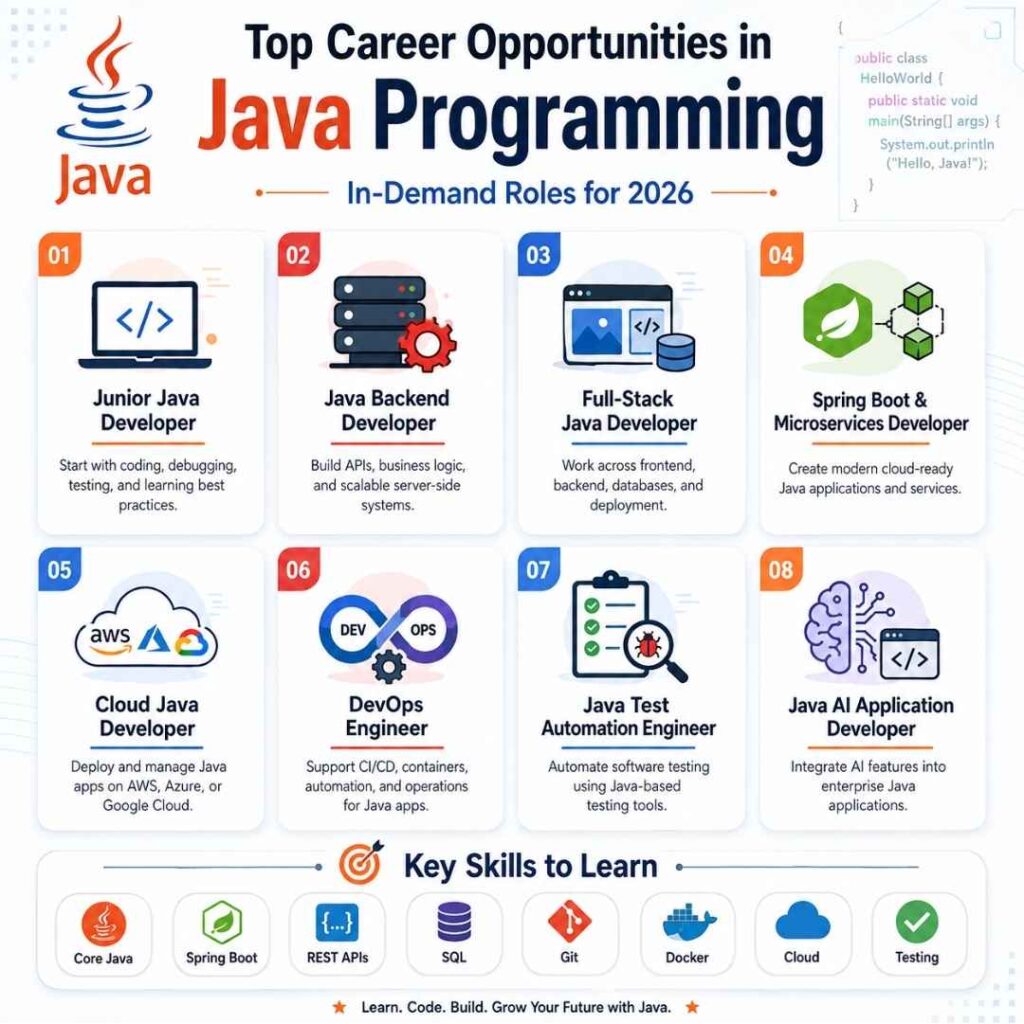
Top Career Opportunities in Java Programming
Scrum Master
Scrum masters are very important, especially in Software development. They work in an Agile environment which is a model in Software development and testing. The primary job of a scrum master is to organize and run a scrum meeting daily. It is the responsibility of a scrum master to resolve any blocker that might present itself. Java programming skills are essential for a scrum master. It also requires a few coordination skills and project management.
Agile methodologies are widely used among technology companies which makes it more important for scrum masters to take full advantage. But for a beginner in java programming who has taken interest in scrum, it is important to acquire a scrum certification and also a java certificate course online. You can also register for free java training and placement programs as scrum will be introduced there.
DevOps Engineer.
DevOps Engineer is developers who deal with managing the environment, automation, and improving the overall structure of software development. A DevOps Engineer has to be an experienced Java programmer having a career experience of about 4-6 years.
DevOps Engineers are software developers who are more interested in deployment and network operations. They also have a great passion for coding and scripting, and they move into the development side where they can improve the planning of trees and deployment.
There is no formal career path for becoming a DevOps Engineer, but you must have good experience in Java programming.
Junior Developer/ Programmer.
As a junior developer, you must know the popular programming language, Java inclusive. This position is the starting point for a beginner in Java programming. The responsibility of a junior developer or programmer is primarily to write, test, analyze, and fix (debug) code. They also take part in code reviews and technical documentation.
At this stage, you need to focus on the industry practices and know them. That is why having a leader or a mentor is recommended for you at this stage. You should also focus on improving your skills daily as a Java programmer since you are just starting. This is to make sure you move up the ranks in the company organizational structure as quickly as possible.
Obtaining a certificate at this stage is also an added advantage. So, taking java certificate courses online and learning java online with a certificate attached is recommended at this level. Also, attending free java training and placement programs can help you boost your java programming skill sets.
Senior Developer/ Senior Computer Java Programmer.
This is more of an advanced role of a junior developer. It can be described as taking charge (or overseeing) a complete project. This means that there are more responsibilities like mentoring the junior developers and programmers, training the users (whether internal or external users) on your improved computer code, amongst others. A senior developer is also involved in writing codes and having to report to higher authorities like the executive officers or the managers. Finally, the constant job of a senior developer involves transitioning to an additional social control track, but additional education and certification are required to get to this level.
A junior developer that is consistent in improving in java programming skills will be promoted to a senior developer within no time. That is why it is important to keep honing your java programming abilities daily.
Java Architect.
The primary role of a java architect is to design and develop the layout of a java application or software. Their job is to categorize the various logic layers that further improve the separation of concerns among the team members involved in a project. A java architect thinks of the best technologies that can be effectively used for the software that is to be developed, and ensures that they are compatible with one another.
Also, a java architect is responsible for interfacing with the purchases and shoppers of your computer code, the general design of the system, and collection and analyzing necessities of the written code.
Considering this job role, it is said that a person must have a minimum of 10 years of experience in java programming. It is considered as one of the advanced levels in java job opportunities.
Java Web Developer.
A Java web developer is responsible for deploying and maintaining server-side code. Apart from the knowledge of java programming, cloud computing knowledge is required for this role and this is due to the growing culture of cloud-based systems.
Java Backend Developer
A Java backend developer builds and maintains the server-side part of a web or mobile application. The developer creates APIs, processes user requests, connects applications to databases and implements business logic.
Important skills for this role include Core Java, Spring Boot, REST APIs, SQL, Hibernate, JPA, Git and unit testing. Java backend development is one of the most suitable career paths for beginners because Java is extensively used for building reliable and scalable server-side applications.
Full-Stack Java Developer
A full-stack Java developer works on both the frontend and backend of an application. Java and Spring Boot are commonly used for backend development, while HTML, CSS, JavaScript, React or Angular may be used for the frontend.
Full-stack developers can create user interfaces, develop APIs, work with databases and deploy complete applications. This role is suitable for programmers who want to understand the entire software-development process.
Spring Boot and Microservices Developer
Spring Boot is one of the most important technologies for modern Java development. It helps developers build web applications, REST APIs and enterprise systems more efficiently.
A microservices developer divides a large application into smaller, independent services. These services can be developed, tested and deployed separately. Useful skills for this career include Spring Boot, Spring Cloud, Docker, Kubernetes, Kafka, Redis, API gateways and distributed-system concepts.
Cloud Java Developer
A cloud Java developer builds, deploys and manages Java applications on cloud platforms. The role may involve cloud databases, containers, serverless services, application monitoring and automated deployment.
Java programmers interested in this field should learn at least one major cloud platform, along with Docker, Kubernetes, Linux and continuous integration and deployment practices.
Java Test Automation Engineer
Java is also widely used in software testing. A Java test automation engineer writes programs that automatically test websites, APIs and software applications.
Common skills and tools for this role include Java, Selenium, JUnit, TestNG, REST Assured, API testing and CI/CD tools. This can be a suitable career option for programmers who enjoy identifying defects and improving software quality.
Java AI Application Developer
Artificial intelligence is creating new opportunities for Java programmers. Java developers can build applications that connect with AI services, analyze documents, automate customer support and add intelligent features to enterprise software.
Developers interested in this career should understand Java APIs, Spring Boot, databases, cloud services, data security and AI integration. They do not necessarily need to become machine-learning researchers, but they should understand how AI models can be safely integrated into business applications.
Is Java Still a Good Career in 2026?
Java remains a strong career choice in 2026 because it is widely used in enterprise software, banking systems, e-commerce platforms, cloud applications, web services and large-scale backend systems. Many companies continue to develop new Java applications while also maintaining and modernizing existing systems.
However, learning only basic Java syntax may not be enough to secure a job. Employers often expect Java developers to understand frameworks, databases, APIs, testing, version control and cloud technologies. Beginners should therefore combine Java knowledge with practical projects and related technical skills.
Skills Required for a Java Career in 2026
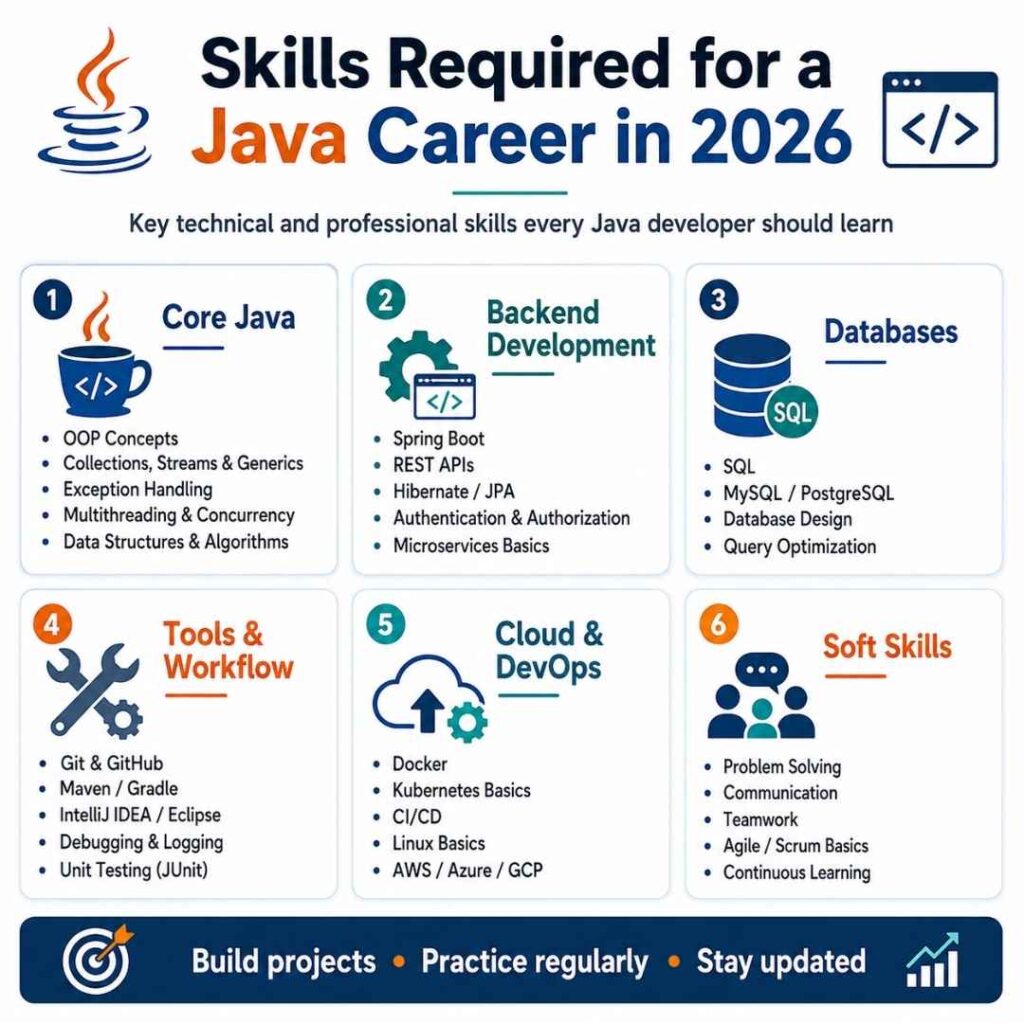
To improve your employment opportunities,Career Opportunities in Java you should develop skills in the following areas:
- Core Java and object-oriented programming
- Collections, streams and exception handling
- Data structures and algorithms
- Spring Boot and REST APIs
- SQL and relational databases
- Hibernate and JPA
- Git and GitHub
- Maven or Gradle
- Unit and integration testing
- Docker and basic cloud deployment
- Debugging and problem-solving
- Communication and teamwork
Learning these skills will help you move beyond basic programming and become prepared for professional Java-development roles.
Java Developer Roadmap for Beginners
A beginner can follow this learning path Career Opportunities in Java:
- Learn Java syntax, variables, loops, methods, classes and objects.
- Understand object-oriented programming, collections, exceptions and streams.
- Learn SQL and connect Java applications to a database.
- Study Spring Boot and create REST APIs.
- Learn Git, GitHub, Maven or Gradle.
- Practise unit testing, debugging and code reviews.
- Learn Docker and basic cloud deployment.
- Build and publish practical Java projects.
Beginners should avoid trying to learn every technology at the same time. Start with Core Java, move to backend development and gradually add advanced technologies.
Java Projects for Your Portfolio
Practical projects can make your résumé stronger and demonstrate your programming ability. Suitable Java project ideas include:
- Expense-tracking application
- Library-management system
- Employee-management application
- E-commerce backend
- Online booking system
- Job portal
- Authentication and authorization service
- Banking application
- Real-time notification system
- Cloud-deployed Spring Boot application
For every project, include clean source code, a README file, database details, testing instructions and an explanation of the technologies used.
Are Java Certifications Necessary?
A Java certification can provide structured learning and may improve a beginner’s résumé. However, a certificate alone does not guarantee employment.
Employers also evaluate coding ability, practical projects, problem-solving skills, communication skills and knowledge of software-development practices. For this reason, certification should be combined with regular coding practice, portfolio projects and interview preparation.
How to Choose the Right Java Career
Choose a Career Opportunities in Java based on your interests and strengths. Backend development may suit you if you enjoy APIs, databases and business logic. Full-stack development may be appropriate if you also enjoy building user interfaces. Cloud and DevOps roles are suitable for people interested in automation, deployment and infrastructure. Testing roles may appeal to programmers who enjoy finding defects and improving application quality.
The best approach is to learn the fundamentals, build several projects and explore different areas before choosing a specialization.
Conclusion
The Career Opportunities in Java continue to grow as businesses rely on Java for enterprise applications, cloud solutions, web development, and Android technologies. Whether you are a beginner or an experienced developer, learning Java can open doors to roles across industries such as finance, healthcare, e-commerce, and technology. Building strong programming skills, working on real-world projects, and staying updated with modern Java frameworks will improve your career prospects. If you’re planning a long-term career in software development, investing in Java skills today can help you take advantage of the many Career Opportunities in Java available in 2026 and beyond.
FAQs About Career Opportunities in Java
1. What are the best career opportunities in Java in 2026?
Some of the top career opportunities include Java Developer, Full Stack Developer, Backend Developer, Software Engineer, Cloud Developer, and Microservices Developer.
2. Is Java still a good career choice in 2026?
Yes. Java remains one of the most in-demand programming languages for enterprise applications, cloud computing, fintech, and Android development.
3. What skills are needed to build a successful Java career?
You should learn Core Java, Spring Boot, Hibernate, SQL, REST APIs, Git, Maven, cloud platforms, and basic DevOps concepts to improve your job prospects.
4. What industries hire Java professionals?
Java professionals are hired across banking, healthcare, e-commerce, telecommunications, government, education, and software development companies.
5. How can beginners prepare for career opportunities in Java?
Beginners should master Java fundamentals, build hands-on projects, practice coding regularly, learn popular frameworks, and gain practical experience through internships or online training.