
In object-oriented programming, a class serves as a blueprint for creating objects, encapsulating data and methods that operate on that data. You would create a class when you need to model real-world entities, allowing for the organization and reuse of code. Additionally, classes facilitate the implementation of inheritance and polymorphism, which are essential for creating flexible and scalable software systems. Establishing a class is particularly beneficial when a clear structure is needed to manage complex relationships and behaviors within an application.
Classes are an integral part of OOP. You deal with classes all the time when using Java, Smalltalk, or any OOP language. In fact, there is no option to declare variables outside a class in Java. So, let’s see what classes are and the properties of classes in OOP. For Java online training, we suggest our rigorous 100-hour Java program at H2K Infosys.
What is a Class?
A class serves as a blueprint for creating objects in object-oriented programming, encapsulating data and related functions into a single entity. Each class defines attributes and methods that characterize the objects instantiated from it, promoting modularity and ease of maintenance. The concept of classes also enhances code readability and facilitates collaboration among developers by providing a clear framework for data organization. Understanding the properties and functionalities of classes is crucial for effective software development in any OOP context.
Let us quote an example of a bicycle to explain what a class is.
There are many bicycles in this world. So, in OOP by creating a ‘bicycle’ object you are creating one instance of a class of objects called bicycles.
Let’s see what we mean by that…
Now the bicycles have many parts like current gear, wheels, current cadence, brake, etc. Similarly, it has behavioral aspects like change gears, apply the front brake, rear brake, so on.
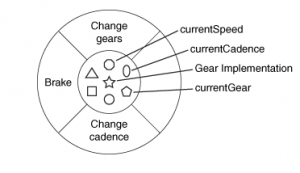
Here in the OOP, the parts are the variables and the behavior of the bicycle can be referred to as methods.
Now, the ‘class’ of bicycles is like a blueprint, and your bicycle or a bicycle in its form is an ‘object’ made out of that blueprint.

[box type=”success” align=”center” class=”” width=””]Definition of class: A class is a collection of variables and methods common to all the objects of a certain kind.[/box]
Once you have created a bicycle class, you can create as many objects or instances of that class meaning bicycles from that blueprint.
Class vs Object
In the above illustrations, the yellow ones are the objects and the clear one is the class. Although, both the illustrations look similar, the blueprint of the bicycle is not a bicycle itself. An object is one instance of the class and as many objects as the developer wants can be created in the development process.
Rules of creating Classes in OOP
Classes are the fundamental concepts of OOP. Developers should abide by the following rules for the successful implementation of object-oriented programing.
- Use meaningful class names and word Class is a keyword.
- Class variables are the attributes of the class.
- Instance variables refer to the attributes of one instance of the class.
- Private variables and private methods are specific to only the object they are contained in.
- Public variables and methods are accessible by all classes within that package.
- Protected variables and protected methods are accessible by that class and its subclasses.
- Classes should be extendable to any classes without modifying them.
- Derived classes should act as substitutes for their superclass.
Java programming for beginners as well as advanced concepts are a part of our 100-hour online training program at H2K Infosys. Check out our website www.h2kinfosys.com for further details.