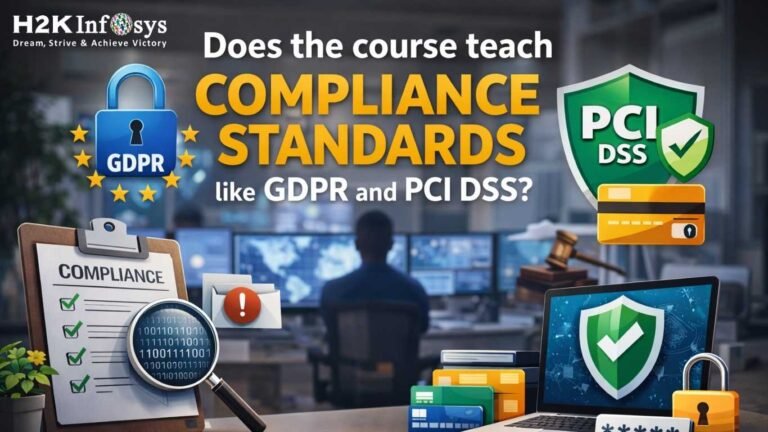
Yes, most modern, industry-relevant cybersecurity courses including programs aligned with H2K Infosys training approaches do teach compliance standards like GDPR and PCI DSS, because companies today cannot separate security operations from regulatory compliance. In real job environments, security teams constantly align technical controls with legal and industry requirements, so any practical training program usually includes compliance fundamentals alongside security tools and threat detection.
Why Compliance standards Is Now a Core Part of Cybersecurity Training
If I’m being honest, a few years ago many entry-level programs barely touched compliance standards. They focused more on hacking tools or vulnerability scanning. But in 2026, things feel very different.
Organizations are under intense pressure to prove they are protecting customer data properly. Whether it’s European user data under GDPR or payment card data under PCI DSS, companies face huge fines and reputation damage if they get compliance wrong.
That’s why strong cybersecurity training and placement programs now include compliance as a practical skill not just theory you memorize for exams.
From what I’ve seen across real project environments, security teams are expected to:
- Understand regulatory requirements
- Map controls to frameworks
- Document security processes
- Support audits
- Work with legal and compliance teams
It’s less “just technical hacking” and more “business + security + legal working together.”
What You Typically Learn About GDPR in Cybersecurity Courses
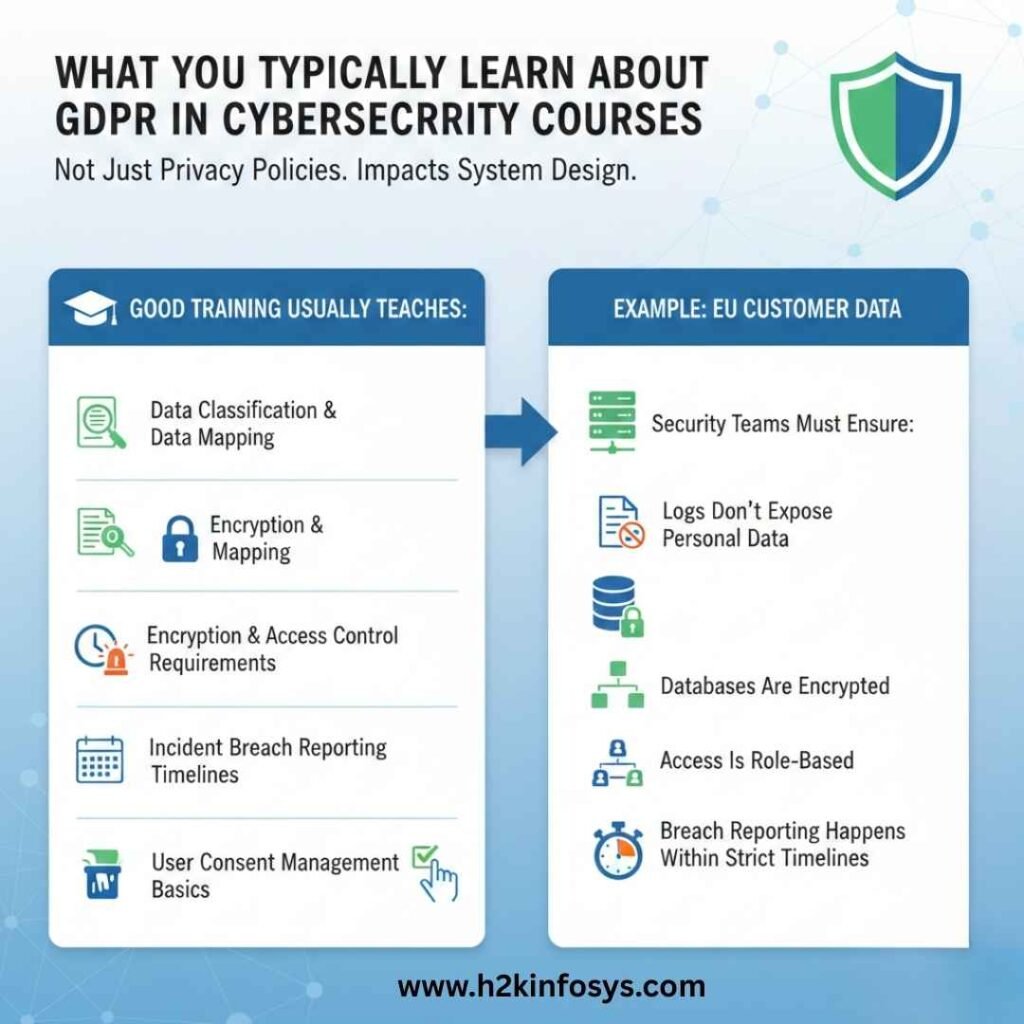
GDPR isn’t just about privacy policies. In real jobs, it directly impacts how systems are designed.
Good training usually teaches:
- Data classification and data mapping
- Encryption and access control requirements
- Incident breach reporting timelines
- Data retention policies
- User consent management basics
For example, if a company stores EU customer data, security teams must ensure:
- Logs don’t expose personal data
- Databases are encrypted
- Access is role-based
- Breach reporting happens within strict timelines
I remember working on a project where even log files had to be reviewed because IP addresses counted as personal data under GDPR. Small details like that matter in real security jobs.
How PCI DSS Fits Into Real Security Job Skills
PCI DSS is especially important for companies handling credit card transactions eCommerce, fintech, SaaS billing platforms, even healthcare payment portals.
In hands-on labs inside strong cyber security jobs with training aligned courses, learners usually practice:
- Network segmentation for card data environments
- Secure payment processing architecture
- Vulnerability scanning and patching cycles
- Access control for payment systems
- Security monitoring and logging
Real-world scenario example:
If a company processes credit card payments, security teams must prove systems are segmented so attackers can’t easily move from a web server to the payment database.
That’s not a theory. That’s daily operational work.
Why Compliance Skills Improve Job Placement Chances in 2026
This is something many learners don’t realize at first.
Companies don’t just hire people who can run tools. They hire people who understand:
- Risk
- Regulations
- Business impact
- Security governance
That’s why many employers specifically look for candidates from cyber security sales training aligned programs or compliance-aware security tracks because those candidates can explain security value in business language.
Honestly, hiring managers love candidates who can say:
“Here’s the vulnerability and here’s the compliance standards risk if we ignore it.”
That shows maturity.
Practical Industry Trend: Compliance + Security + AI Monitoring
In 2026, compliance standards and automation meet as the use of AI drives monitoring.
Many organizations now use:
- AI log monitoring for compliance proof
- Automated audit report generation
- Continuous compliance dashboards
- Real-time risk scoring
Security teams are transitioning from “annual compliance standards check” to “continuous compliance posture.”
That shift is huge.
How Most Courses Teach Compliance in Practice (And Not Just Theory)
A strong program does not merely explain regulations. They simulate work environments.
- Typical hands-on learning includes:
- Mock audit preparation
- Risk assessment worksheets
- Compliance standards gap analysis exercises
- Security policy writing practice
- Incident response compliance reporting
These are the very kinds of tasks that entry-level analysts often perform in actual jobs.
Common Mistake Learners Make About Compliance Training
Some students think compliance standards is boring or only for auditors.
But honestly, compliance standards knowledge often helps beginners enter cybersecurity faster because:
- Many entry roles involve documentation + monitoring
- SOC roles require compliance standards awareness
- GRC roles are growing fast
- Cloud security needs regulatory mapping
I’ve seen people move into security careers through compliance standards-focused roles first then move deeper into technical areas.
Final Thought
If a course claims to prepare you for real security careers but skips GDPR, PCI DSS, or similar frameworks that’s honestly a red flag.
Modern cybersecurity roles blend:
Technical skills
Risk thinking
Compliance knowledge
Business communication
And the industry is only moving further in that direction.
If you’re planning a cybersecurity career in 2026, learning compliance standards isn’t extra. It’s part of the foundation.