SQL is not just important for a Data analyst today it’s practically non-negotiable. If you can’t query, filter, and manipulate data directly, you’ll struggle to keep up with real-world analytics work, no matter how good your dashboards look.
Why SQL Still Sits at the Core of Every Data Analyst Role
Here’s the thing most beginners don’t realize early on tools change fast, but SQL doesn’t. I’ve seen people jump from Excel to Power BI to Python in a few months, but SQL? It sticks. It’s like the common language between databases and analysts.
In almost every Data analyst job description today, SQL shows up as a “must-have.” Not “nice to have.” Not “optional.” That alone tells you something.
And honestly, it makes sense. Companies are sitting on massive datasets. Whether it’s customer transactions, app usage, or marketing data you need SQL to actually get that data before you analyze it and that’s exactly why a well-structured Data Analytics course emphasizes hands-on SQL from the very beginning.
Real-World Scenario: Where SQL Becomes Essential
Let’s say you’re working as a Data analyst in an e-commerce company.
Your manager asks:
“Can you find why our conversions dropped last week?”
Now, without SQL, you’re stuck waiting for someone from the data engineering team. With SQL? You jump straight into the database:
- Pull last week’s sales data
- Compare it with previous weeks
- Filter by traffic source or product category
- Identify the drop
That speed that independence is exactly why SQL is so critical.
The Shift in 2026: Data Analysts Are Expected to Be More Technical
The expectations from a Data analyst have changed a lot in recent years.
A few years ago:
- Excel + basic reporting = enough
Now:
- SQL + dashboards + data storytelling + basic Python = expected
Companies want analysts who don’t just consume data but can extract and shape it themselves. And that’s where SQL plays a central role.
Even with AI tools becoming popular, they still rely on structured queries underneath. So yeah, SQL isn’t going anywhere.
How Much SQL Does a Data Analyst Really Need?
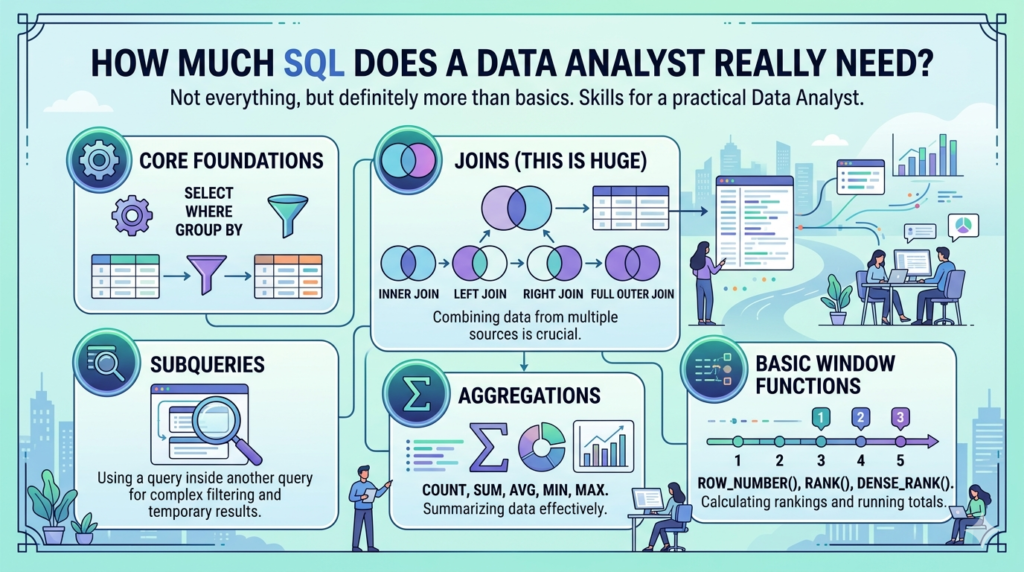
Good question and the answer is: not everything, but definitely more than basics.
A practical Data analyst should be comfortable with:
- SELECT, WHERE, GROUP BY
- JOINs (this is huge)
- Subqueries
- Aggregations
- Basic window functions
You don’t need to be a database engineer, but you do need to think like someone who understands how data is structured.
SQL vs Other Tools: What Matters More?
People often ask:
“Can I skip SQL if I know Power BI or Tableau?”
Short answer: not really.
Visualization tools are great but they sit on top of data. SQL is what helps you shape that data correctly before visualizing it.
A strong Data analyst uses:
- SQL → to extract and clean data
- Excel/Python → to analyze
- BI tools → to present
Skipping SQL is like trying to cook without preparing ingredients first.
Industry Insight: What Hiring Managers Look For
From what I’ve seen (and heard from hiring teams), when they evaluate a Data analyst, they often test SQL skills first.
Why?
Because SQL proves:
- You understand data structures
- You can solve problems logically
- You can work independently with raw data
Some companies even include live SQL tests during interviews. That’s how seriously it’s taken.
Learning SQL the Right Way (Not Just Theory)
This is where many learners struggle. Watching tutorials is easy but writing queries from scratch? That’s where things get tricky.
If you’re planning to become a Data analyst, structured learning really helps. A good Data Analytics course should include:
- Real datasets (not just dummy examples)
- Business problem scenarios
- Hands-on SQL practice
- Project-based learning
That’s exactly where platforms like H2K Infosys stand out.
Why H2K Infosys is a Strong Choice for SQL & Data Analytics Training
If you’re serious about becoming a Data analyst, choosing the right training matters more than you think.
H2K Infosys focuses heavily on practical learning rather than just theory. In their Data analyst online classes, you don’t just learn SQL commands you actually use them in real-world scenarios.
A Quick Reality Check: Can You Become a Data Analyst Without SQL?
Technically? Maybe.
Practically? Very unlikely.
You might land an entry-level role with minimal SQL, but growth will be slow. Every experienced Data analyst I’ve come across eventually relies on SQL heavily.
So skipping it now just delays the inevitable.
Final Thoughts
SQL is not just a skill it’s the backbone of what a Data analyst does daily. From pulling raw data to uncovering insights, it plays a role at every stage.
If you’re planning to enter this field, don’t treat SQL as optional. Learn it properly, practice consistently, and apply it in real scenarios.
And if you want a smoother path, enrolling in a structured Data Analytics course like the one offered through Data analyst online classes at H2K Infosys can give you that practical edge that most self-learners struggle to build.
Because at the end of the day, being a Data analyst isn’t about knowing tools it’s about knowing how to use data to answer real questions.