Introduction
A good data analytics program prepares you for the real working world by teaching you how businesses actually use data to make decisions, solve problems, and improve profits. It’s not just about learning charts or formulas anymore. Companies want people who can look at messy information, figure out what matters, and explain it in a way normal teams can understand.
That’s one reason interest in Data Analytics Program has gone through the roof lately. Businesses in healthcare, finance, retail, cybersecurity, even sports management, are relying heavily on analytics now. And honestly, the hiring demand feels very different compared to even a few years ago.
I was talking to someone recently who switched from customer support into analytics after taking a structured Data analysis course online, and one thing stood out from their experience: employers cared much more about practical projects than perfect academic scores. That’s becoming pretty common.
Why Companies Care So Much About Data Analytics Right Now
Businesses collect insane amounts of data every single day.
Customer behavior. Sales reports. Website traffic. Ad performance. Inventory movement. Subscription cancellations. Support tickets.
The problem isn’t collecting data anymore. The real challenge is figuring out what to do with it.
That’s where trained analysts come in.
A retail company might want to know why online sales suddenly dropped in one region. A hospital may need forecasting models for patient demand. A cybersecurity firm could use analytics to detect unusual behavior patterns before a breach happens.
These aren’t theoretical classroom situations. They’re everyday business problems.
Good analytics professionals help companies make faster and smarter decisions instead of relying on assumptions.
What You Actually Learn in a Data Analytics Program
A lot of beginners assume analytics training is mostly about spreadsheets.
It’s really not.
Modern Data Analytics Program usually focus on a mix of technical skills, business thinking, and hands-on problem solving.
Learning Industry Tools That Employers Already Use
Most programs train students on tools companies actively use in day-to-day operations.
That often includes:
- SQL
- Python
- Tableau
- Power BI
- Excel
- Google Looker Studio
- Basic cloud analytics platforms
But the important part is how you use them.
For example, instead of simply memorizing SQL commands, students might work on a mock e-commerce database and answer real business questions like:
- Which products are generating the highest revenue?
- Why are customers abandoning carts?
- Which locations are underperforming?
That kind of project work matters because employers usually ask scenario-based questions during interviews.
Data Cleaning: The Skill Nobody Talks About Enough
This surprises a lot of new learners.
People imagine analysts spending all day building beautiful dashboards.
Reality? A huge amount of time goes into cleaning messy data.
Missing records. Duplicate entries. Broken formatting. Incomplete customer information.
Pretty normal stuff.
Strong data analytics certification courses prepare students for this because companies need analysts who can work with imperfect data, not just ideal classroom datasets.
And honestly, this is usually where beginners struggle in their first real projects.
Programs Also Teach You Business Thinking
One thing that separates average analysts from valuable analysts is business understanding.
A company doesn’t care about charts just for the sake of charts.
They care about answers.
Why are customers leaving? Why did revenue dip last quarter? Which marketing campaign performed best? What products should be discontinued?
A solid Data Analytics Program teaches students how to connect data findings to business decisions.
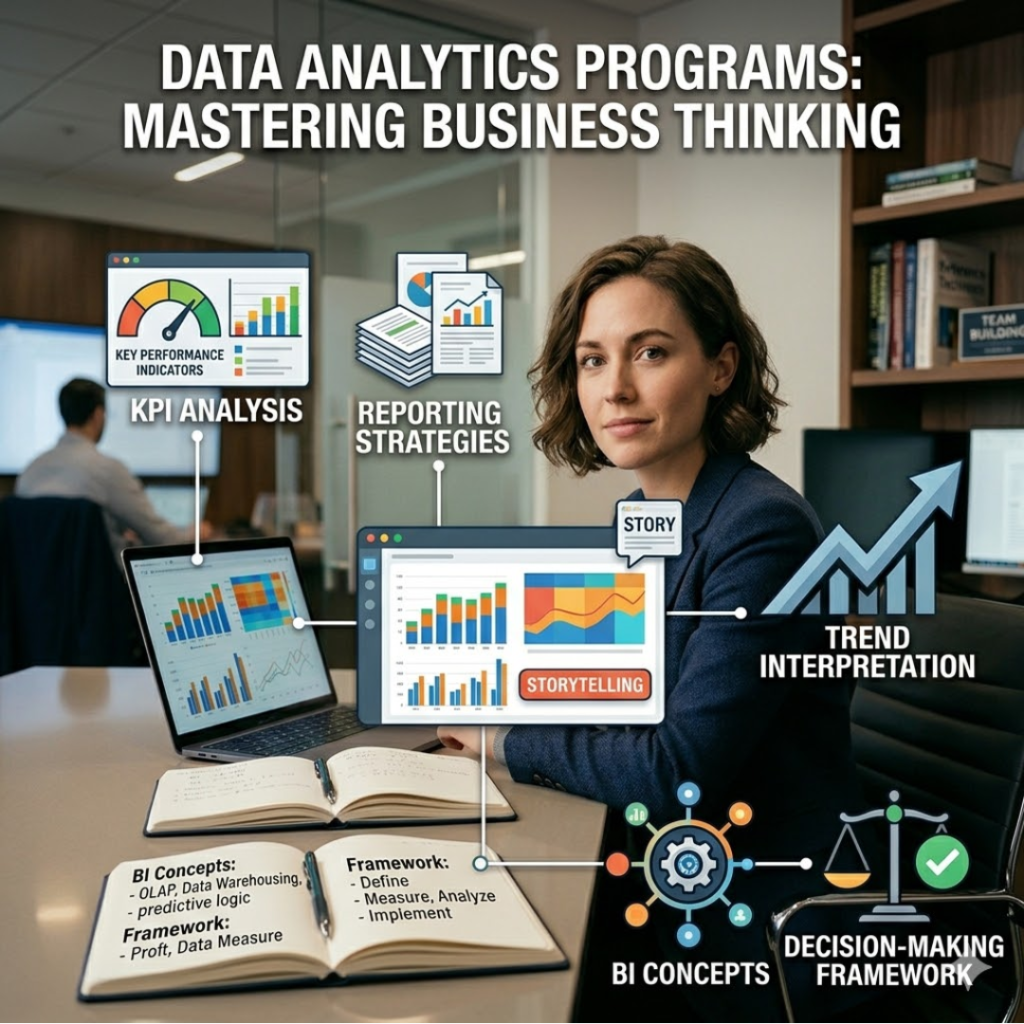
That includes:
- KPI analysis
- Reporting strategies
- Dashboard storytelling
- Trend interpretation
- Business intelligence concepts
- Decision-making frameworks
This part is huge because many entry-level learners focus only on coding and forget that communication matters just as much.
I’ve personally seen candidates with average technical skills get hired because they explained business insights clearly during interviews.
Why Certifications Still Matter in 2026
No, certifications alone won’t magically get someone hired.
But they absolutely help when backed by practical experience.
Recruiters often use certifications as proof that candidates:
- Completed structured learning
- Worked on projects
- Understand analytics basics
- Learned industry tools
- Stayed current with market trends
This is especially true now that remote hiring has become more common globally.
Companies receive hundreds of applications for Data Analytics Program positions. Certifications can help resumes survive the first screening stage.
That’s why many learners look for job-oriented Data Analytics Program like H2K Infosys that include hands-on projects, mentorship, and interview preparation instead of only recorded theory sessions.
AI Is Changing Analytics Jobs, But Not Replacing Analysts
This topic comes up constantly now.
With AI tools becoming smarter, people wonder whether analytics jobs are disappearing.
Not really.
The role is evolving.
AI tools can automate repetitive reporting tasks, generate quick summaries, and even suggest trends. But businesses still need humans who understand context.
Someone still has to:
- Verify data quality
- Interpret results
- Ask the right business questions.
- Explain findings to leadership.
- Catch misleading conclusions
That’s why modern data analytics programs are increasingly introducing students to AI-assisted analytics workflows.
Things like:
- Predictive analytics
- AI-powered dashboards
- Automated reporting systems
- Prompt engineering basics
- Responsible AI usage
The analytics professionals adapting to AI tools are usually the ones growing fastest in their careers right now.
Skills You Build Through a Data Analytics Program
A proper Data Analytics Program develops both technical and professional skills.
Technical Skills
- SQL querying
- Python data analysis
- Dashboard creation
- Data visualization
- Statistical analysis
- Spreadsheet modeling
- Data cleaning
- Reporting automation
Professional Skills
- Problem solving
- Communication
- Analytical thinking
- Presentation skills
- Business reporting
- Decision-making support
A lot of hiring managers care deeply about communication now.
A data analytics program must explain findings in simple language; otherwise, the insights do not significantly benefit the business.
What Career Opportunities Open Up?
This is one of the biggest reasons people join analytics programs in the first place.
Data analytics continues to be one of the stronger career transition fields because demand exists across multiple industries.
Common job roles include:
- Data Analyst
- Business Analyst
- Reporting Analyst
- Operations Analyst
- BI Developer
- Product Analyst
- Junior Data Scientist
Companies in finance, healthcare, SaaS, retail, logistics, and cybersecurity are all hiring analytics professionals aggressively because data-driven decision making has become essential.
And salaries have remained fairly competitive compared to many other entry-level tech paths.
Common Mistakes Beginners Make While Learning Analytics
A few patterns show up over and over.
Watching Tutorials Without Building Projects
A lot of people spend months consuming videos but never actually solving business problems.
That usually backfires during interviews.
Employers want to see:
- Dashboards
- SQL projects
- Business case studies
- Portfolio work
- Real analysis examples
Ignoring SQL
This happens constantly.
People jump directly into AI tools or Python while skipping SQL.
Big mistake.
SQL is still one of the most requested analytics skills globally.
Avoiding Messy Real-World Data
Practice datasets are clean and easy.
Real business data usually isn’t.
Structured programs help students learn how to handle that reality through guided projects and simulations.
Why Structured Training Helps Career Changers
Self-learning works for some people.
But honestly, many learners struggle because there’s no roadmap.
They jump between random YouTube tutorials, outdated blogs, and disconnected lessons.
A structured program typically gives:
- Clear learning paths
- Project-based assignments
- Mentor support
- Mock interviews
- Resume guidance
- Career preparation
That support system can make a huge difference, especially for working professionals trying to transition careers.
If someone is serious about entering Data Analytics Program professionally, structured learning often shortens the confusion phase dramatically.
That’s one reason many learners explore programs from H2K Infosys Data Analytics Program because the training focuses heavily on practical industry exposure and job readiness.
Build a Portfolio Earlier Than You Think
One practical tip that genuinely helps?
Start building projects early.
Even small projects can strengthen a resume.
Some good beginner project ideas include:
- Customer churn analysis
- Sales trend dashboards
- Marketing campaign analysis
- Inventory forecasting
- Financial reporting dashboards
- Website traffic analysis
Recruiters usually care more about seeing problem-solving ability than perfect theory knowledge.
Related Topics You Can Also Explore
If you want to build deeper expertise in analytics, you can also explore topics like:
- “Best SQL Skills for Data Analysts in 2026”
- “How to Build a Data Analytics Portfolio That Gets Interviews”
- “Data Analytics vs Data Science: What’s the Real Difference?”
These topics naturally connect with data analytics certification courses and help learners build broader industry knowledge.
FAQs
Are online data analytics courses worth it in 2026?
Yes, especially programs that include live projects, mentorship, and practical business case studies. Employers mainly care about real skills and project experience.
Can beginners join a Data analysis course online?
Absolutely. Many beginner-friendly programs start from fundamentals before moving into SQL, Python, dashboards, and analytics projects.
Do I need coding experience before joining a Data analysis course online?
No. Most beginner-friendly programs start with fundamentals and gradually introduce SQL, Python, and analytics tools.
Which industries hire data analysts the most?
Healthcare, finance, retail, cybersecurity, SaaS, logistics, and e-commerce are among the strongest hiring sectors right now.
What is the average salary after completing analytics classes online?
Salaries depend on experience and location, but certified analysts with practical project experience generally see strong entry-level opportunities and long-term career growth.
Final Thoughts
Data analytics has shifted from being a niche technical skill to a core business capability. Companies today need professionals who can interpret information clearly, spot trends quickly, and help leaders make smarter decisions.
The biggest advantage of joining a strong analytics program isn’t just learning tools it’s gaining the confidence to solve real business problems using data.
And if you’re planning to transition into analytics seriously, choosing practical, project-based training with mentorship and career support can make the process much smoother. Programs from H2K Infosys are often considered by learners looking for that balance between technical depth, hands-on experience, and job readiness.
The field is moving fast. Starting now gives you a much better chance to grow alongside it rather than trying to catch up later.