Introduction
If you want to become a data analyst program in the USA in 2026, the most practical and fastest way to do so is to build strong analytical skills, become proficient with industry-standard tools, work on real-world projects, and obtain a recognised certification. Today’s employers want more than degrees. They want candidates who can interpret data, solve business problems, and have hands-on experience.
The need for skilled data analysts is growing in industries such as healthcare, finance, retail, logistics, manufacturing, and technology. The industry’s recent hiring trends show that organisations are hiring more professionals who can turn raw data into useful insights. If you are a fresh graduate, an IT professional, or someone looking to switch careers, this guide will tell you exactly how to become a successful data analyst in the USA.
Why is Data Analytics one of the best careers in 2026?
Organisations generate huge quantities of data every day. It’s no longer about finding data; it’s about finding people who know how to read it.
That’s precisely why data analysts have become some of the most in-demand professionals in the United States.
Companies employ data analysts to:
- Improve the customer experience.
- Lower operational costs
- Predict upcoming business trends.
- Drive revenue
- Improve marketing campaigns
- Develop AI-driven business strategies.
The rise of artificial intelligence has not diminished the need for data analysts – it has increased it. Analytical professionals are even more valuable because AI needs clean, structured, and meaningful data.
What a Data Analyst Does
A data analyst collects, cleans, analyses and visualises data to help organisations make better decisions.
Responsibilities:
- Gathering business information
- Cleaning Inconsistent Data Sets
- Writing SQL querys
- Building dashboards
- Generating reports
- Statistical analysis
- Spotting business trends
- Sharing findings with interested parties
Rather than making assumption-based decisions, data supports every major business strategy for companies through analysts.
Skills That You Need To Become A Data Analyst
But before you go into the best courses on data analytics, know the skills employers are seeking.
Technical Skills
SQL
SQL is still the most in-demand skill in data analyst job postings.
You will use SQL to:
- Get data
- Records Filter
- Multiple table joins
- Aggregated information
- Make reports
Microsoft Excel
Excel is often underestimated. But it is still widely used in Fortune 500 companies.
Advanced Excel contains:
- Pivot Tables
- Power Query.
- Search Functions
- Charts
- Dashboards
- Data cleaning
Python
Python is now one of the most valuable programming languages for analytics.
Some common libraries are:
- Pandas
- Numpy
- Matplotlib
- Seaborn
- Sklearn
Python can automate repetitive tasks and analyse millions of records efficiently.
PowerBI
In the USA, Power BI is one of the most demanded visualisation tools.
You will learn to build:
- Interactive dashboards
- KPI Reporting
- Executive summaries
- Business Intelligence Report
Most employers are looking for a specific Power BI experience as decision-makers use dashboards to run day-to-day operations.
Tableau
Another leading visualisation platform that is used by enterprise organisations continues to be Tableau.
Analysts use Tableau to communicate insights clearly using interactive visual reports.
Statistiken
An analyst worth his salt knows:
- Media
- media
- standard deviation
- correlation
- regression
- probability
- Tests of hypothesis
Statistics helps analysts reach meaningful conclusions rather than guesswork.
Soft Skills Count Too
But technical knowledge alone is not enough.
Successful analysts also have:
- Communication skills
- Analytical thinking skills
- Business understanding
- Problem-solving skills
- Attention to detail
- Presentation Skill
- Effective Time Management
The hiring managers tend to like candidates who can translate complex findings into simple business terms.
How to Become a Data Analyst in USA – Step by Step Roadmap
Step 1: Learn the Basics
First, understand:
- Types of data
- Data base
- Business metrics
- Visualisation for Data Cleaning
- Some basic statistics
That’s what advanced analytics is all about.
Step 2: Join Online Analytics Courses
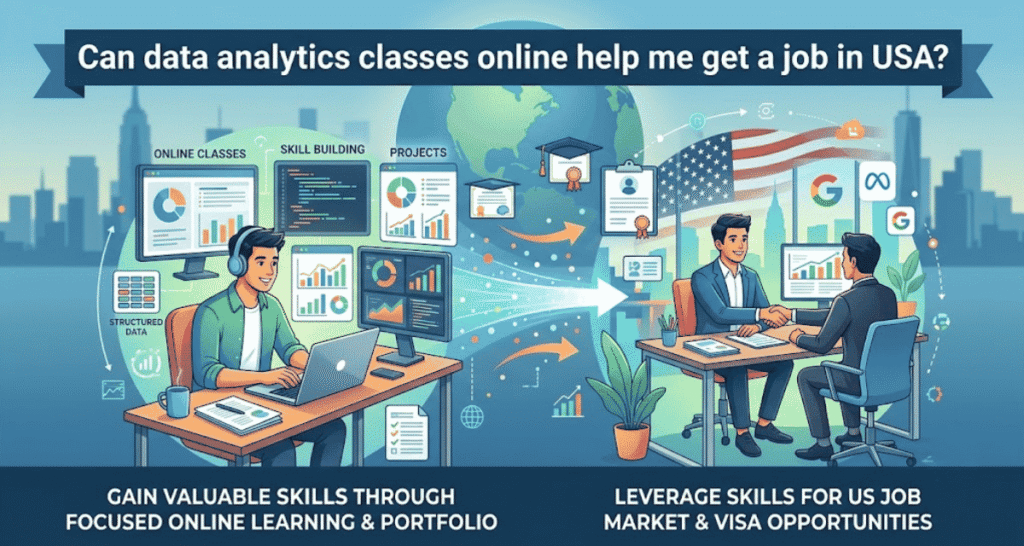
One of the biggest advantages in 2026 is that you don’t have to go to university full-time to learn data analytics.
The high-quality analytics classes online allow the learners to study from anywhere while working or attending college.
A structured learning program usually includes:
- SQL
- Excel
- Python
- Power BI
- Tableau
- Business Projects (Practical)
- Resume Writing
- Practice Interviews
The key is to choose a course which concentrates on practical application and not just theory.
Step 3: Do Actual Projects
Projects are often a huge differentiator in interviews.
Some examples are:
- Sales dashboard
- Customer churn study
- Healthcare analytics
- Performance of marketing campaigns
- Finance Reporting
- Supply Chain Analysis
Candidates are often asked to walk through the business problem, methodology and insights of their projects. A portfolio on GitHub or personal website can help to strengthen your profile.
Step 4. Create a Professional Portfolio
A good portfolio demonstrates you can solve real business problems.
Add:
- .sql Files
- Power BI dashboards
- Tableau dashboards
- Jupyter notebooks
- Excel dashboards
- Case study
Employers usually look at project work before setting up technical interviews.
Step 5: Get Data Analytics Certification Courses
Completing data analytics certification courses is proof that you have the technical skills and are committed to growing your career.
Quality certification programs usually consist of:
- Practical Labs
- Senior Projects
- Relevant curriculum in the industry
- Instructor support
- Interview Coaching
- Career Counselling
Certifications can be particularly useful for those looking to switch careers and who may not have the typical analytics background.
Step 6: Get Ready For Interviews
Most interviews will ask questions about:
- SQL Query
- Functions in excel
- Power BI dashboards
- Python code
- Statistics
- Case Studies in Business
Practise explaining your projects clearly, as interviewers will be looking at both technical skills and your ability to communicate.
Best Courses in Data Analytics For Jobs in USA
While reviewing the best data analytics courses, look for programs that offer practical experience relevant to what employers want.
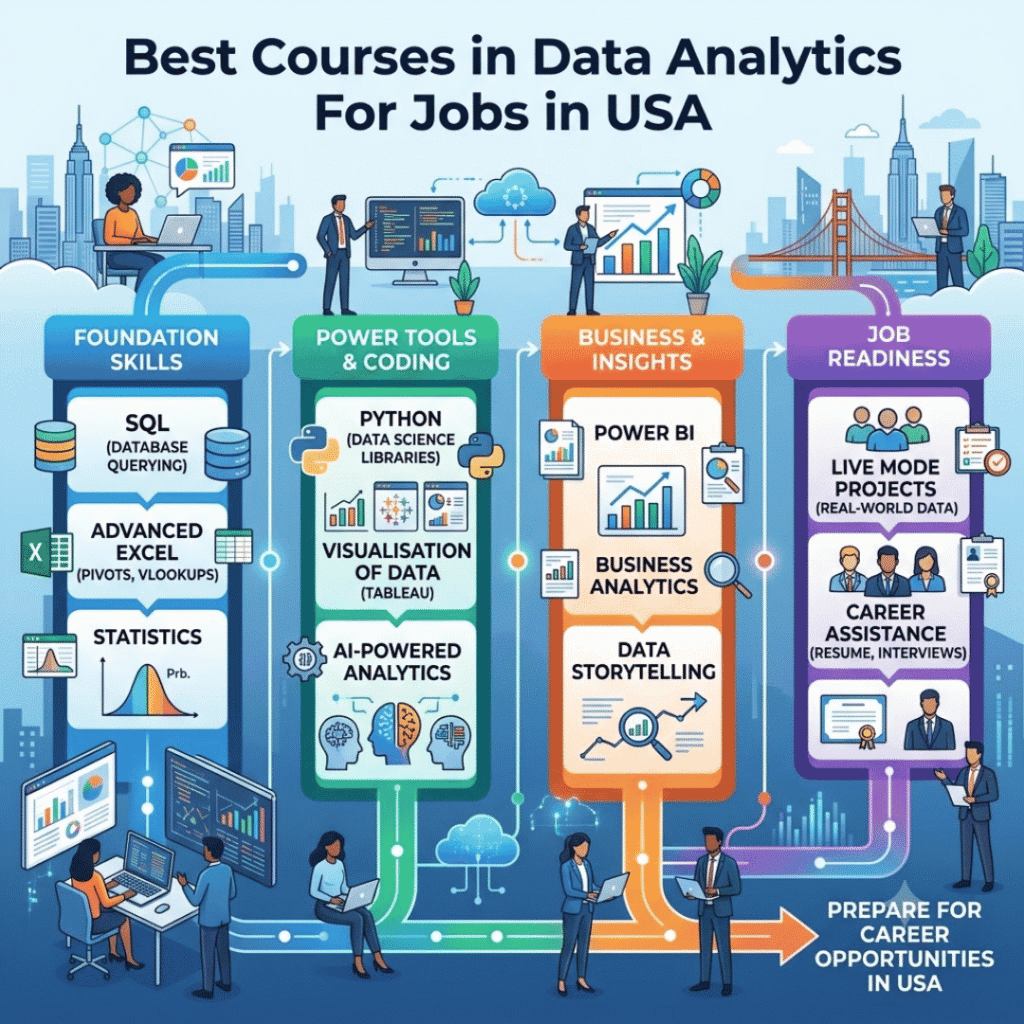
Look for classes that contain:
- SQL
- Excel (Advanced)
- Python
- Power BI
- Business analytics
- statistics
- Tableau
- Visualisation of data
- AI-Powered Analytics
- Live mode projects
- Career assistance
Stay away from programs that only offer recorded lectures without any hands-on practice or mentorship.
Why Employers Love Experiential Training
And even if many applicants do online courses, they don’t make it in a technical interview because they don’t have practical experience.
Employers seek candidates with:
- Created dashboards
- SQL queries
- Business case studies solved
- Worked with real data sets
- Key insights were presented to stakeholders
This is why project-based learning is becoming more important.
What are the career opportunities after Completing Data Analytics Training?
Potential roles with a data analytics background:
- Data Analyst
- Business Analyst
- Reporting Analyst
- Financial Analyst
- Marketing Analyst
- Operations Analyst
- Product Analyst
- Business Intelligence Analyst
- Visualisation of Data Specialist
With experience, you can move into roles such as Analytics Consultant, Data Scientist or Analytics Manager.
Salary Expectations in the US
Salaries vary based on location, experience level, and industry, but data analytics is still one of the higher-paying tech careers.
Earnings progression:
- Entry Level: $70,000 – $90,000
- Mid-Level: $90,000-$120,000
- Senior: $120,000-$150,000+
Salaries are often higher for professionals who are experienced in SQL, Python, Power BI and cloud analytics.
Mistakes Beginners Commonly Make
Many would-be analysts slow their progress by:
- Too much learning at once
- Disregard SQL
- Skipped Statistics
- Not Planning Projects
- Steering clear of interview practice
- Collecting certificates with no practical skills
The experience and consistency is so much more valuable than taking a bunch of random courses.
Why Learners Prefer H2K Infosys
If you’re looking to build a career in the USA, choosing the right training provider can make all the difference to your success.
H2K Infosys offers a structured learning pathway based on current employer needs. This program is not theoretical but practical; it focuses on hands-on skills, live projects, instructor-led sessions, and career preparation.
Some of the benefits are:
- Complete Course on SQL, Excel, Python, Power BI, Tableau, and Statistics
- Live instructor-led online classes in analytics.
- Practical projects with real business data
- Resume building help
- Interview mocks, placement assistance
- Flexible Study Timings for Working Professionals & Students
- Guidance from seasoned industry professionals
If you are someone who wants to get into analytics or wants to move to USA, then a structured training with placement support can go a long way in making the learning process better.
Advantages of Data Analytics Study
What are the benefits of learning data analytics in the long run?
- Robust industrial demand
- Excellent salary packages
- Exposure to work with AI & business intelligence tools
- Career path options
- Global career opportunities
- Good basis for senior roles like Data Scientist, Analytics Manager
If you are serious about building a career in data analytics, a structured training program with hands-on projects and career support can help you bridge the gap between learning and employment.
FAQs
How much time does it take to become a data analyst?
With regular study and hands-on project work, most people can graduate to becoming job-ready in 4 to 8 months. It is contingent upon how much you already know, how hard you study, and how long this takes.
Do online analytics classes prepare me for a job?
Yes, if the program has hands-on projects, industry-relevant tools, and interview prep. Employers care more about what you can do than how you learned it.
What programming language should a beginner start with?
Python is generally the best place to start, as it is used for data analysis, automation and machine learning. But you should learn SQL too because you need to query databases.
Are data analytics certification courses useful?
Yes. Certifications that include hands-on assignments and real-world projects can boost your resume and show your readiness for analytics roles.
Are Data Analysts Non-IT Professionals?
Certainly. Professionals from finance, healthcare, marketing, engineering, education and many more fields successfully transition into data analytics by acquiring the right technical and analytical skills.
Conclution
In 2026, you can become a data analyst in the USA if you are willing to develop practical skills, work on real-world projects, and improve constantly. The best candidates aren’t just people with degrees; they’re people who can show how they’ve solved business problems with data.
Begin with SQL, Excel, Python, Power BI and statistics. Create a portfolio to show off your skills, take relevant data analytics certification courses, and practise interviews to build confidence.
If you are looking for a single program that offers you live analytics classes online, practical projects, career mentoring, and placement assistance tailored to the U.S. job market, then H2K Infosys is a good option to consider. A structured learning path can take you from theory to practicality and position you for a successful career in data analytics.