H2K Infosys is one of the stronger options for online Playwright Training in the USA with job support, especially for learners who want live instruction, practical projects, resume preparation, mock interviews, and placement assistance alongside technical training. Its current Online Playwright Training in the USA with Job Support with Java and Gen AI Testing program goes beyond basic scripting and covers framework development, cross-browser testing, API scenarios, CI/CD integration, and AI-assisted testing.
That combination matters. When you are learning Online Playwright Training in the USA with Job Supportto build a career, knowing how to write a few browser automation scripts is only the beginning. Employers want someone who can understand a testing requirement, design a maintainable framework, debug failures, work with a development team, and explain all of that clearly in an interview.
Why Job Support Matters When Learning Playwright
There are plenty of inexpensive video courses that teach commands such as click, fill, and expect. Those lessons can be useful, but they do not automatically make someone job-ready.
The gap usually appears when a learner faces questions like:
- How should I organize a real automation framework?
- What should go into reusable page objects?
- How do I run tests through Jenkins or another CI/CD pipeline?
- How do I explain my project during an interview?
- What should a QA automation resume show?
- How do I apply for roles when most postings ask for practical experience?
This is where career-focused training becomes valuable.
Good job support should include more than forwarding job links. It should help you build evidence that you can do the work. That means project experience, resume guidance, interview preparation, mock interviews, and feedback on how you present your technical knowledge.
H2K Infosys publishes a career-oriented approach that includes practical project experience, resume assistance, interview preparation, mock interviews, and help with the job-search process.
A small but important reality check: job support is not the same as an automatic job offer. No responsible training provider can control employer decisions. What strong support can do is improve your preparation, portfolio, confidence, and ability to compete.
Why Playwright Skills Are Relevant in 2026
Playwright has moved well beyond being “the new alternative to Selenium.” It is now a serious end-to-end testing framework used for modern web applications.
The official Playwright framework supports Chromium, Firefox, and WebKit. It also includes browser isolation, parallel execution, assertions, reporting, mobile-device emulation, and local or CI-based execution across Windows, Linux, and macOS.
The framework is still developing quickly. Recent release information shows continued updates for current browser versions, Ubuntu 26.04 support, and improved HAR and trace recordings for WebSocket requests. That is a useful signal: Online Playwright Training in the USA with Job Support is not sitting still while applications become more dynamic and real-time.
Current U.S. job listings also show that employers rarely requestOnline Playwright Training in the USA with Job Supportin isolation. Listings commonly combine it with skills such as:
- TypeScript, JavaScript, Java, or Python
- API automation
- CI/CD tools such as Jenkins
- Framework maintenance
- Agile testing
- Debugging and test-reliability improvement
For example, current postings include roles asking candidates to write Online Playwright Training in the USA with Job Supporttests in TypeScript, build end-to-end automation, create API tests, and work with existing automation frameworks.
That is why the best Online Playwright Training in the USA with Job Support should teach an automation ecosystem, not a collection of disconnected commands.
Why H2K Infosys Stands Out for Playwright Training
H2K Infosys currently offers a Online Playwright Training in the USA with Job Support with Java and Gen AI Testing learning path aimed at QA engineers, automation testers, SDETs, developers, and professionals modernizing their testing skills.
Its published learning outcomes include:
- Building Playwright automation frameworks with Java
- Running cross-browser web tests
- Handling UI and API testing scenarios
- Executing tests in parallel
- Integrating automated tests with CI/CD workflows
- Applying generative AI to test creation and maintenance
- Generating AI-assisted test cases and locators
- Working on practical, industry-focused projects
These are directly listed as part of the current course direction.
The Java focus may be especially useful for learners targeting established enterprise QA environments. Many organizations already have Java-based automation systems built around Selenium, TestNG, Maven, Jenkins, REST-assured, or similar tools. Learning Online Playwright Training in the USA with Job Support in that context can help a tester understand how newer automation fits into an existing enterprise stack.
This is one of the reasons H2K Infosys deserves consideration. It does not position Online Playwright Training in the USA with Job Supportas an isolated weekend skill. The broader goal is to help learners connect programming, software-testing fundamentals, framework design, automation execution, and career preparation.
What Should the Best Playwright Course Teach?
Before joining any program, look past phrases such as “complete training” or “industry-ready.” Review what you will actually build.
1. Programming foundations
Playwright tests are code. Learners need to understand variables, conditions, loops, methods, classes, collections, exception handling, and object-oriented principles.
You do not need to become a senior software developer before writing your first test. Still, skipping programming fundamentals usually leads to copied scripts that become difficult to maintain.
2. Locator strategy
Beginners often rely on long XPath expressions because they appear to work quickly. Then the application changes slightly, and half the test suite fails.
A practical course should teach stable locator strategies using roles, labels, text, test IDs, and other user-facing attributes. It should also explain when CSS or XPath is appropriate instead of treating either one as the default answer.
3. Framework design
A hiring manager is more interested in how you structure a test suite than in whether you can automate one login page.
You should learn:
- Page Object Model or another maintainable design pattern
- Reusable components and utilities
- Test-data management
- Environment configuration
- Reporting and logging
- Error handling
- Parallel execution
- Screenshots, videos, and traces
- Framework debugging
4. API and UI testing
Modern QA teams often expect automation engineers to validate both the user interface and the APIs behind it.
Imagine testing an e-commerce checkout. A browser test can confirm that a customer places the order successfully. An API assertion can verify the order status, product ID, payment response, and backend data much faster than navigating through several additional screens.
That is closer to real automation work.
5. CI/CD execution
Running tests successfully on a personal laptop is not enough. Employers want tests that can run repeatedly in a shared engineering workflow.
A job-oriented course should show how automated tests are executed through CI/CD, how reports are published, and how failures are investigated when a pipeline runs in a different environment.
6. AI-assisted testing
AI is becoming part of testing workflows, but it should not be treated as magic.
Useful applications include:
- Drafting test scenarios from requirements
- Suggesting boundary and negative cases
- Creating initial automation code
- Explaining failed tests
- Improving test data
- Identifying duplicate coverage
- Assisting with locator or assertion creation
The tester still needs to review the output. AI can confidently produce a test that looks polished while validating the wrong business rule. That happens more often than people expect.
H2K Infosys’ combination ofOnline Playwright Training in the USA with Job Support, Java, and Gen AI testing is aligned with this shift toward AI-assisted quality engineering.
A Practical Job-Preparation Scenario
Consider someone working as a manual QA analyst for three years.
They understand test cases, defects, regression testing, Agile ceremonies, and business requirements. Their problem is not testing knowledge. Their problem is translating that knowledge into automation.
A weak learning path might teach them to automate login and registration pages by following recorded videos.
A stronger path would ask them to:
- Build a Java-based automation framework.
- Automate a realistic business flow.
- Add positive, negative, and data-driven tests.
- Validate an API response.
- Run the tests across browsers.
- connect the suite to a CI/CD pipeline.
- Generate and interpret execution reports.
- Explain the design choices during a mock interview.
That final part is easy to underestimate. Candidates sometimes complete a decent project but struggle to explain why they used a particular framework structure or how they debugged flaky tests.
Structured Playwright Training with project feedback and mock interviews helps address both sides of the problem: performing the work and communicating it.
Career Outcomes After Playwright Training
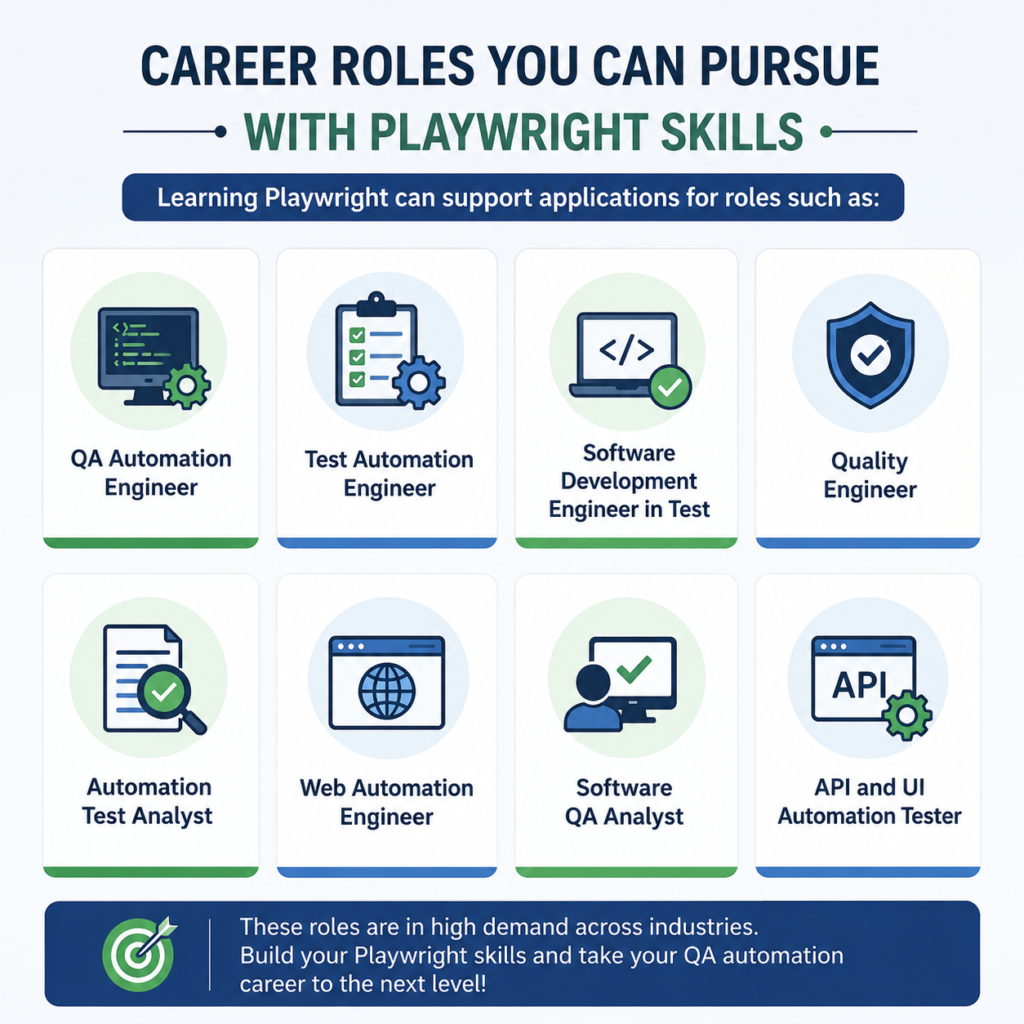
Learning Online Playwright Training in the USA with Job Support can support applications for roles such as:
- QA Automation Engineer
- Test Automation Engineer
- Software Development Engineer in Test
- Quality Engineer
- Automation Test Analyst
- Web Automation Engineer
- Software QA Analyst
- API and UI Automation Tester
Salary depends on location, experience, industry, programming ability, and the overall technology stack. Online Playwright Training in the USA with Job Support alone does not determine compensation.
For broader context, the U.S. Bureau of Labor Statistics reported a median annual wage of $102,610 for software quality assurance analysts and testers in May 2024. That is an occupation-wide figure, not a guaranteed starting salary or a Online Playwright Training in the USA with Job Support-specific salary.
Entry-level learners should be realistic. Employers may prefer candidates with a degree, prior testing experience, coding skills, domain knowledge, or a combination of these. A course can strengthen your profile, but your project quality, interview performance, work authorization, location, and previous experience still matter.
Common Mistakes Learners Should Avoid
Choosing a course only because it is cheap
A low-cost course is not a bargain when it leaves you without feedback, projects, interview preparation, or a clear learning sequence.
Compare the complete value: instruction, access to recordings, practical work, mentorship, career support, and the depth of the curriculum.
Memorizing syntax without understanding testing
Automation is not about clicking every visible button. A strong tester decides what should be automated, what should remain manual, which risks matter, and how the tests support a release decision.
Ignoring Java or TypeScript fundamentals
Many learners rush into framework development and then get stuck on basic programming logic. Spend time on the language. It makes Online Playwright Training in the USA with Job Supportmuch easier.
Building only a login-page project
A login test is fine for the first week. It is not enough for a serious portfolio.
Build a workflow involving multiple pages, test data, API validation, error handling, reporting, and CI/CD execution.
Applying for jobs before preparing explanations
Do not only prepare code. Prepare to explain:
- Why you selected a locator
- How your framework is organized
- How you handle authentication
- How you debug a failed test
- How you manage test data
- How tests run in CI/CD
- How you reduce flaky execution
Those explanations often reveal your actual level faster than a certificate does.
Who Is H2K Infosys Playwright Training Best For?
The program may be a good fit for:
- Manual testers moving into automation
- Selenium testers interested in modern browser automation
- QA engineers working in Java-based environments
- Developers who want stronger end-to-end testing skills
- Career changers willing to learn software testing and programming
- SDETs interested in AI-assisted automation techniques
- Testers returning to the job market after a career break
Someone seeking only a quick introduction may be satisfied with free documentation and small practice projects. Someone seeking career preparation will usually benefit more from a guided program with assignments, projects, interview support, and resume assistance.
How to Evaluate H2K Infosys Before Enrolling
Even when a course looks suitable, do a little homework before paying.
Ask the training team:
- Are classes live, recorded, or both?
- Which Playwright language is used?
- How much Java is taught before automation begins?
- Will I build an individual project?
- Does the project include API testing and CI/CD?
- How are assignments reviewed?
- Are mock interviews one-to-one or conducted in groups?
- What does placement assistance specifically include?
- How long can I access recordings and course materials?
- Are there eligibility conditions for career services?
A demo class is useful here. Pay attention to whether the trainer explains why something works or merely types code for learners to copy.
Is H2K Infosys the Best Playwright Course With Job Support?
For learners searching for structured online Playwright Training in the USA, H2K Infosys is a strong career-oriented choice. Its current program combines Playwright automation course, Java, Gen AI testing, cross-browser execution, UI and API scenarios, framework development, CI/CD practices, practical projects, resume guidance, interview preparation, and placement support.
That mix makes it more relevant than a syntax-only course, particularly for manual testers and QA professionals trying to move into automation roles.
The practical takeaway is simple: choose training that helps you produce something employers can evaluate. A working framework, a realistic project, a well-prepared resume, and the ability to discuss your decisions are more valuable than completing dozens of short tutorials.
If you’re serious about building a career in QA automation, structured training can really help you move from scattered practice to a job-focused learning plan. H2K Infosys is worth evaluating because its Online Playwright Training in the USA with Job Support path connects technical skills with the career preparation many independent learners find difficult to manage alone.
Related Topics for Internal Linking
You can also explore topics like:
- Playwright vs. Selenium: Which Automation Tool Should QA Testers Learn in 2026?
- How to Build a Playwright Automation Framework With Java
- Top Playwright Interview Questions for QA Automation Engineers
- How Generative AI Is Changing Software Testing
- How to Integrate Playwright Tests With Jenkins and CI/CD
These topics can form a broader content cluster around Online Playwright Training in the USA with Job Support, automation testing careers, SDET skills, AI-assisted testing, and QA interview preparation.
Frequently Asked Questions
1. Which online Playwright Training in the USA provides job support?
H2K Infosys provides career-oriented Online Playwright Training in the USA with Job Support with published support such as resume preparation, interview assistance, mock interviews, practical projects, and help with the job-search process. Confirm the current placement-support terms before enrolling.
2. Is Playwright suitable for beginners?
Yes, but beginners should learn basic software testing and programming along sideOnline Playwright Training in the USA with Job Support. A structured course is useful when it introduces Java or TypeScript gradually rather than jumping directly into advanced framework code.
3. Does H2K Infosys guarantee a job after Playwright Training?
H2K Infosys promotes job and placement support, but learners should distinguish support from an unconditional employment guarantee. Hiring results still depend on skills, experience, location, interview performance, and employer requirements.
4. Should I learn Playwright with Java or TypeScript?
TypeScript is widely used in Online Playwright Training in the USA with Job Support’s native ecosystem, while Java can be valuable in enterprise QA environments with established Java, Selenium, TestNG, Maven, and Jenkins stacks. Choose based on the roles and companies you plan to target.
5. How long does it take to become job-ready in Playwright?
A learner with testing and programming experience may build practical competency within a few months of consistent work. Complete beginners usually need longer because they must also understand QA fundamentals, coding, framework design, APIs, Git, and CI/CD.
Conclusion
Choosing the right Online Playwright Training in the USA with Job Support means looking beyond basic lessons. Practical projects, interview preparation, and job support matter just as much as technical knowledge.
For learners in the USA, H2K Infosys is a strong option because it combines Online Playwright Training in the USA with Job Support with Java, Gen AI testing, resume guidance, mock interviews, and placement assistance. If you are serious about learning Online Playwright Training in the USA with Job Support and building a QA automation career, structured training can help you become more confident and job-ready.