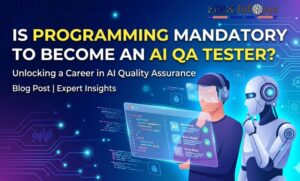
Artificial Intelligence (AI) is transforming industries worldwide, and with this growth comes an increasing demand for professionals who can ensure that AI systems operate accurately, reliably, and ethically. This is where AI QA testers play a crucial role. Many aspiring testers often ask an important question: Is programming mandatory to become an AI QA tester?”
The short answer is no, programming is not always mandatory, but having some coding knowledge can definitely be an advantage. In this blog, we will explore what an AI QA tester does, the role programming plays in testing, and how enrolling in a quality assurance tester course, QA certification courses, or QA testing online training can help you start a successful career in this field.
Understanding the Role of an AI QA Tester
Before discussing programming requirements, it’s important to understand what AI QA testers actually do.
An AI QA tester is responsible for ensuring that AI-powered applications, machine learning models, and automated systems function correctly. Their job involves testing whether AI systems provide accurate outputs, handle edge cases properly, and operate without bias or errors.
Typical responsibilities include:
- Testing AI models for accuracy and reliability
- Verifying data quality used for training AI systems
- Checking application performance and functionality
- Detecting bugs or unexpected behavior in AI-based software
- Ensuring ethical and unbiased results from AI systems
- Reporting issues and collaborating with developers to resolve them
Unlike traditional software testing, AI testing also involves validating data, algorithms, and predictions, as well as application functionality.
Is Programming Mandatory for AI QA Testers?
One of the biggest myths in the testing industry is that you must be an expert programmer to become a QA Testing with AI Online Training Course. In reality, many testing roles do not require advanced programming skills.
Manual Testing Roles
In manual testing, testers verify software functionality by interacting with the application just like an end user. Tasks include:
- Creating test cases
- Executing test scenarios
- Identifying bugs
- Reporting issues in bug tracking tools
These roles focus more on analytical thinking, attention to detail, and understanding software requirements rather than programming.
Many professionals begin their careers by completing a quality assurance tester course or enrolling in QA Testing Online Training that teaches manual testing fundamentals.
Automation Testing Roles
Automation testing is where programming knowledge becomes useful. Automation testers write scripts that automatically test applications using tools like
- Selenium
- Cypress
- Playwright
- Appium
Languages often used include:
- Python
- Java
- JavaScript
However, automation testing is usually a progression step after gaining manual testing experience. Many QA certification courses gradually introduce automation tools and basic scripting concepts so learners can transition smoothly.
AI-Specific Testing Roles
AI testing introduces additional responsibilities, such as:
- Testing machine learning models
- Validating datasets
- Checking algorithm predictions
- Evaluating model bias and fairness
While programming knowledge can help in understanding AI systems better, it is not always mandatory for entry-level AI QA roles.
Many companies hire testers who specialize in:
- Data validation
- Test design
- Model evaluation
- AI system behavior analysis
With proper QA testing online training, professionals can learn how to test AI systems without needing deep coding expertise.
Skills Required to Become an AI QA Tester
Whether or not you know programming, certain skills are essential for becoming a successful Quality assurance tester in the AI domain.
1. Strong Analytical Thinking
AI testers must evaluate whether a system’s output makes sense. This requires strong logical reasoning and analytical skills.
2. Understanding Software Development Lifecycle
Knowledge of the SDLC and STLC (Software Testing Life Cycle) helps testers understand when and how testing should occur during development.
3. Test Case Design
Creating effective test cases is a core skill taught in most quality assurance tester courses.
4. Knowledge of Testing Tools
Common tools used by testers include
- Jira
- TestRail
- Selenium
- Postman
- Jenkins
Many QA certification courses include hands-on practice with these tools.
5. Basic Understanding of AI Concepts
AI testers benefit from understanding concepts such as
- Machine learning models
- Training data
- Model accuracy
- Bias detection
Even a basic understanding can help testers identify issues in AI systems.
Advantages of Learning Programming for QA Testers
Although programming is not mandatory, learning some coding skills can offer several benefits.
Better Automation Opportunities
Automation testing significantly improves efficiency. Learning scripting languages allows testers to automate repetitive test cases.
Higher Career Growth
Testers who understand both manual testing and automation often receive better career opportunities and higher salaries.
Better Collaboration with Developers
Coding knowledge helps testers communicate more effectively with development teams when discussing bugs and technical issues.
Many professionals start with QA Testing Online Training for manual testing and later upgrade their skills through automation-focused QA certification courses.
How QA Training Helps You Become an AI QA Tester
Entering the QA field is much easier with structured training. A good quality assurance tester course provides both theoretical knowledge and practical experience.
Structured Learning
Courses typically cover:
- Testing fundamentals
- Manual testing techniques
- Automation tools
- API testing
- Agile methodologies
This structured approach helps beginners quickly understand industry practices.
Hands-On Experience
Practical projects are a crucial part of QA training. Students often work on:
- Real-world testing scenarios
- Automation scripts
- Bug reporting exercises
- Test case creation
Hands-on experience prepares learners for real job environments.
Industry-Relevant Skills
Many QA certification courses align their curriculum withindustry needs, including
- Agile testing
- DevOps integration
- AI and data testing basics
This ensures learners are ready for modern QA roles.
Career Support
Many QA testing online training programs offer additional support such as:
- Resume building
- Interview preparation
- Mock interviews
- Job placement assistance
These services help candidates transition into the workforce faster.
Career Opportunities for AI QA Testers
AI is rapidly expanding across industries, increasing demand for QA professionals who can test intelligent systems.
Common job roles include:
- QA Tester
- Automation Test Engineer
- AI QA Specialist
- Software Test Analyst
- Machine Learning Test Engineer
Industries hiring AI QA testers include:
- Healthcare
- Finance
- E-commerce
- Autonomous vehicles
- Robotics
- FinTech
- EdTech
Professionals who complete a quality assurance tester course or QA certification courses often find opportunities in both startups and large tech companies.
How to Start Your Career in AI QA Testing
If you want to become an AI QA tester but don’t have programming experience, you can follow these steps.
Step 1: Learn QA Fundamentals
Start with a beginner-friendly QA Testing Online Training program that teaches:
- Manual testing basics
- Test case writing
- Bug tracking
Step 2: Practice Real Projects
Work on sample applications and practice writing test cases, executing tests, and reporting defects.
Step 3: Learn Basic Automation
Once you understand manual testing, start learning automation tools like Selenium.
Many QA certification courses introduce automation gradually so beginners can adapt easily.
Step 4: Understand AI Basics
Learn basic concepts such as:
- Machine learning models
- Training data
- AI predictions
This knowledge will help you specialize in AI testing roles.
Step 5: Apply for Entry-Level QA Jobs
Look for roles such as
- Junior QA Tester
- Manual Tester
- QA Analyst
Once you gain experience, you can move toward AI-focused testing positions.
The Future of AI QA Testing
As AI continues to evolve, testing intelligent systems will become increasingly important. Organizations must ensure their AI models are:
- Accurate
- Reliable
- Secure
- Ethical
This creates a growing demand for QA professionals with knowledge of AI testing techniques.
The good news is that you don’t need to be a programming expert to enter this field. With the right training through a quality assurance tester course, relevant QA certification courses, or comprehensive QA Testing Online Training, you can build a successful career in QA and gradually expand into AI testing roles.
Final Thoughts
Programming is not mandatory to become an AI Quality assurance training and placement, especially for entry-level roles focused on manual testing and system validation. However, learning basic coding skills can enhance your career opportunities and help you transition into automation testing or advanced AI testing roles.
If you’re interested in starting a career in QA, enrolling in a quality assurance tester course is a great first step. With the help of structured QA certification courses and flexible QA testing online training, you can gain the skills needed to enter the fast-growing field of AI testing and build a rewarding career in the tech industry.
The future of QA is evolving alongside artificial intelligence and skilled testers will continue to play a critical role in ensuring these intelligent systems work safely and effectively.