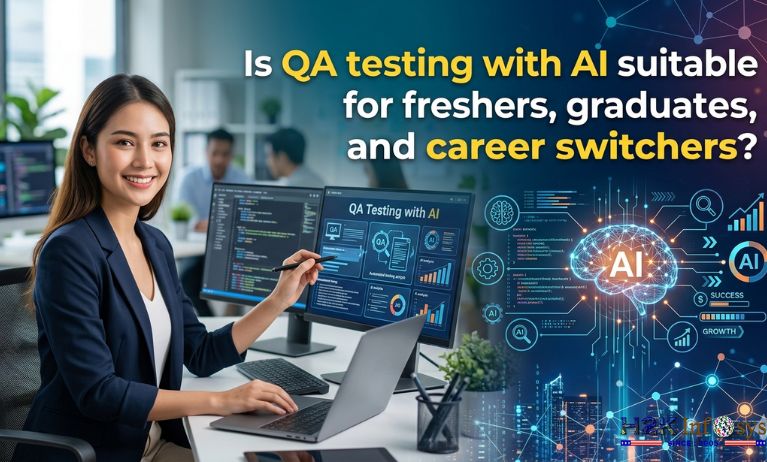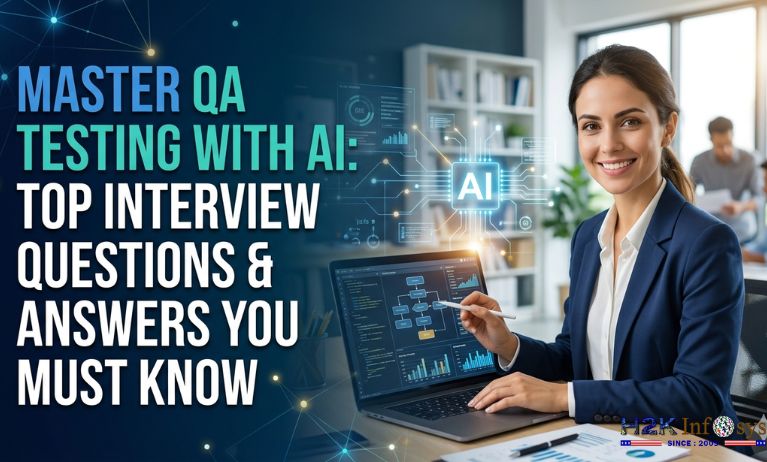
Quality Assurance (QA) testing has undergone a massive transformation recently, thanks to the rise of artificial intelligence (AI). What was once a largely manual and repetitive process is now evolving into a smarter, faster, and more predictive discipline. Companies today are actively seeking QA professionals who understand testing fundamentals and know how to leverage AI tools effectively.
If you’re preparing for a QA role in 2026 and beyond, mastering AI-driven testing concepts is no longer optional; it’s essential. In this guide, we’ll walk you through the most important interview questions and answers that will help you stand out in today’s competitive job market.
Why AI is Transforming QA Testing
Before diving into interview questions, it’s important to understand why AI matters in QA.
AI enhances testing by
- Automating repetitive tasks
- Predicting defects before they occur
- Improving test coverage
- Reducing maintenance effort in automation scripts
- Enabling smarter test case generation
Traditional QA focuses on “finding bugs,” while AI-powered QA focuses on “preventing bugs.”
Core QA Testing Interview Questions (With AI Context)
1. What is Software Testing?
Answer:
Software testing is the process of evaluating a software application to ensure it meets specified requirements and is free of defects. It involves executing test cases, identifying bugs, and verifying functionality, performance, and security.
AI Perspective:
With AI, testing becomes more predictive. AI models can analyze historical defect data to identify high-risk areas in the application, helping testers focus their efforts more efficiently.
2. What are the different types of testing?
Answer:
Common types include:
- Functional Testing
- Non-functional Testing (Performance, Security, Usability)
- Regression Testing
- Integration Testing
- System Testing
- User Acceptance Testing (UAT)
AI Enhancement:
AI can automatically prioritize which tests to run based on code changes, reducing regression testing time significantly.
3. What is Test Automation?
Answer:
Test automation involves using tools and scripts to execute test cases automatically instead of manual execution.
AI Twist:
AI-powered automation tools can self-heal test scripts. For example, if a UI element changes, AI can still identify it using patterns instead of failing the test.
4. What is the difference between QA and QC?
Answer:
- QA (Quality Assurance): Process-oriented, focuses on preventing defects
- QC (Quality Control): Product-oriented, focuses on identifying defects
AI Role:
AI strengthens QA by predicting where defects are likely to occur, shifting the focus further toward prevention.
5. What is a Test Case?
Answer:
A test case is a set of conditions or steps used to verify a specific functionality.
AI Evolution:
AI tools can generate test cases automatically by analyzing application behavior, user flows, and historical bugs.
AI-Focused QA Interview Questions
6. How is AI used in software testing?
Answer:
AI is used in:
- Test case generation
- Visual testing (UI comparison)
- Defect prediction
- Test optimization
- Self-healing automation scripts
AI reduces manual effort and improves accuracy by learning from past data.
7. What is self-healing automation?
Answer:
Self-healing automation refers to the ability of test scripts to adapt automatically when UI changes occur.
For example, if a button ID changes, AI can still identify it using attributes like text, position, or behavior.
8. What is predictive analytics in QA?
Answer:
Predictive analytics uses historical data to forecast:
- Defect-prone areas
- Test coverage gaps
- Risk levels in releases
This allows teams to focus testing efforts where they matter most.
9. Can AI replace manual testers?
Answer:
No – AI enhances testers, but doesn’t replace them.
Manual testers are still needed for:
- Exploratory testing
- User experience evaluation
- Critical thinking and edge cases
AI handles repetitive work, freeing testers to focus on higher-value tasks.
10. What are some popular AI testing tools?
Answer:
Examples include:
- Testim
- Applitools (visual AI testing)
- Functionize
- Mabl
These tools use machine learning to improve test stability and coverage.
Practical QA Scenario Questions
11. How would you test a login page?
Answer:
Test cases would include:
- Valid login credentials
- Invalid username/password
- Empty fields
- SQL injection attempts
- Password masking
- Session timeout
AI Advantage:
AI can analyze user behavior patterns and generate additional edge cases automatically.
12. What is Regression Testing?
Answer:
Regression testing ensures that new code changes do not affect existing functionality.
AI Optimization:
AI can identify which test cases are relevant after a code change, reducing unnecessary test execution.
13. What is a Bug Life Cycle?
Answer:
Stages include:
- New
- Assigned
- Open
- Fixed
- Retested
- Closed
AI Improvement:
AI can prioritize bugs based on severity, impact, and historical patterns.
14. How do you handle flaky tests?
Answer:
Flaky tests produce inconsistent results.
Solutions:
- Stabilize the test environment
- Improve synchronization
- Refactor test scripts
AI Solution:
AI can detect flaky patterns and suggest fixes or automatically stabilize tests.
Advanced QA + AI Questions
15. What is shift-left testing?
Answer:
Shift-left testing means starting testing early in the development lifecycle.
AI Benefit:
AI tools can analyze code during development and predict defects before testing even begins.
16. What is Visual Testing?
Answer:
Visual testing ensures UI consistency across devices and browsers.
AI Role:
AI compares screenshots pixel-by-pixel while ignoring acceptable variations, reducing false positives.
17. What is Test Data Management?
Answer:
It involves creating, managing, and maintaining test data.
AI Enhancement:
AI can generate realistic test data automatically, including edge cases.
18. How does AI help in CI/CD pipelines?
Answer:
AI improves CI/CD by:
- Selecting relevant tests
- Predicting build failures
- Optimizing execution time
This speeds up deployment cycles significantly.
Behavioral Interview Questions
19. Tell me about a challenging bug you found.
Tip for Answer:
Explain:
- The issue
- How did you discover it
- Tools used
- Impact on the project
Highlight any use of automation or AI tools if applicable.
20. How do you stay updated with QA trends?
Answer:
- Follow QA blogs and communities
- Learn new tools
- Practice automation frameworks
- Explore AI testing platforms
Continuous learning is critical in modern QA roles.
Key Skills Employers Look For in AI-Driven QA Roles
To succeed in QA interviews today, you should demonstrate:
1. Strong Fundamentals
Understand testing concepts deeply. AI builds on these basics.
2. Automation Knowledge
Familiarity with tools like Selenium, Playwright, or Cypress is essential.
3. AI Awareness
You don’t need to be a data scientist, but you should understand:
- Machine learning basics
- AI testing tools
- Use cases of AI in QA
4. Analytical Thinking
Employers value testers who can think critically and identify hidden risks.
5. Adaptability
Technology is evolving fast – your ability to learn matters more than what you already know.
Tips to Crack QA Interviews in 2026
- Practice real-world scenarios instead of memorizing definitions
- Understand AI concepts in testing, not just buzzwords
- Work on projects using AI testing tools
- Be ready to explain your thought process clearly
- Show curiosity and willingness to learn
Final Thoughts
The future of QA testing is intelligent, automated, and data-driven. AI is not replacing QA professionals; it’s empowering them to do more meaningful work.
To master QA testing in today’s world, you need a balanced skill set:
- Strong fundamentals
- Hands-on automation experience
- Awareness of AI-driven tools and strategies
By preparing the questions and concepts covered in this guide, you’ll be well-equipped to crack modern QA interviews and build a future-proof career.