

Introduction
In the ever-evolving world of software development, testing plays a critical role in ensuring that applications function as expected and remain free from defects. While traditional testing methods such as unit, integration, and regression testing have long been used, Mutation Testing offers a deeper way to measure the effectiveness of your tests.
If you’re exploring QA testing courses understanding It will give you an advanced edge in ensuring test reliability, code coverage, and software quality. This technique doesn’t just test your code; it tests the tests themselves.

What Is Mutation Testing?
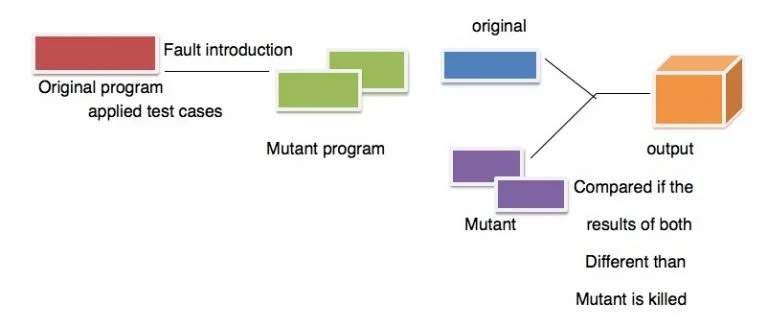
It is a fault-based testing technique used to evaluate the quality of test cases. It involves introducing small, deliberate changes (mutations) into the source code and then checking whether the existing test cases detect these changes.
If the test cases fail due to the mutation, the test suite is considered strong. If they pass, it indicates a weakness, suggesting that your tests may not be robust enough to catch real-world defects.
These deliberate changes simulate possible human coding errors, helping testers identify gaps in test coverage.
Why Mutation Testing Matters
Helps determine how effective your tests are at finding defects. It acts as a test for your tests.
Here’s why it’s essential in modern QA:
- Improves test suite quality:
It exposes weak or missing test scenarios that may have gone unnoticed in standard testing. - Increases code coverage confidence:
Developers can be more confident that all critical parts of the application are tested. - Enhances debugging efficiency:
By detecting undetected code behaviors early, it minimizes late-stage debugging costs. - Encourages better coding practices:
Since Mutation Testing focuses on logic-level defects, developers are encouraged to write more testable, cleaner code.
For professionals taking QA testing courses provides a framework for measuring the effectiveness rather than just the existence of tests.
How Works
systematic process that ensures reliability and consistency:
Step 1: Generate Mutants
A “mutant” is a modified version of your original program. The tool introduces small changes such as:
- Replacing arithmetic operators (
+becomes-) - Modifying logical operators (
&&becomes||) - Changing relational operators (
>becomes<) - Altering variable assignments or constants
Example:
Original code:
Step 2: Run Test Cases
if (a > b):
    print("A is greater")
Mutated code:
if (a < b):
    print("A is greater")
All existing test cases are executed against both the original and mutated versions of the code.
Step 3: Observe Test Outcomes
- If a test case fails on the mutated version, the mutant is killed.
- If it passes, the mutant survives, indicating the test suite missed this defect.
Step 4: Calculate Mutation Score
The Mutation Score represents the effectiveness of your tests.
It’s calculated as:
Mutation Score = (Number of Killed Mutants / Total Mutants) × 100
A higher mutation score indicates a stronger test suite.
Example of Action
Let’s consider a simple Python function:
def is_even(num):
    return num % 2 == 0
Step 1: Mutate the Code
Possible mutants might include:
- Change
==to!= - Change
%to/
Step 2: Test Cases
assert is_even(4) == True
assert is_even(7) == False
Step 3: Execution Result
- For the first mutant (
!=), the test case fails → mutant killed. - For the second mutant (
/), the test case still passes → mutant survives.
This tells us the second test doesn’t adequately validate that the modulo operator is required, revealing a weakness.
Thus encourages creating stronger, more targeted test cases.
Types of Mutations
Tools apply different types of modifications. The most common ones are:
- Statement Mutations – Adding, deleting, or modifying statements.
- Operator Mutations – Changing arithmetic, logical, or relational operators.
- Constant Mutations – Altering numerical or character constants.
- Variable Mutations – Swapping variable references.
- Control Flow Mutations – Changing loops or conditional paths.
Understanding these types is crucial for anyone enrolled in a Quality assurance tester course, as it highlights how diverse mutations simulate real coding errors.
Mutation Testing Tools
Several Mutation Testing tools automate the process, saving time and improving accuracy. Here are a few popular ones:
| Tool | Language | Key Features |
|---|---|---|
| PIT | Java | Integrates with JUnit and Maven; detailed mutation reports |
| MutPy | Python | CLI tool for mutant generation and mutation scoring |
| Stryker | JavaScript, TypeScript, C# | Dashboard reporting, easy CI/CD integration |
| Jumble | Java | Works with Ant builds, compatible with older projects |
| Mutant | Ruby | Simplified interface for RSpec-based testing |
These tools are often introduced during QA testing courses to help students gain practical experience.
Advantages of Mutation Testing
Mutation Testing offers numerous advantages over traditional methods:
1. Strong Indicator of Test Quality
It directly measures how effective your tests are in detecting real-world code changes.
2. Encourages Comprehensive Testing
Developers are motivated to write detailed, boundary-covering test cases.
3. Improves Maintainability
By detecting weak test areas, Mutation Testing ensures long-term software reliability.
4. Reveals Hidden Defects
It helps uncover logical errors that standard testing might overlook.
5. Boosts Confidence in Deployment
Teams can deploy software knowing the test suite is both strong and resilient.
In a Quality assurance tester course, Mutation Testing is taught as an advanced skill for improving test maturity and confidence.
Limitations of Mutation Testing
While effective, Mutation Testing does have challenges:
- High Computational Cost
Running hundreds or thousands of mutants can be time-consuming. - Equivalent Mutants Problem
Some mutants behave exactly like the original program, making it impossible to kill them through testing. - Complex Setup
Requires tools and configurations, which can be intimidating for beginners. - Not Ideal for Large Systems
On very large codebases, Mutation Testing can become resource-intensive.
However, modern QA testing courses teach strategies to minimize these limitations, such as running Mutation Testing selectively or integrating it into CI/CD pipelines.
Best Practices for Mutation Testing
To make the most of Mutation Testing, testers should follow these best practices:
- Focus on Critical Code Areas
Apply mutations to business-critical or high-risk sections first. - Use Automation Tools
Tools like PIT or Stryker automate mutation creation and testing, saving hours of manual effort. - Combine with Unit Testing
works best alongside robust unit tests to ensure deeper coverage. - Filter Equivalent Mutants
Avoid unnecessary overhead by excluding logically identical mutants. - Integrate with CI/CD
Running continuous integration environments ensures consistent test suite evaluation. - Educate Teams
If your organization offers a Quality assurance tester course, include Mutation Testing as a core module to strengthen test competency.
Mutation Testing vs. Other Testing Techniques
| Aspect | Mutation Testing | Unit Testing | Regression Testing |
|---|---|---|---|
| Goal | Evaluate test suite strength | Verify individual functions | Ensure new changes don’t break existing features |
| Focus | Tests for tests | Code functionality | Code stability |
| Outcome | Mutation Score | Pass/Fail results | Pass/Fail results |
| Usage | Quality improvement metric | Baseline testing | Ongoing maintenance |
| Complexity | High | Low to medium | Medium |
Mutation Testing complements rather than replaces other testing techniques. It ensures the quality of your testing strategy itself.
Real-World Application of Mutation Testing
Mutation Testing is widely used across industries such as finance, healthcare, e-commerce, and aerospace, where reliability is critical.
For instance:
- In banking, it ensures fraud detection algorithms have strong logical testing.
- In healthcare, it validates that life-critical applications have resilient test coverage.
- In e-commerce, it checks that order-processing and payment workflows are thoroughly validated.
Professionals who complete QA testing courses learn to apply Mutation Testing within continuous testing pipelines, improving release quality.
Integrating Mutation Testing in QA Workflows
Step 1: Add to Your QA Strategy
Plan Mutation Testing for modules that are frequently modified or prone to logic errors.
Step 2: Automate Testing
Integrate Mutation Testing tools with CI/CD (like Jenkins or GitLab CI) to continuously monitor test quality.
Step 3: Review Mutation Reports
Analyze reports for surviving mutants and strengthen test cases accordingly.
Step 4: Educate Testers
Ensure all QA professionals, especially those completing a Quality assurance tester course, understand how to interpret mutation metrics.
Step 5: Iterate
Continuous refinement leads to stronger, more resilient testing frameworks.
Future of Mutation Testing
With the rise of AI-driven QA and DevSecOps pipelines, Mutation Testing is evolving. Tools are becoming smarter, faster, and more automated.
- AI-based mutant generation: Artificial intelligence can predict potential weak points and generate meaningful mutants.
- Cloud-based Mutation Testing: Scalable cloud platforms are reducing computational load.
- Integration with static analysis: Combining Mutation Testing with static analysis improves defect detection accuracy.
As QA evolves, Mutation Testing will remain a core skill for anyone completing modern QA testing courses.
Conclusion
Mutation Testing is more than just another testing approach. It’s a quality assurance enhancer that validates how effective your test cases really are.By identifying gaps, improving coverage, and promoting better coding habits, it ensures that both code and tests are equally strong.
For professionals pursuing a Quality assurance tester course mastering Mutation Testing opens doors to advanced roles in software quality engineering, automation, and DevOps-driven testing environments.As businesses demand greater reliability and precision, Mutation Testing stands out as a sophisticated technique to ensure software quality in the digital era.


























10 Responses
Mutation testing is a type of white box testing , it is testing at source code level by inducing errors. This is not applicable for Black box testing as it requires changes to source code.
Mutation testing is a white box testing that finds the usefulness of existing test cases & test data. Mutation testing is a changed copy of the original program where both outcomes are the same.
Mutation Testing
In my understanding of mutation testing is purposely inserting error to verify whether the existing test case can defect the error or not. The main objective of mutation testing is to check whether each mutant creates an output where it means that it is different from the output of the original program. There are three types of mutant testing
• Decision mutations- This type of mutation testing will check the design errors.
• Value mutations- The values will modify to identify the errors in the program.
• Statement mutations – it means that we can do the modifications into statements by removing or replacing the line.
Mutation Testing is done by modifying the original program. Very small changes are made. Mutation testing aim is to evaluate the quality of the case that should be able to fail the mutant code so this method is called as Fault-based testing. Types of testing are Decision, Value and Statement testing. This type of testing is an excellent method to achieve the extensive coverage of the source program but is it quite time consuming and a lot of cost is added to it.
Mutation Testing
Mutation testing is a type of white box testing method where we insert errors intentionally to verify whether the existing test case can defect the error or not. The main objective of mutation testing is to check whether each mutant creates an output of the original program.
There are three types of Mutation Testing:
• Decision mutations- This type of mutation testing will check the design errors. Here we will do the modification in arithmetic and logical operator to detect errors in the program.
• Value mutations – The values will modify to identify the errors in the program.
• Statement mutations- It means that we can do the modifications into statements by removing or replacing the line.
Advantage:
• t approaches right for error detection to the application programmer.
• Mutation testing is an excellent method to achieve the extensive coverage of the source program.
• Mutation testing helps us to give the most established and dependable structure for the client
Dis-advantage-
• This testing is bit time taking and costlier process because we have many mutant programs which need to be created.
• This mutation testing is not appropriate for black box testing it includes the modification in the source code.
Mutation Testing:
It is a type of white box testing to evaluate the quality of the testing. The main point of mutation testing is to show whether the tests are able to detect subtle errors that might be created in future. Mutation frameworks take the original source code and introduce some modifications to it, named as mutation. Then unit tests are run against both the original code and mutated one and results are compared. If all test pass after mutation, that means mutation survived. On the other hand, if one or more tests fail after mutation, means there is no error in the code, the Mutation version was killed.
Mutation testing is a type of white box testing method where we insert errors intentionally to verify whether the existing test case can detect an error or not. Mutation may be small modification within the program. Mutation testing aim is to improve the quality of the test . This method is also called Fault-based testing .
Mutatio testing is the method of evaluvating the test quality by injecting the bug into code and see whether the test detecting the fault or not.There are 3 types of mutatio testing
1. decision mutation
2. value mutation
3. statement mutation
Mutation testing is a white box method in software testing, where we insert errors purposely into a program (under test) to verify whether the existing test case can detect the error or not. In this testing, the mutant of the program is created by making some modifications to the original program.
Mutation testing aim is to improve the quality of the test. This method is also called Fault-based testing.
There are 3 types of mutation testing
1. Decision mutation
2. Value mutation
3. Statement mutation
Mutation testing is a type of white box testing method where we insert errors intentionally to verify whether the existing test case can defect the error or not. Here the mutant of the program which is some modification to the original program. The main objective of mutation testing is to check whether each mutant creates an output where it means that it is different from the output of the original program. We will make some modifications in the mutant program because if we change it on a massive scale, then it will affect the overall plan.
Mutation testing aim is to evaluate the quality of the case that should be able to fail the mutant code so this method is called as Fault-based testing as it produces the errors within the program and that we can say that mutation testing is performed to see check the efficiency of the test cases.