
Introduction
Look, here’s the honest truth: cybersecurity is booming, and companies are desperate for people who actually know what they’re doing. At H2K Infosys, we get it. Real-World Projects in Cybersecurity aren’t just checkboxes on a curriculum. Data breaches are happening left and right, and threats are getting scarier every day. But here’s what most training programs get wrong, they’re teaching theory when the industry needs people who can do the work.
They’re how you transform from someone who can talk about Cyber security training into someone who can fix security problems. When you’re running actual penetration tests, setting up firewalls that actually matter, and responding to simulated breaches, you’re not just learning, you’re becoming job-ready.
The reality? Employers don’t care about textbook knowledge anymore. They want people who’ve tackled real scenarios, made mistakes in safe environments, and learned how to handle actual security incidents. That’s exactly what Real-World Projects in Cybersecurity deliver.
Why Real-World Projects Matter in Cybersecurity Training
Here’s something that took me a while to understand: you can’t master cybersecurity by sitting and reading. It just doesn’t work that way. The field moves too fast, the threats are too varied, and the solutions are too practical. Real-World Projects in Cybersecurity solve this problem head-on.
1. Bridging the Gap Between Theory and Practice
Reading about vulnerabilities is one thing. Actually finding them is something else entirely. When you work through Real-World Projects in Cybersecurity, you move from the classroom to the real deal. You’re not just understanding cyber threats conceptually; you’re spotting them, exploiting them (ethically), and learning how to patch them. That bridge from “I know what a vulnerability is” to “I can find and fix vulnerabilities” is massive.
2. Simulating Real Cyber Threats
Cyber attacks don’t come with a warning label. They’re messy, unpredictable, and fast-moving. With Real-World Projects in Cybersecurity, you get to experience them in a safe sandbox. You’ll encounter phishing attempts, malware that actually runs, and network intrusions that feel uncomfortably real. The difference? You’re in control. You can pause, think, and learn without worrying about destroying a production system.
3. Developing Problem-Solving Skills
Cybersecurity isn’t a multiple-choice test. When something goes wrong, you need to think fast and make smart decisions under pressure. Real-World Projects in Cybersecurity force you into these situations. You’ll analyze logs at 2 AM (in a training environment), make calls about what’s a real threat and what’s noise, and actually see the consequences of your decisions play out.
4. Building Professional Confidence
The more you do it, the more confident you become. And confidence matters in this field. Walking into a security interview after completing Real-World Projects in Cybersecurity feels completely different than walking in cold. You’ve done this work. You know what it feels like. That shows.
Real-World Projects in Cybersecurity: What You’ll Actually Work On
So what does this actually look like? Here are the major project categories you’ll encounter:
Network Security Projects
Network security is basically the bouncer at the door. You need to know who gets in and who doesn’t. Real-World Projects in Cybersecurity in this area teach you how networks actually work—not in theory, but in practice.
You’ll get hands-on with:
- Setting up firewalls that actually block the bad stuff without breaking legitimate traffic
- Watching network packets flow across your screen and learning to spot anomalies
- Installing and configuring IDS and IPS systems (basically your automated threat cops)
- Running network analysis tools that show you what’s really happening on the wire
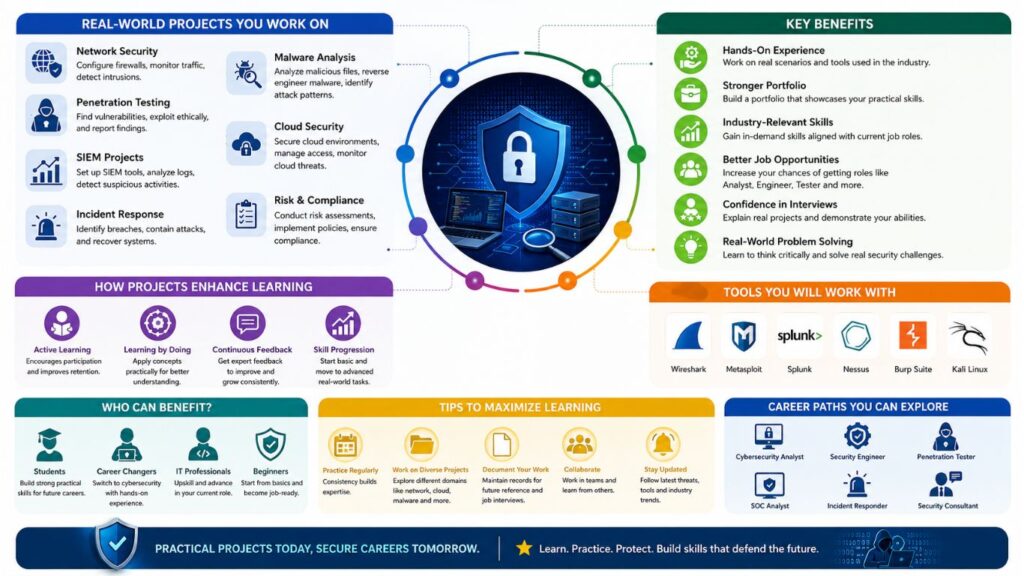
By the time you’re done with Real-World Projects in Cybersecurity focused on networks, you’ll understand threat detection, firewall management, and how real organizations monitor their traffic.
Penetration Testing Projects
Penetration testing is essentially ethical hacking, and it’s exactly what companies want you to try. They’re literally paying for you to break in (the right way). Real-World Projects in Cybersecurity in pen testing teach you how to:
- Run vulnerability scans that reveal weak spots
- Actually exploit those weaknesses (with explicit permission) to show how far an attacker could get
- Write reports that management actually reads and acts on
- Think like an attacker while staying on the right side of the law
SIEM and Log Monitoring Projects
SIEM tools like Splunk are how large organizations watch their entire infrastructure. Millions of events happening every second, and someone needs to spot the one that matters. Real-World Projects in Cybersecurity using SIEM teach you:
- Building dashboards that highlight what actually matters
- Setting up alerts for suspicious login attempts and unusual access patterns
- Creating correlation rules that connect separate events into a coherent threat picture
- Making sense of chaos, which is basically what SOC analysts do all day
Incident Response Projects
When the alarm goes off and everyone’s looking at you, panic isn’t an option. Real-World Projects in Cybersecurity in incident response prepare you for exactly this scenario. You’ll practice:
- Finding and containing data breaches in progress
- Stopping malware before it spreads
- Recovering compromised systems
- Making critical decisions when everything is on fire (metaphorically speaking)
These projects teach you crisis management and the methodical thinking you need when things go wrong.
Malware Analysis Projects
You can’t defend against what you don’t understand. Real-World Projects in Cybersecurity in malware analysis let you:
- Study actual malicious files in safe sandbox environments
- Reverse engineer suspicious programs to see what they’re really doing
- Understand attacker tactics and techniques
- Learn how threats actually behave in the wild
Cloud Security Projects
Cloud isn’t the future anymore, it’s now. AWS, Azure, Google Cloud, most companies are running critical systems in the cloud. Real-World Projects in Cybersecurity focused on cloud environments teach you:
- Configuring cloud security properly (and learning from misconfigurations)
- Managing identity and access controls
- Monitoring cloud infrastructure for threats
- Understanding the unique security challenges cloud brings
Compliance and Risk Management Projects
Here’s something people often overlook: cybersecurity isn’t just about keeping attackers out. It’s also about following the rules. Regulations like GDPR, HIPAA, and PCI-DSS matter. Real-World Projects in Cybersecurity in this area teach you:
- Running security audits and compliance checks
- Implementing security policies that actually work
- Assessing risk and prioritizing what matters most
- Understanding the business side of security (which matters more than you’d think)
Why These Projects Actually Change Your Career
You Build Real, Verifiable Experience
“I read about firewalls” doesn’t impress anyone. “I configured Palo Alto firewalls in a production environment and implemented traffic segmentation.” does. Real-World Projects in Cybersecurity give you that story to tell.
Your Portfolio Becomes Your Resume
In cybersecurity, your portfolio does more talking than your resume ever could. Employers can see what you’ve built, what you’ve fixed, and how you approach problems. That’s way more valuable than a list of certifications.
You Learn the Tools People Actually Use
By working through Real-World Projects in Cybersecurity, you’ll get comfortable with:
- Wireshark (network packet analysis)
- Splunk (log management and SIEM)
- Nessus and OpenVAS (vulnerability scanning)
- Metasploit (penetration testing framework)
- Burp Suite (web application security testing)
- Snort (intrusion detection)
These aren’t obscure tools. Every security job assumes you know at least some of these.
Better Job Prospects
Employers actively look for candidates with project experience. Positions like:
- Cybersecurity Analyst
- SOC Analyst
- Security Engineer
- Penetration Tester
- Incident Response Analyst
- Cloud Security Engineer
…all prioritize candidates who’ve actually done the work. Real-World Projects in Cybersecurity prepare you for these exact roles.
You Can Actually Fix Things
Projects teach you response, not just theory. You learn how to think through problems systematically and implement solutions that actually work.
You Stay Current with Industry Standards
Good training programs build Real-World Projects in Cybersecurity around what’s happening right now in the industry, not what was relevant five years ago. You’re learning current threats, current tools, and current best practices.
How Project-Based Learning Actually Improves Your Brain
Here’s the thing about learning: humans remember what they do way better than what they read. It’s not motivational speaking, it’s neuroscience. When you’re actively solving problems, making mistakes, and fixing them, your brain wires those lessons in deep.
Real-World Projects in Cybersecurity aren’t passive lectures. You’re:
- Making real decisions
- Seeing real consequences (in a safe environment)
- Troubleshooting actual problems
- Getting feedback from instructors who’ve done this work themselves
That feedback loop, doing something, getting guidance, adjusting, and trying again, is where real learning happens.
What Good Cybersecurity Training Actually Looks Like
Not all programs are created equal. Here’s what separates the ones that actually prepare you from the ones that just take your money:
Structured progression: You start with fundamentals and gradually work toward advanced topics. You don’t jump into malware analysis if you don’t understand networks yet.
Experienced mentorship: Your instructors should be people who’ve actually worked in cybersecurity. They know what’s hard, what matters, and where you’ll get stuck.
Career support: Beyond training, good programs help with resumes, mock interviews, and sometimes even job placement connections. That matters.
Continuous updates: The curriculum should reflect what’s actually happening in the industry, not what was taught three years ago.
If You’re Brand New to Cybersecurity
I get it, starting from zero is intimidating. But Real-World Projects in Cybersecurity are actually perfect for beginners. Here’s why:
You don’t need prior knowledge. Good programs introduce concepts in a way beginners can understand, then immediately show you how they work in practice.
The difficulty increases gradually. You’re not thrown into the deep end. You start with foundational tasks and work up to complex scenarios. By the time you reach advanced stuff, you’ve got the context to understand it.
You’re training for a real job. The scenarios you work through are actual problems you’ll face professionally, not academic exercises.
The Hard Truth
Let’s be real: some Real-World Projects in Cybersecurity are genuinely difficult, especially at the start. That’s intentional. Security is complex, and if the training were easy, it wouldn’t prepare you for the real world.
This kind of learning requires patience, consistency, and effort. You can’t rush it. And here’s something people don’t always want to hear: cybersecurity is a field where you never stop learning. New threats emerge constantly. New tools come out regularly. Staying current isn’t optional, it’s your job.
But getting through these challenges? That’s exactly what makes you stronger as a security professional.
How to Actually Succeed
Practice consistently. Seriously. Don’t be flashy about it. Just show up regularly and work through projects. Your skills compound over time.
Be broad, not narrow. Start with network security, move to penetration testing, try cloud security. The wider your experience, the more valuable you become.
Document everything. Keep a detailed record of your projects. What did you do? What did you find? How did you solve problems? This becomes your portfolio and your interview talking points.
Learn with others when possible. Working through Real-World Projects in Cybersecurity solo teaches you technical skills. Working with others teaches you communication, collaboration, and how to explain complex topics, all critical in real jobs.
Stay curious. Read about emerging threats. Try new tools. Join communities. Security professionals who keep learning are the ones who advance.
What’s Changing in Cybersecurity Right Now
The industry is shifting in several important ways:
AI and machine learning aren’t cool additions anymore, they’re core to modern security operations. Threat detection, anomaly detection, and incident prediction increasingly rely on ML.
Cloud and DevSecOps are becoming standard. Security isn’t something you bolt on at the end anymore. It’s built into development from day one.
Talent shortage is real. Organizations are hiring aggressively. The demand for skilled security professionals is higher than the supply, and that gap is growing.
Real-world projects will keep being essential. As technology evolves and threats change, hands-on training will remain the best way to prepare security professionals who actually know what they’re doing.
Conclusion
Real-World Projects in Cybersecurity aren’t just a training method, they’re the training method that actually works. When you’re building firewalls, running penetration tests, analyzing malware, and responding to simulated breaches, you’re not just absorbing information. You’re becoming a security professional.
That practical experience gives you real skills, clearer thinking, and the confidence to solve problems under pressure. It gives employers proof that you can actually do the work, not just talk about it. And it makes interviews feel like conversations with colleagues instead of interrogations.
Whether you’re starting from scratch or switching careers, the journey is more interesting and effective when you learn by doing. You build a portfolio that speaks for itself. You develop the judgment that comes only from experience. You become the kind of professional organizations are actively looking for. If you want to succeed in Cybersecurity training and placement, stop reading about it and start doing it. Get your hands dirty with Real-World Projects in Cybersecurity. It’s one of the best decisions you’ll make.