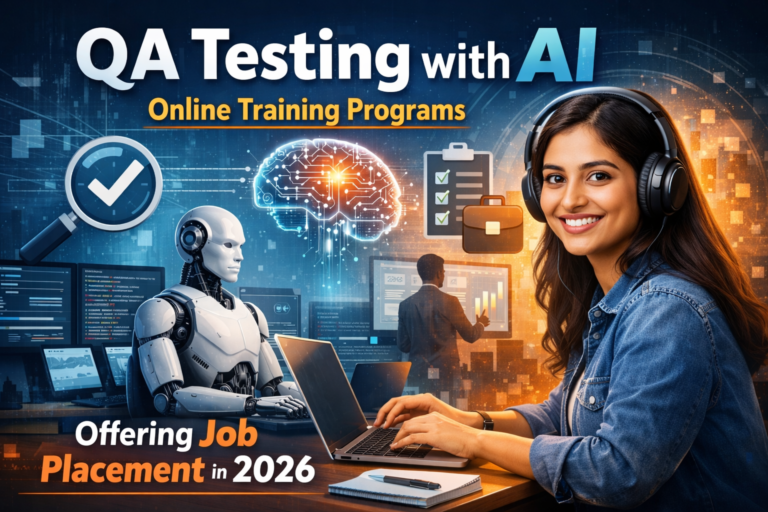
In 2026, the software industry continues to evolve at lightning speed, and quality assurance (QA) testing remains one of the most critical domains in tech. But traditional QA is no longer enough. Companies today are integrating artificial intelligence (AI) into their QA processes, creating unprecedented demand for professionals skilled in AI-driven QA testing.
To meet this demand, online QA Testing with AI programs is shifting from basic QA courses to AI-powered QA programs that include job placement support, mentoring, and real-world project experience. This blog post explores why QA testing with AI skills matters, what these online programs offer, how they help with job placement, and how you can future-proof your career in this burgeoning field.
Why QA Testing with AI Matters in 2026
Quality assurance is the backbone of software reliability. From mobile apps to enterprise systems, QA ensures products work as expected. Traditionally, QA has focused on manual testing and scripted automation. But with AI becoming central to software development lifecycles, QA teams are leveraging machine learning (ML) and AI tools to:
- Automate test design and execution
- Predict defects before they occur
- Improve test coverage using intelligent algorithms
- Accelerate regression testing with AI models
- Shift left testing into earlier development phases
As companies adopt CI/CD pipelines and DevOps cultures, AI-augmented QA engineers are in higher demand, making them valuable assets in modern tech teams.
What Skills Employers Are Looking For
By 2026, the ideal QA professional isn’t just someone who can run test suites – they’re someone who can:
✔ Understand basic software development life cycles (SDLC)
✔ Write test scripts using modern tools (e.g., Selenium, Cypress)
✔ Integrate AI/ML tools in testing workflows
✔ Use analytics to interpret test results
✔ Implement continuous testing in DevOps environments
✔ Collaborate with developers, product owners, and data scientists
This blend of technical and soft skills makes QA with AI expertise one of the most future-proof careers in tech.
Online Training with Job Placement – A Game Changer
Many aspiring QA professionals hesitate to pursue online training because they worry about job placement after certification. In 2026, training providers are closing this loop by offering structured programs that include job placement support, mentoring, internship opportunities, and real project experience.
Here’s what you can expect from top QA + AI online training programs:
1. Comprehensive Curriculum Combining QA + AI
These programs go beyond traditional QA testing and include modules like:
- Introduction to QA fundamentals
- Automation frameworks (like Selenium, Playwright)
- Introduction to AI and machine learning basics
- AI tools for testing (e.g., AI test generation, predictive analytics)
- Cloud-based testing platforms
- DevOps and CI/CD integration
2. Hands-On Projects & Real Case Studies
Theory is important, but true expertise comes from doing. Quality programs provide:
- End-to-end QA automation projects
- AI-enabled testing case studies
- Group labs and simulated real-world environments
3. Career Mentorship and Resume Building
Dedicated mentorship helps you:
- Build and polish a professional resume
- Prepare for interviews
- Create a portfolio with projects that matter
Some programs offer one-on-one career coaching, mock interviews, and even personal branding support.
4. Internships & Industry Experience
Top programs often partner with tech companies to provide:
- Internships or apprenticeships
- Access to client projects
- Paid or unpaid experiential training
This experience becomes a crucial stepping stone to a full-time job.
5. Job Placement or Job Assistance Guarantees
Today, some courses come with:
✔ Job placement support within X months of graduation
✔ Guaranteed interviews with hiring partners
✔ Dedicated placement cells
These services transform training from a certificate into a career launchpad.
Top Components of an Effective QA + AI Curriculum
A high-quality training program typically includes modules that cover:
Core QA Testing Fundamentals
Understanding quality assurance basics:
- SDLC & STLC (Software & Test Life Cycles)
- Manual testing techniques
- Bug reporting and defect tracking
- Quality metrics and KPIs
Automation Testing
Modern automation frameworks:
- UI testing with Selenium, Playwright
- API testing with Postman or RestAssured
- Cross-browser testing
- Test scripting best practices
Introduction to AI & Machine Learning
QA professionals don’t need to be data scientists, but they should understand:
- What AI and ML are
- How AI applies to QA/testing
- Tools that automate test generation and defect prediction
AI Tools for QA
Examples may include:
- AI-powered test generation tools
- Visual regression tools
- Predictive QA analytics
- Intelligent bots for exploratory testing
These tools speed up test creation, reduce manual workload, and detect complex anomalies faster than humans.
Modern DevOps & Continuous Testing
QA professionals today must know:
- CI/CD pipelines (e.g., Jenkins, GitHub Actions)
- Version control (Git)
- Continuous testing and deployment
- Monitoring and feedback loops
How Job Placement Support Works
Training programs leverage various mechanisms to help learners enter the workforce:
Dedicated Career Support Teams
These teams coach learners through:
- Crafting resumes tailored to QA roles
- Preparing for technical and HR interviews
- Setting up mock interviews and feedback sessions
Recruitment Partnerships
Programs often partner with:
- Tech startups
- Mid-sized product companies
- IT consultancies
- Outsourced QA providers
This network increases opportunities for on-the-job placement.
Job Boards & Referrals
Access to specialized QA job boards gives candidates:
- Priority interview listings
- Insider referrals
- Fast-track placement pipelines
Some programs even have placement guarantees – if you meet training milestones, you’ll get job support.
Benefits of QA Testing with AI Skills
Here are compelling reasons to pursue QA + AI training in 2026:
High Demand, Competitive Salaries
AI-savvy QA professionals are in demand – employers seek automation expertise combined with analytical skills.
Wide Range of Job Roles
With QA + AI proficiency, you can explore roles like:
- QA Engineer
- Automation Engineer
- AI Test Analyst
- Test Architect
- QA Lead
Flexible Career Pathways
QA testing with AI skills allows you to:
- Work in remote or hybrid environments
- Join startups or large enterprises
- Transition to related fields like DevOps or product management
Continuous Learning Opportunities
QA professionals are increasingly expected to:
- Learn new AI tools
- Understand cloud and data pipelines
- Grow into leadership roles
This field offers lifelong career growth.
Is This Training Worth It? – ROI Perspective
Many learners ask – “Is investing time and money in QA + AI training worth it?” The answer in 2026 is a strong yes, because:
✔ Job placement support reduces unemployment risk
✔ Relevant skills command better salaries
✔ Certification + portfolio experience strengthens credibility
✔ AI expertise sets you apart from traditional QA professionals
For many, the cost of training is recovered within months through a higher salary and quicker job placement – especially when programs help secure interviews directly with employers.
How to Choose the Right Program
When evaluating QA + AI online courses, consider these factors:
Industry Reputation
Look for:
- Established training providers
- Verified student reviews
- Alumni success stories
Curriculum Relevance
Your program should cover:
- QA fundamentals
- Automation with real tools
- AI/machine learning basics
- DevOps/CI/CD integration
Job Placement Support
Verify:
- Placement timelines
- Interview opportunities
- Mentorship & resume support
Mentor Interaction
Instructor support and personalized coaching are key – avoid courses that are purely self-paced with no live guidance.
Hands-On Experience
Projects and labs should simulate real QA tasks so you can learn by doing – not just by watching videos.
Final Thoughts: Your Future in QA + AI
The future of quality assurance is not just about finding bugs – it’s about leveraging AI to improve software quality faster and more intelligently than ever before. In 2026, QA professionals who understand automation and AI will be highly sought after.
Software testing boot camp with job guarantee programs that blend QA fundamentals, AI tools, mentorship, and job placement support give learners a competitive edge – turning education into a real career opportunity.