Data analytics refers to the process of collecting, transforming, and analyzing data to extract meaningful insights that support decision-making. Learning data analytics equips professionals with the ability to interpret structured and unstructured data using tools such as Power BI, Tableau, SQL, and business intelligence platforms. These skills are widely applied across industries to improve efficiency, forecast trends, and support strategic planning.
What Is Data Analytics?
This involves examining datasets to identify patterns, correlations, and trends that can guide business actions. It typically includes stages such as data collection, cleaning, transformation, analysis, and visualization.
Professionals working in data analytics use tools like SQL for querying databases, Power BI and Tableau for visualization, and BI systems for reporting. Many also pursue an Online data analytics certificate to validate their practical skills and demonstrate proficiency in these tools. The objective is to convert raw data into actionable insights that organizations can rely on for operational and strategic decisions.
Why Is Data Analytics Important for Working Professionals?
Data analytics has become a core capability in modern organizations. It is commonly used in finance, healthcare, retail, and technology sectors to support evidence-based decision-making.
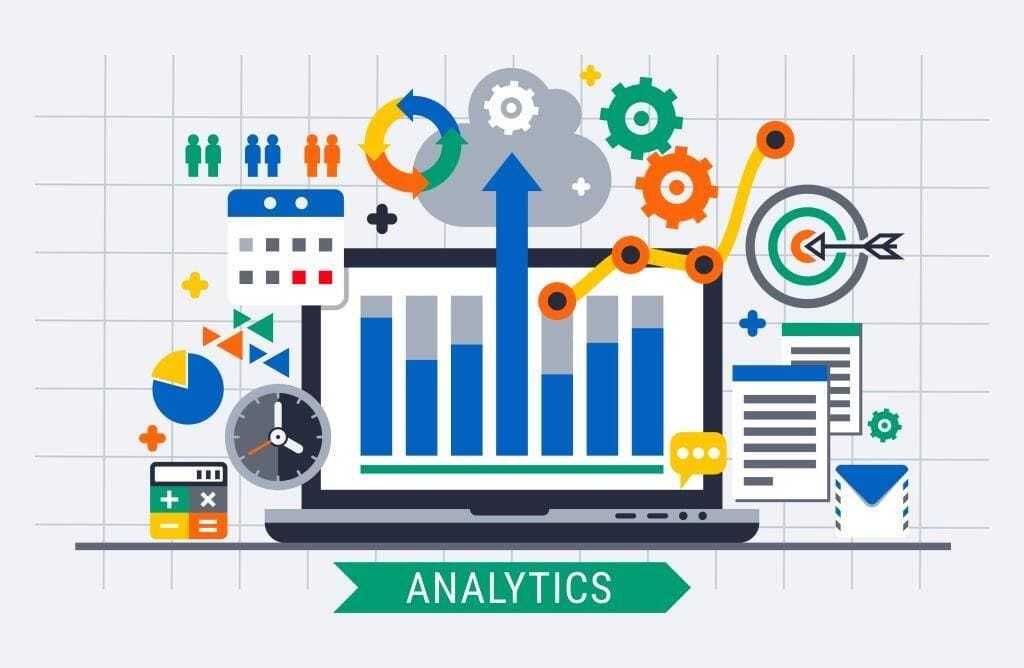
Key reasons why it is important include:
- Enables data-driven decisions instead of assumptions
- Helps identify inefficiencies and optimize operations
- Supports predictive analysis and forecasting
- Improves customer insights and personalization
- Enhances reporting accuracy and transparency
For working professionals, learning analytics provides a structured way to understand business problems through data, making them more valuable in cross-functional teams.
What Are the Key Benefits of Learning Data Analytics?
1. Improved Decision-Making Skills
One of the primary benefits of it is the ability to make informed decisions. Professionals can analyze trends, compare metrics, and evaluate outcomes before taking action. This reduces risk and increases confidence in business strategies.
2. High Demand Across Industries
Data analytics skills are widely adopted across industries. Organizations increasingly rely on data analysts to interpret large volumes of information. This demand creates opportunities for professionals from both technical and non-technical backgrounds.
3. Versatility of Career Options
Learning this opens pathways to multiple roles such as:
- Data Analyst
- Business Analyst
- Reporting Analyst
- BI Developer
- Data Visualization Specialist
Each role uses data analytics in different ways, but all require a strong understanding of data interpretation and reporting tools.
4. Practical Application in Real Projects
It is not just theoretical. Professionals apply these skills in real-world scenarios such as:
- Analyzing sales trends using dashboards
- Building reports for stakeholders
- Querying databases to extract business metrics
- Creating visualizations to communicate insights
This practical orientation makes learning this highly relevant for job roles.
How Does Data Analytics Work in Real-World IT Projects?
In enterprise environments, These follows a structured workflow:
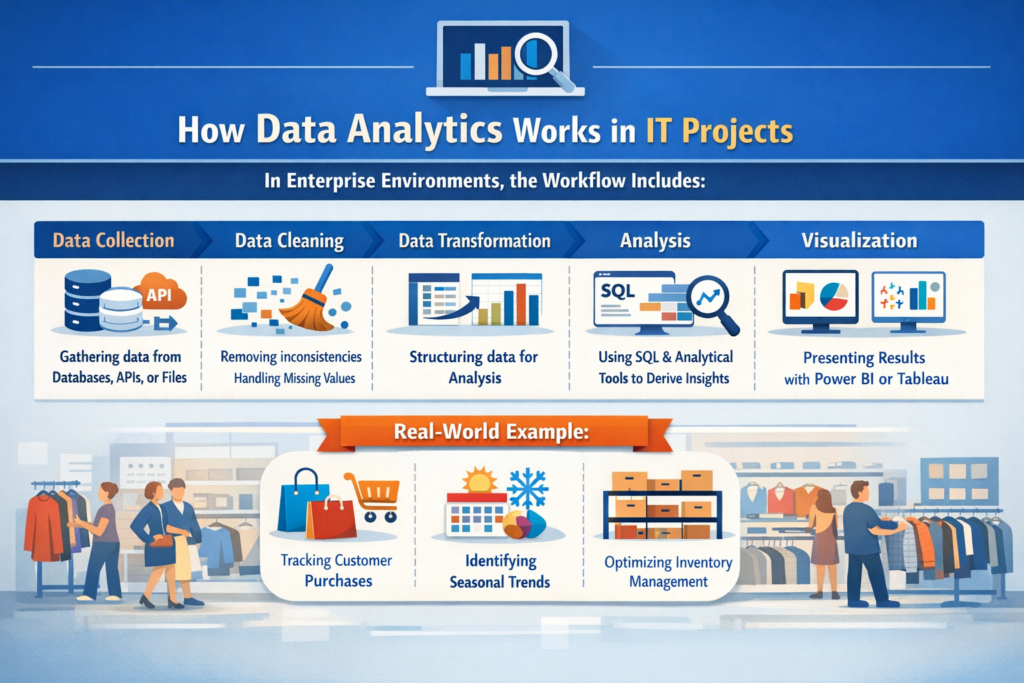
- Data Collection – Gathering data from databases, APIs, or files
- Data Cleaning – Removing inconsistencies and handling missing values
- Data Transformation – Structuring data for analysis
- Analysis – Using SQL or analytical tools to derive insights
- Visualization – Presenting results using Power BI or Tableau
For example, a retail company may use this to track customer purchases, identify seasonal trends, and optimize inventory management.
What Skills Are Required to Learn Data Analytics?
To effectively learn data analytics, professionals typically need a combination of technical and analytical skills:
- Basic understanding of statistics and data concepts
- Knowledge of SQL for database querying
- Familiarity with visualization tools like Power BI and Tableau
- Ability to interpret data and communicate findings
- Problem-solving and critical thinking skills
These skills are often developed through structured learning programs such as analytics training.
How Is Data Analytics Used in Enterprise Environments?
In enterprise IT systems, it is integrated into business intelligence workflows. Common use cases include:
- Financial reporting and budgeting
- Customer behavior analysis
- Operational performance tracking
- Risk management and compliance reporting
Organizations use BI tools to create dashboards that provide real-time insights. These dashboards are often used by management teams to monitor key performance indicators (KPIs).
What Job Roles Use Data Analytics Daily?
Several job roles rely heavily on this in their daily tasks:
- Data Analysts use SQL and visualization tools to generate reports
- Business Analysts interpret data to improve business processes
- BI Developers design dashboards and reporting systems
- Operations Analysts monitor performance metrics
These roles require consistent use of this tools and methodologies to support business objectives.
What Careers Are Possible After Learning Data Analytics?
Learning this can lead to a variety of career opportunities. Professionals can transition into roles that involve data interpretation, reporting, and decision support.
Common career paths include:
- Entry-level data analyst roles
- Mid-level business intelligence positions
- Advanced analytics or data engineering roles
The availability of an online certificate can help demonstrate competency and improve employability in competitive job markets.
How Does H2K Infosys Support Data Analytics Training?
H2K Infosys provides structured Data analytics training designed for working professionals. The training focuses on practical skills required in real-world projects, including SQL, Power BI, Tableau, and BI reporting techniques.
Key aspects of H2K Infosys training include:
- Hands-on project-based learning
- Exposure to real-time business scenarios
- Guidance on enterprise tools and workflows
- Flexible learning options for professionals
The program is aligned with industry requirements, helping learners build job-ready skills in data analytics.
Why Choose H2K Infosys for an Online Data Analytics Certificate?
An online certificate from H2K Infosys emphasizes applied learning rather than theoretical concepts. The curriculum is structured to cover essential tools and workflows used in enterprise environments.
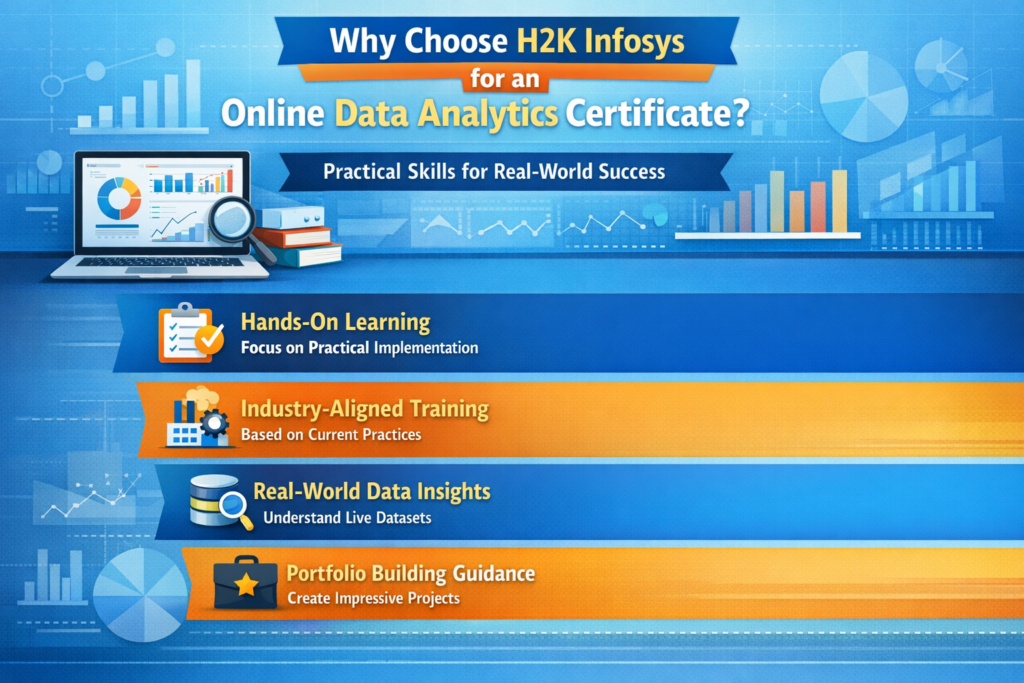
Benefits of choosing H2K Infosys include:
- Focus on practical implementation of data analytics
- Training aligned with current industry practices
- Support for understanding real-world datasets
- Guidance on building professional portfolios
This approach helps learners transition from learning concepts to applying it in real job roles.
Frequently Asked Questions (FAQ)
What is the main goal of learning data analytics?
The main goal is to develop the ability to analyze data and extract insights that support business decisions.
Is data analytics suitable for non-technical professionals?
Yes, many aspects of this can be learned with basic technical knowledge, especially with structured training.
How long does it take to learn data analytics?
The duration depends on the learning path, but most foundational skills can be acquired within a few months of consistent practice.
Which tools are essential for data analytics?
Common tools include SQL, Power BI, Tableau, and business intelligence platforms.
Does an online data analytics certificate help in getting a job?
An online certificate can validate skills and improve job prospects when combined with practical experience.
Conclusion
Learning data analytics provides professionals with the ability to interpret data, support decision-making, and contribute to business outcomes. It is widely applicable across industries and offers multiple career opportunities.
Key Takeaways:
- It enables data-driven decision-making
- Skills include SQL, visualization, and analytical thinking
- Tools like Power BI and Tableau are commonly used
- Career opportunities span multiple roles and industries
- Structured training helps build practical expertise
Explore H2K Infosys courses to gain hands-on experience in data analytics. Build practical skills and advance your career with structured learning.