Choosing between PMP or PSM is one of the biggest decisions for professionals entering Agile project management. Many learners ask whether the Professional Scrum Master certification is more relevant today or if the traditional Project Management Professional pathway still provides better stability and growth. The truth is simple: both certifications unlock strong opportunities, but your choice depends entirely on your goals, your work environment, and the type of projects you want to lead.
Today’s business landscape is changing fast. Agile teams work at high speed, and organizations want project leaders who can deliver value with clarity, collaboration, and adaptability. This pressure leads many professionals to explore certifications such as Certified Scrum Master certification, agile software certification, PSM certification, and other job-focused programs. But how do you decide between PMP or PSM when both appear valuable?
This detailed guide breaks everything down with real-world examples, research insights, and practical scenarios so you can clearly identify which certification aligns with your long-term career goals.
PMP or PSM – Which One Aligns with Your Future?
If you plan to work as a scrum project manager, Agile coach, or project lead, the debate around PMP or PSM is unavoidable. You want a credential that strengthens your profile, boosts your credibility, and supports your long-term career.
Industry leaders predict a continuous rise in demand for project management and Agile roles:
- 91% of organizations now use Agile practices in some form.
- PMI predicts 2.3 million new project management roles by 2030.
- Scrum is the most widely used Agile framework globally.
This tells us something important: both PMP and PSM matter but their use cases differ.
To help you decide, this blog explains:
- The meaning of each certification
- Core differences
- Real workplace applications
- Salary insights
- Role expectations
- Which certificate benefits which type of professional
- A practical step-by-step decision guide
Let’s start with the basics before comparing PMP or PSM across real job scenarios.
What Is PMP?
The Project Management Professional (PMP) certification focuses on traditional, predictive, and hybrid project management. It teaches a structured approach to planning, executing, controlling, and closing projects.
Key Focus Areas
- Project scheduling
- Cost management
- Risk management
- Stakeholder communication
- Scope and resource planning
- Hybrid and Agile concepts
Who Chooses PMP?
Professionals who:
- Work on large-scale projects
- Manage timelines, budgets, and resources
- Lead cross-functional teams
- Want global project management skills
Career Examples
- Project Manager
- Program Manager
- Delivery Manager
- PMO Lead
Many leaders choose PMP when they work across industries like construction, finance, healthcare, or telecom where traditional project cycles are common.
What Is PSM?
The Professional Scrum Master certification (PSM certification) focuses fully on Scrum values, Agile principles, servant leadership, product delivery, and team collaboration.
Key Focus Areas
- Scrum framework
- Sprint execution
- Scrum roles and events
- Delivery cycles
- Team facilitation
- Removing blockers
- Coaching developers and product owners
Who Chooses PSM?
Professionals who:
- Work in Agile teams
- Want to guide teams through Scrum processes
- Prefer flexibility and continuous delivery
- Enjoy coaching and facilitation roles
Career Examples
- Scrum Master
- Agile Coach
- Product Owner (entry roles)
- Delivery Facilitator
PSM is ideal for modern IT, software, gaming, DevOps, and digital product environments.
PMP or PSM – Core Differences You Must Know
This is the most important section because it explains how PMP or PSM differ in responsibilities, mindset, and career outcomes.
1. Methodology Orientation
| Area | PMP | PSM |
|---|---|---|
| Approach | Predictive + Hybrid + Agile | Pure Agile / Scrum |
| Structure | Highly process-driven | Lightweight and flexible |
| Leadership | Directive, structured | Servant leadership |
2. Role Expectations
- PMP-certified professionals plan, manage, and control large projects.
- PSM-certified professionals guide Agile teams and ensure smooth Scrum execution.
3. Work Environment
- PMP fits long-term, complex, multi-phase projects.
- PSM fits fast-paced product development teams.
4. Team Interaction
- PMP focuses on coordination, documentation, and stakeholder alignment.
- PSM focuses on removing blockers and coaching teams.
5. Exam Style
- PMP requires broad project management knowledge.
- PSM requires deep Scrum understanding.
When PMP or PSM Makes Sense (Based on Real Scenarios)
Understanding theory is one thing. Seeing real-world examples makes it easy to decide.
Here are seven real workplace scenarios:
Scenario 1: Large Enterprise System Migration
- Multiple vendors
- Multi-quarter timeline
- Heavy documentation
PMP is better.
Scenario 2: Mobile App Development
- Iterative builds
- Quick testing cycles
PSM is better.
Scenario 3: Banking or Insurance Compliance Project
- Strict deadlines
- Regulatory processes
PMP is better.
Scenario 4: E-commerce Product Feature Launch
- Backlog updates
- Sprint planning
PSM is better.
Scenario 5: Digital Transformation Program
- Hybrid teams
- Changing scope
Both PMP or PSM work well.
Scenario 6: Startups Building MVP
- Rapid changes
PSM is better.
Scenario 7: Multiple Vendor Coordination
- Contract-based work
PMP is better.
Understanding these differences will help you confidently pick between PMP or PSM in your own career.
Skills You Gain Through PMP or PSM
Skills from PMP
- Planning and scheduling
- Risk analysis
- Budget management
- Contracts and procurement
- Stakeholder communication
- Quality and compliance
Skills from PSM
- Sprint planning
- Agile coaching
- Removing blockers
- Conflict management
- Product delivery
- Value-driven decision making
Both skill sets are valuable but used differently across teams.
Career Growth Comparison – PMP or PSM?
Salary Insights
Industry surveys show:
- PMP-certified professionals often earn higher salaries in traditional project roles.
- PSM-certified professionals experience strong demand in tech, digital, and Agile teams.
Job Market Trends
- Agile roles are growing fast due to digital transformation.
- Traditional project management roles remain stable and necessary.
- Hybrid roles combining both areas are rising in demand.
This means both PMP or PSM offer strong returns on investment but for different job types.
PMP or PSM – Which One Should You Choose?
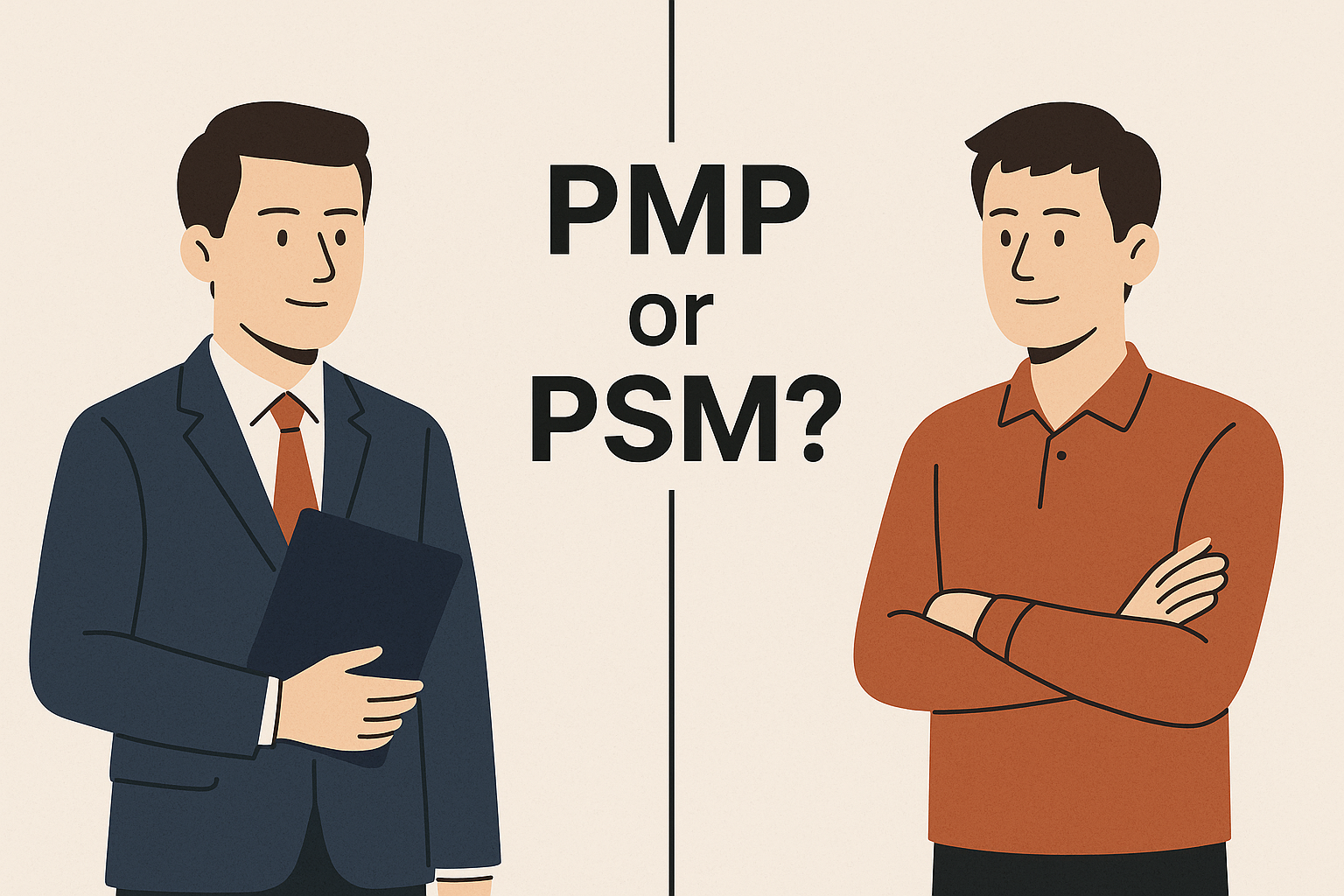
Below is a simple decision guide:
Choose PMP if you:
- Want global project management skills
- Manage budgets, schedules, and documentation
- Work in industries that follow structured planning
- Want to grow into PMO or program leadership roles
Choose PSM if you:
- Want to work with Agile and Scrum teams
- Prefer coaching instead of commanding
- Aim to become a scrum project manager
- Want faster career entry into IT and digital roles
- Want a certification with strong industry recognition
Choose Both if you:
- Want hybrid roles
- Aim for long-term leadership
- Work in companies that use mixed methodologies
Many professionals eventually choose both because PMP or PSM complement each other beautifully.
Humanized Insights — What Real Professionals Experience
Professionals who choose PMP often say:
“I lead bigger projects, manage budgets, and coordinate multiple teams. PMP helped me understand everything from schedules to risks.”
Professionals who choose PSM often say:
“I enjoy working directly with Agile teams. Coaching, sprint reviews, and backlog improvement feel rewarding. PSM made me effective on the ground.”
Both journeys are inspiring. Your path depends on whether you prefer structure or flexibility in your daily work.
Step-by-Step Guide to Decide Between PMP or PSM
Step 1: Identify your preferred work style
Do you enjoy planning or coaching?
Step 2: Analyze your industry
Tech → PSM
Mixed → Both
Traditional → PMP
Step 3: Review your long-term goals
Leadership → PMP
Team facilitation → PSM
Step 4: Check job descriptions in your region
See which certification appears more often.
Step 5: Evaluate learning curve
PMP covers broad management concepts.
PSM focuses deeply on Scrum.
Step 6: Consider your timeline
PSM usually requires less preparation time than PMP.
Step 7: Plan continuous learning
Most professionals eventually value both PMP or PSM.
The Real Answer – PMP or PSM?
Here is the truth that most experts agree on:
- Choose PSM if you want immediate entry into Agile and Scrum roles.
- Choose PMP if you want traditional project management leadership roles.
- Choose both if you want long-term, multi-industry career flexibility.
Modern organizations value professionals who can manage teams, deliver value, and adapt quickly. Learning through structured programs such as Agile Scrum-focused courses helps you gain real-world abilities for project success.
Conclusion
Both PMP and PSM give you strong career advantages. Your decision depends on your role, goals, and work style. Choose the one that fits your future and helps you grow as a confident project leader.
Start your Agile career journey with H2K Infosys. Enroll today to gain hands-on skills and build the career you deserve.