Through collaboration with both students and industry experts, H2K Infosys has identified an unmistakable trend: by 2026, understanding specific Salesforce features will become the definitive differentiator between run-of-the-mill administrators and those with an elevated level of value. Salesforce evolves quickly, and those admins who are able to quickly pivot to the changes are likely to receive promotions, increased salaries, and more strategic career opportunities.
Let’s take a look at Salesforce features that every admin will need to understand by 2026. I’m not talking about the ones you memorize and regurgitate in a future exam, but the ones that you actually apply in a high-pressure, live production scenario situation when the sales teams are screaming, ‘This isn’t working, why isn’t this working?!’
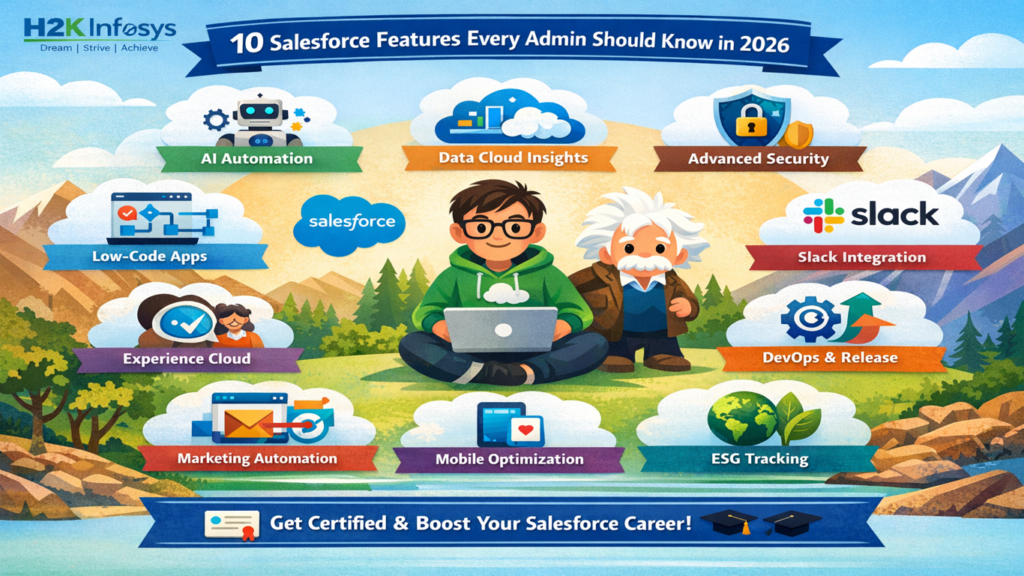
1. AI-Powered Automation (Einstein + Flow)
If you have been in Salesforce for even a year, you would appreciate that automation is everything. But for 2026, it is not about simple workflows.
New Salesforce Features, including AI and Flow, are changing the way admins create new solutions.
I remember working with a client in the retail sector last year. They had lead assignment that was manual, messy, and slow. With AI-driven Flow automation, we were able to reduce lead assignment from hours to seconds. That is the level of impact that businesses expect.
By leveraging specific Salesforce features, admins can create predictive automations that can suggest next steps, spot discrepancies, and enhance customer experience.
Therefore, most Salesforce certification programs focus primarily on Flow and AI capabilities as these are crucial.
2. Real-time Customer Insights and Data Cloud
One of the most highly anticipated Salesforce features is Data Cloud. It consolidates customer data from various sources as it enters the system, allowing companies to analyze as it arrives.
While consulting for a financial services company, we encountered a challenge when customer data was dispersed. After Data Cloud was implemented, the marketing and sales teams could view the same customer data, allowing for rapid growth in conversion rates.
Most advanced Salesforce certifications now include modules on real-time data, identity resolution, and data model management.
3. TrustZero and Enhanced Security
Security is something that admins usually take care of during audits, but that is no longer the case.
Recently, admins must integrate new Salesforce features for security, as there is, unfortunately, a perpetual increase in data security and compliance challenges. If he uses new permission sets and event monitoring, he must take a more proactive approach to the security of customer data.
When creating an online Salesforce course, include modules that cover the latest security strategies, as employers are prioritizing this the most.
4. Low-Code App Development
Low-code is now the norm.
Today’s admins are required to build applications. Salesforce has Admin tools such as App Builder, Dynamic Forms, and Components to streamline the process of creating applications with minimal code.
I personally know admins who learned these Salesforce Features and, within a couple of years, became solution architects. That’s the type of progression I’m talking about.
5. Slack and Collaboration Integration
When Salesforce bought Slack, many considered it just another tool. Now, however, collaboration within the CRM is crucial.
Recent Salesforce enhancements enable teams to automate direct interactions with customers (and other team members) inside Slack, eliminating emails and accelerating the decision-making process.
Candidates who understand and can integrate workflows among different platforms stand out during the hiring process.
6. Experience Cloud for Customer and Partner Portals
Customers want quick solutions and companies want to provide them. Experience Cloud facilitates this process.
To reduce support expenses and enhance user experience, admins should know how to set up and configure portal access to personalize user interactions.
In many Salesforce training certifications, this is a newly considered core skill.
7. DevOps and Release Management
Let’s be honest. Going through the deployment process has always been a painful process.
Now, Salesforce has DevOps related features such as version control, automated testing, and CI/CD (Continuous Integration and Continuous Deployment) pipelines. They now fall within the realm of ‘needed’ within the industry. Companies expect (and demand) faster and more frequent releases while also expecting not to break production.
Administrators who know and understand the concepts of Git, pipelines and the overall deployment strategy are in demand.
8. Hyper Personalization and Marketing Automation
Customers are expecting personalized experiences. Immediate personalization (real time) is made possible through the Salesforce features that integrate the CRM with the marketing tools.
An example of this is when I was consulting with an e-commerce brand that utilized these Salesforce Features to trigger a personalized offer. Their engagement rate skyrocketed in a matter of months.
Journey mapping, segmentation, and automation are skills that admins need to acquire. This is the reason advanced Salesforce certifications have marketing integration as their core.
9. Mobile First and Remote Work Enablement
At this point in 2026, remote work is still very prevalent. Salesforce functionalities that prioritize a mobile first approach, allow the sales team to work from anywhere.
Mobile UI, Offline capability, and overall performance are the areas that admins must focus on and develop.
If you have witnessed a sales rep battle with an unresponsive mobile application, you will understand this issue very well.
10. Sustainability and ESG Tracking
This may come as a surprise to many, but sustainability is now an aspect of CRM strategy.
New Salesforce Features are designed for companies to manage their environmental influence and social governance. Organizations need to be compliant and honest about their falls.
Admins learning these developing specialties are securing their prospects.
Importance of these competencies for advancing in a career
The need for skilled administrators has become universal. Companies are not looking for complainers to click through a system. They are seeking solutions.
That’s where a Salesforce certification course comes in. Many professionals are in middle Salesforce courses.
Seek professionalism in the Salesforce Certification Courses. Look for career counseling, live projects, and real issues. That’s the difference in readiness to take up a job.
Conclusion
To build a career for a Salesfore system administrator it’s necessary to learn modern Salesforce features that offer real world solutions to business problems. The technology may change but helping businesses improve by offering smarter and faster operating solutions and offering better insights to customers will always be needed.
Having an inquisitive and adaptable mindset will reward an admin with the most personal growth and development. Growth and development do not occur simply from having a comprehensive understanding. It’s more important to have an understanding that will help identify the important areas.
In the Salesforce ecosystem the possibilities are endless and are continually growing. Be patient, gain the needed experience, and continue to develop your skills.