Introduction:
Artificial Intelligence is not just a futuristic buzzword, it’s the heartbeat of modern digital transformation. From automating customer service to predicting business outcomes, AI is reshaping how we live and work. Whether you’re an aspiring tech professional or a curious learner, understanding the Top AI Trends, tools, and real-world uses of AI is crucial for success.
With the rise of demand in intelligent systems and machine learning applications, many learners are turning to Artificial Intelligence course online options to skill up. In this blog, we’ll dive deep into the Top AI Trends, essential tools, and powerful real-world applications. We’ll also explore how you can gain hands-on experience through Artificial intelligence online training programs designed with career placement in mind.
What Are the Top AI Trends in 2026?
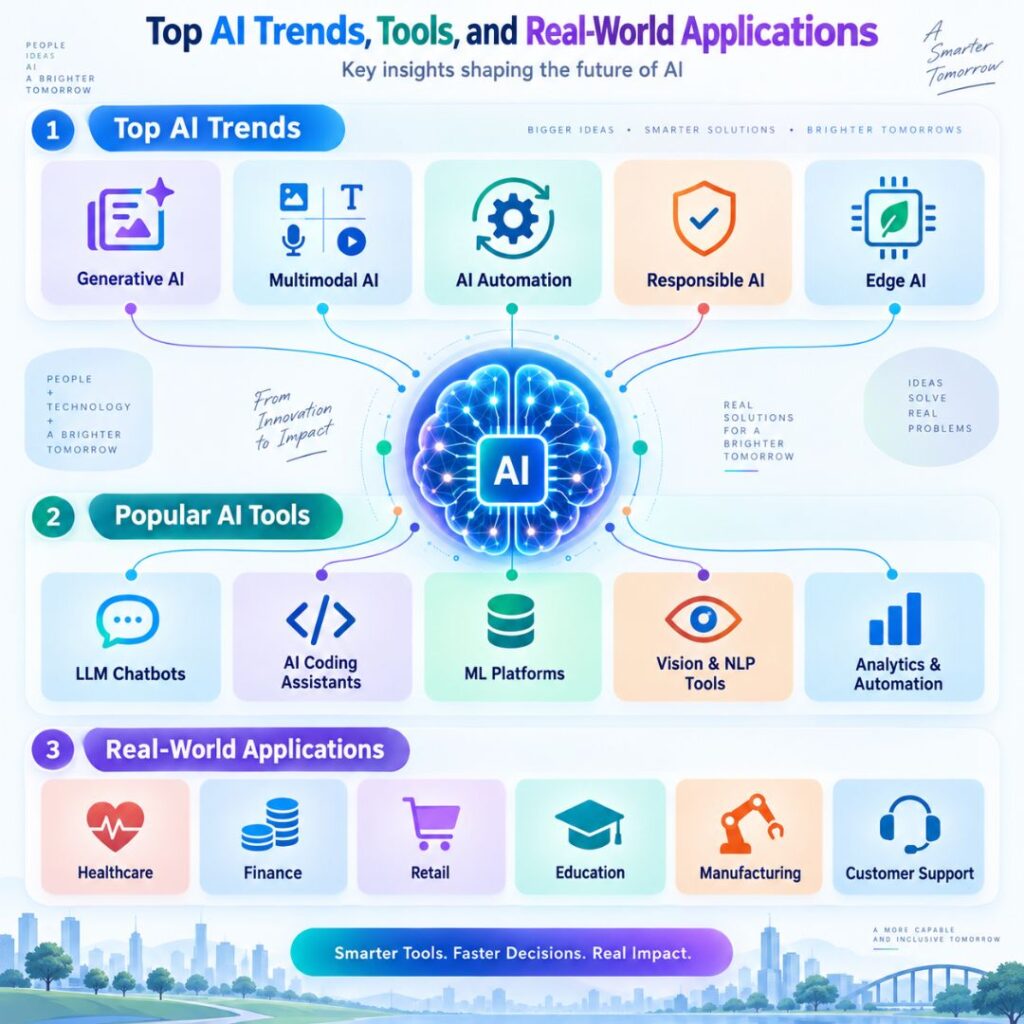
The top AI trends in 2026 are agentic AI, multimodal AI, generative AI, AI-powered automation, AI in software development, domain-specific AI, and AI security and governance. These trends are changing how businesses use artificial intelligence to automate tasks, analyze information, create content, improve decision-making, and build more efficient workflows.
1. Agentic AI
Agentic AI is becoming a major trend in 2026 as AI systems move beyond simple question-and-answer tasks and begin handling multi-step activities with greater independence. AI agents can plan tasks, make decisions, use different tools, and complete workflows with limited human input. Businesses are exploring agentic AI for customer support, research, data analysis, software development, and business process automation.
2. Multimodal AI
Multimodal AI allows systems to understand and work with different types of information, including text, images, audio, and video. Instead of relying only on written prompts, users can interact with AI using multiple formats. This trend is creating new opportunities in areas such as education, healthcare, customer service, content creation, and accessibility.
3. Generative AI
Generative AI continues to evolve in 2026, with applications extending beyond content generation. Organizations are using AI to create text, images, presentations, software code, reports, and other business content. Improvements in AI models are making these tools more useful for everyday workflows while helping professionals save time and focus on higher-value tasks.
4. AI-Powered Automation
AI-powered automation combines artificial intelligence with business workflows to reduce repetitive manual work. Companies are using AI to automate tasks such as document processing, data entry, customer communication, reporting, and workflow management. This trend is helping organizations improve efficiency while allowing employees to spend more time on analysis, problem-solving, and strategic activities.
5. AI in Software Development
AI is increasingly becoming part of the software development process, supporting developers with code generation, debugging, testing, documentation, and code review. AI coding assistants can help developers work faster and explore solutions more efficiently. However, human developers still play an important role in reviewing AI-generated code, maintaining quality, and making technical decisions.
6. Domain-Specific AI
Domain-specific AI models are designed for particular industries or business functions rather than general-purpose use. These systems can be tailored to areas such as healthcare, finance, cybersecurity, legal services, and manufacturing, where specialized knowledge and requirements are important. This approach can make AI more relevant and useful for specific professional workflows.
7. AI Security and Governance
As AI adoption grows, security, privacy, and responsible AI are becoming increasingly important. Organizations need to manage risks related to sensitive data, inaccurate outputs, bias, unauthorized AI use, and model security. AI governance helps businesses establish guidelines for how AI systems are developed, deployed, monitored, and used responsibly.
8. AI in Real-World Business Applications
AI is moving deeper into everyday business operations, with applications in marketing, sales, finance, healthcare, customer service, human resources, and data analysis. Rather than using AI only for experimentation, organizations are focusing on practical use cases that can improve productivity, decision-making, customer experiences, and operational efficiency.
Why AI Tools Matter More Than Ever
Key AI Tools to Learn in 2026
To master the Top AI Trends, you must be familiar with the right tools:
- Python: The go-to language for AI development, known for its simplicity and rich libraries like TensorFlow and Scikit-learn.
- TensorFlow: Open-source library for numerical computation and machine learning.
- Keras: High-level neural networks API written in Python.
- Pandas & NumPy: Ideal for data preprocessing and numerical analysis.
- Jupyter Notebooks: A great environment for testing AI models interactively.
- AutoML Tools: Emerging tools that help automate the machine learning workflow without writing complex code.
Each of these tools plays a vital role in implementing the Top AI Trends that are shaping industries today.
Real-World Applications of AI
Let’s now move from theory to practice and look at how the Top AI Trends are applied in the real world.
1. AI in Finance
Banks use AI for fraud detection, credit scoring, and personalized customer service. AI tools analyze transactional behavior to flag anomalies within milliseconds.
2. AI in Retail
Retailers use AI for demand forecasting, price optimization, and customer personalization. Chatbots and recommendation engines are powered by machine learning algorithms.
3. AI in Manufacturing
AI predicts equipment failures, reduces downtime, and optimizes supply chain operations. This application reflects one of the Top AI Trends: predictive analytics in production.
4. AI in Education
AI customizes learning paths based on student performance. Adaptive learning platforms are becoming more sophisticated, enhancing both online and offline education.
5. AI in Agriculture
Farmers now rely on AI for crop health monitoring, weather prediction, and yield estimation. These innovations help in addressing food security, marking agriculture’s place in the Top AI Trends.
Artificial Intelligence Course Online: Why It’s the Smart Choice
Choosing an Artificial intelligence course online equips you with flexible, accessible learning tailored to modern careers. Online courses offer:
- Self-paced learning
- Hands-on projects
- Live mentor sessions
- Industry-based scenarios
At H2K Infosys, our Artificial Intelligence online training modules are designed with beginners and working professionals in mind. You don’t just learn theory, you apply skills through real projects aligned with the Top AI Trends.
AI Courses with Placement: Bridge the Gap Between Learning and Earning
The job market is actively seeking professionals trained in the Top AI Trends. But training is only part of the equation. Placement support ensures you land roles that match your skills.
Our AI courses with placement help learners:
- Prepare for interviews with mock sessions
- Build strong portfolios with project work
- Connect with hiring partners in AI-focused industries
- Gain resume feedback and career guidance
With Artificial Intelligence certification online, you earn credentials that validate your expertise and give you a competitive edge in the job market.
Step-by-Step: How to Master Top AI Trends
To truly gain expertise in the Top AI Trends, follow this structured path:
Step 1: Understand the Basics
Learn foundational concepts, AI types, supervised and unsupervised learning, neural networks, and decision trees.
Step 2: Practice With Tools
Use Python, TensorFlow, and Jupyter to build simple machine learning models.
Step 3: Work on Mini Projects
Try real-world tasks like stock price prediction, chatbot creation, or sentiment analysis.
Step 4: Join an Artificial Intelligence Course Online
Choose structured Artificial Intelligence online training that provides a syllabus aligned with market needs.
Step 5: Get Certified
Complete an Artificial Intelligence certification online to validate your learning.
Step 6: Focus on Placement
Pick AI courses with placement to transition smoothly into the workforce.
The Role of AI in Future Careers
Mastering the Top AI Trends opens doors to high-paying and diverse career paths:
- AI Engineer
- Machine Learning Developer
- Data Scientist
- Business Intelligence Analyst
- AI Researcher
- AI Product Manager
With every industry tapping into AI’s power, job roles are expanding across domains from tech to healthcare and finance to education.
Long-Tail Keywords to Know in AI Learning
In your journey, keep these long-tail keyword concepts in mind to align your learning with niche skills:
- “AI-powered chatbots for eCommerce”
- “Python for AI beginners”
- “Job-oriented AI courses with placement support”
- “Online Artificial Intelligence certification programs”
- “AI tools for business intelligence in 2026”
Understanding and targeting these terms ensures your skill set stays aligned with the Top AI Trends.
Make AI Your Career Catalyst
Artificial Intelligence is no longer optional, it’s essential. The Top AI Trends are not just shaping technology but also redefining what it means to be job-ready in the modern world. With the right tools, real-world experience, and targeted training, you can future-proof your career.
Whether you’re just starting or upskilling, Artificial Intelligence course online options give you the flexibility to learn at your own pace while ensuring practical application. Combine that with AI courses with placement, and you’ve got a roadmap to success.
Conclusion:
Stay ahead by mastering the Top AI Trends. Enroll in H2K Infosys’ Artificial Intelligence online training and fast-track your AI career with real-world skills and placement support.
FAQs:
1. What are the top AI trends in 2026?
The top AI trends in 2026 include agentic AI, multimodal AI, generative AI, AI-powered automation, AI software development, domain-specific AI, and AI security.
2. What is agentic AI?
Agentic AI refers to systems that can plan tasks, make decisions, use tools, and complete multi-step workflows with limited human intervention.
3. How is generative AI used in businesses?
Generative AI is used for content creation, software development, data analysis, customer support, marketing, and automating repetitive business tasks.
4. What are some popular AI tools?
Popular AI tools include AI assistants, coding platforms, content-generation tools, data-analysis solutions, image and video generators, and business automation platforms.
5. What are the real-world applications of AI?
AI is used in healthcare, finance, education, marketing, cybersecurity, manufacturing, customer service, and software development.