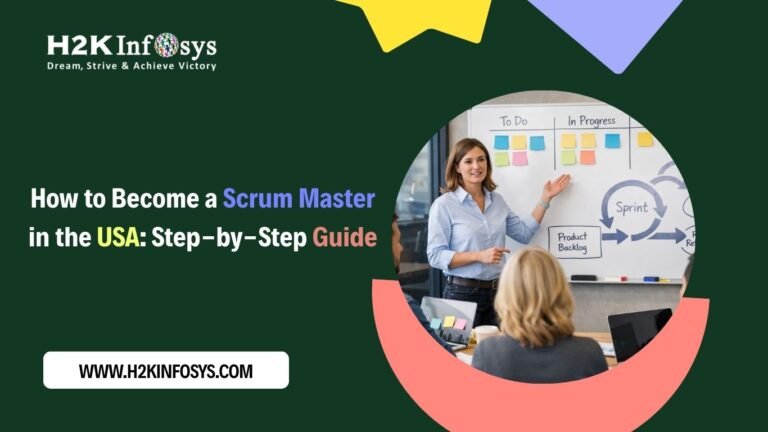
Becoming a Scrum Master in the USA involves learning Agile and Scrum principles, gaining practical experience working with Scrum teams, and earning a recognized Scrum certification aligned with industry expectations. A Scrum Master in the USA typically supports Agile teams by facilitating Scrum events, removing impediments, and ensuring Scrum is applied correctly in enterprise software and business environments. This role requires both conceptual knowledge of Agile frameworks and hands-on experience working within real-world delivery constraints.
What is a Scrum Master in the USA?
A Scrum Master in the USA is a professional responsible for enabling Scrum teams to follow the Scrum framework effectively within organizations that adopt Agile delivery models. The role is defined in the Scrum Guide and focuses on facilitation, coaching, and process ownership rather than traditional project management authority.
In enterprise environments, a Scrum Master in the USA often works alongside product owners, developers, QA engineers, business analysts, and stakeholders across distributed teams. The Scrum Master ensures that Scrum values transparency, inspection, and adaptation are practiced consistently while aligning Agile delivery with organizational goals.
Key responsibilities include:
- Facilitating Scrum ceremonies (Sprint Planning, Daily Scrum, Sprint Review, Retrospective)
- Coaching teams on Agile principles and Scrum practices
- Removing blockers that impact delivery
- Supporting product owners with backlog refinement
- Helping organizations adopt Agile ways of working
How does Agile Scrum Master work in real-world IT projects?
In real-world IT projects, Agile Scrum Master responsibilities extend beyond running meetings. Scrum Masters operate within complex environments that include legacy systems, compliance requirements, distributed teams, and evolving business priorities.
A typical enterprise workflow includes:
- Product owners maintaining and prioritizing a product backlog
- Scrum teams delivering increments in time-boxed sprints
- Scrum Masters facilitating communication and continuous improvement
Scrum master training focuses on applying Agile and Scrum training concepts in scenarios such as:
- Coordinating releases across multiple Scrum teams
- Managing dependencies between Agile and non-Agile teams
- Supporting DevOps and CI/CD pipelines
- Addressing stakeholder expectations and delivery risks
Agile and scrum training prepares professionals to handle these realities by emphasizing inspection and adaptation rather than rigid plans.
Why is becoming a Scrum Master in the USA important for working professionals?
The demand for Agile delivery has made the Scrum Master in the USA a relevant career option for professionals transitioning from QA, development, business analysis, or project coordination roles. Organizations commonly adopt Scrum to improve delivery predictability, collaboration, and responsiveness to change.
For working professionals, Scrum master training provides:
- Transferable skills applicable across industries
- Exposure to enterprise Agile practices
- Alignment with agile software certification standards
A Scrum Master in the USA is often involved in organizational Agile transformations, making the role valuable beyond individual project teams.
What skills are required to learn Agile Scrum Master practices?
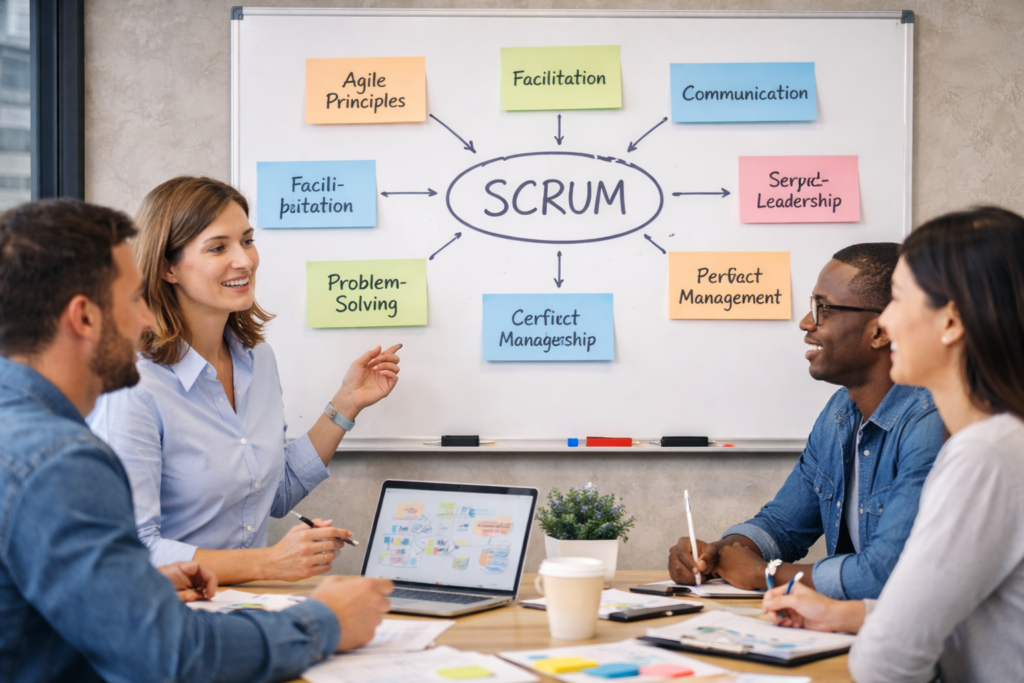
Learning Agile Scrum Master skills requires a balance of technical awareness, facilitation ability, and systems thinking. Scrum Masters do not manage people directly but influence outcomes through collaboration and coaching.
Core skill areas include:
Agile and Scrum Fundamentals
- Scrum roles, events, and artifacts
- Agile values and principles
- Incremental and iterative delivery
Facilitation and Communication
- Running effective meetings
- Conflict resolution
- Stakeholder communication
Technical and Delivery Awareness
- Understanding SDLC and DevOps workflows
- Working with tools such as Jira, Azure DevOps, and Confluence
- Supporting cross-functional Agile teams
Agile and scrum training programs often combine theory with case-based discussions to reflect real enterprise constraints.
How is Scrum used in enterprise environments in the USA?
In enterprise settings, Scrum is rarely implemented in isolation. A Scrum Master in the USA typically operates within scaled Agile environments where multiple teams contribute to shared products.
Common enterprise adaptations include:
- Scrum of Scrums coordination
- Integration with SAFe, LeSS, or enterprise Agile frameworks
- Alignment with governance, compliance, and security standards
Scrum master training and placement programs often introduce learners to these scaled environments, preparing them to operate effectively beyond small, single-team projects.
Step-by-step guide to become a Scrum Master in the USA
Step 1: Learn Agile and Scrum fundamentals
Begin with structured agile and scrum training that covers:
- Agile manifesto and principles
- Scrum framework and roles
- Sprint lifecycle and metrics
This foundational knowledge is essential before pursuing certification scrum agile paths.
Step 2: Gain practical exposure to Scrum environments
Hands-on exposure can be gained through:
- Working on Agile teams in current roles
- Participating in simulated Scrum projects
- Observing Scrum ceremonies and workflows
Practical experience helps contextualize Certified scrum master certification concepts.
Step 3: Choose the right Scrum certification
Common certification paths include:
- Certified scrum master certification (CSM)
- Professional Scrum Master (PSM)
- Agile software certification programs
Certification scrum agile programs validate foundational knowledge but should be supported by real-world application.
Step 4: Apply Scrum practices in real projects
Applying Scrum involves:
- Facilitating ceremonies
- Coaching teams on Agile values
- Supporting continuous improvement
Scrum master training emphasizes applying these skills under real constraints.
Step 5: Prepare for Scrum Master roles in the USA job market
A Scrum Master in the USA is expected to demonstrate:
- Practical understanding of Agile delivery
- Experience with enterprise tools
- Ability to support cross-functional teams
Scrum master training and placement initiatives often include interview preparation and role alignment.
What job roles use Scrum daily?
Scrum is used daily by several roles, including:
- Scrum Master in the USA
- Product Owner
- Agile Coach
- Business Analyst working in Agile teams
- Development and QA leads
These roles collaborate closely to deliver incremental value.
What careers are possible after learning Agile Scrum Master skills?
Learning Agile Scrum Master skills can lead to roles such as:
- Scrum Master in the USA
- Senior Scrum Master
- Agile Coach
- Delivery Manager
- Program-level Agile roles
Career progression often depends on experience with complex enterprise environments rather than certification alone.
Tools commonly used by Scrum Masters in enterprise projects
| Category | Tools |
|---|---|
| Agile Planning | Jira, Azure DevOps |
| Collaboration | Confluence, MS Teams |
| Reporting | Burndown charts, Velocity metrics |
| DevOps Integration | Jenkins, Git-based tools |
Understanding how these tools support workflows is part of effective scrum master training.
Common challenges faced by Scrum Masters in the USA
A Scrum Master in the USA may encounter challenges such as:
- Resistance to Agile adoption
- Distributed and remote teams
- Stakeholder pressure on delivery timelines
- Balancing Scrum purity with enterprise constraints
Best practices focus on incremental improvement rather than rigid enforcement.
Frequently Asked Questions (FAQ)
Is certification mandatory to become a Scrum Master in the USA?
Certification is not legally mandatory, but Certified scrum master certification or similar credentials are commonly expected by employers.
How long does it take to become a Scrum Master in the USA?
The timeline varies based on prior experience, but foundational agile and scrum training followed by hands-on practice typically takes several months.
Can non-technical professionals become Scrum Masters?
Yes. Many Scrum Masters come from QA, BA, or coordination backgrounds, provided they understand Agile delivery workflows.
What is the difference between Agile Coach and Scrum Master?
A Scrum Master focuses on one or more teams, while an Agile Coach operates at program or organizational levels.
Key takeaways
- A Scrum Master in the USA enables Agile teams to apply Scrum effectively in enterprise environments
- Agile and scrum training provides foundational knowledge but must be paired with practical experience
- Certification scrum agile programs validate understanding but do not replace real-world exposure
- Scrum master training and placement pathways support career transitions when aligned with hands-on practice
Explore Agile Scrum Master learning paths at H2K Infosys to build practical skills and apply them in real-world enterprise projects.
Advance your professional growth with structured training designed for working professionals.