

AI courses with placement can help candidates get AI jobs faster when they provide structured learning, hands-on project experience, and job-readiness support such as resume guidance and interview preparation. At H2K Infosys, AI Training Programs are designed to align with real-world hiring needs and enterprise AI workflows. Programs focused on AI learning for beginners often reduce learning time by aligning training with real industry tools, workflows, and hiring expectations rather than theory alone.
What is “Do AI Courses with Placement Really Help Candidates Get AI Jobs Faster?”
AI courses with placement are structured training programs designed to teach artificial intelligence skills while also supporting job readiness. These programs typically combine technical learning with career preparation components such as:
- Portfolio and project development
- Resume and LinkedIn optimization
- Mock technical interviews
- Real-world scenario-based assignments
- Guidance on job search strategy
The goal is not to guarantee employment but to shorten the time between learning AI concepts and applying for real job roles.
For many working professionals transitioning into AI roles, structured Ai learning for Beginners can provide clarity, direction, and industry context that self-learning alone may lack.
How Does AI Work in Real-World IT Projects?
In enterprise environments, AI is rarely used as standalone algorithms. Instead, it operates inside full production workflows.
Typical Enterprise AI Workflow
| Stage | What Happens | Tools Commonly Used |
|---|---|---|
| Data Collection | Raw data gathered from apps, sensors, logs | SQL, APIs, Data Lakes |
| Data Processing | Cleaning and transformation | Python, Pandas, Spark |
| Model Training | Machine learning model building | TensorFlow, PyTorch, Scikit-learn |
| Deployment | Model integrated into applications | Docker, Kubernetes, Cloud ML |
| Monitoring | Performance tracking and updates | MLOps tools, Logging platforms |
Real Example Scenarios
Fraud Detection Systems
- AI models analyze transaction patterns
- Flag unusual behavior in milliseconds
Customer Support Automation
- NLP models classify customer queries
- Route tickets to correct teams
Predictive Maintenance
- Models predict equipment failure
- Reduce downtime in manufacturingProfessionals learning through structured Ai and Machine learning Courses often practice these workflows using simulated enterprise datasets.
Why is AI Course Placement Support Important for Working Professionals?
Working professionals face three main barriers when transitioning into AI:
1. Skill Gap vs Job Requirements
Companies expect:
- Real tool exposure
- Project-based understanding
- Production workflow knowledge
2. Interview Readiness Gap
Many learners know theory but struggle to explain:
- Model selection reasoning
- Data preprocessing decisions
- Performance tuning approaches
3. Portfolio Gap
Employers often prefer candidates with:
- GitHub projects
- Case study explanations
- Dataset handling experience
Structured ai programs help bridge these gaps by focusing on applied learning rather than just conceptual knowledge.
What Skills Are Required to Learn AI and Machine Learning Courses?
Core Technical Skills
| Skill Area | Why It Matters |
|---|---|
| Python Programming | Most AI frameworks rely on Python |
| Statistics & Probability | Required for model understanding |
| Data Handling | Cleaning, transformation, feature engineering |
| Machine Learning Concepts | Model training, evaluation, optimization |
| Basic Cloud Knowledge | Deployment and scaling models |
Supporting Skills
- Data visualization
- SQL querying
- Version control (Git)
- API integration basics
- Basic Linux command usage
How Is AI Used in Enterprise Environments?
AI adoption in enterprises is usually practical and problem-focused rather than experimental.
Enterprise AI Use Cases
Finance
- Risk scoring
- Credit prediction
- Fraud monitoring
Healthcare
- Medical imaging analysis
- Patient risk prediction
Retail
- Recommendation engines
- Demand forecasting
IT Operations
- Log anomaly detection
- Predictive incident alerts
Enterprise Constraints AI Teams Must Consider
- Data privacy compliance
- Model explainability requirements
- Scalability under heavy load
- Security vulnerabilities
- Cost optimization in cloud environments
These constraints are often covered in advanced Ai and machine learning.
What Job Roles Use AI Daily?
Core AI Roles
| Role | Primary Focus |
|---|---|
| Machine Learning Engineer | Build and deploy ML models |
| Data Scientist | Analyze data and create predictive models |
| AI Engineer | Integrate AI into applications |
| NLP Engineer | Build language-based AI systems |
| Computer Vision Engineer | Image and video AI models |
Supporting AI Roles
- Data Analyst (AI-assisted analytics)
- MLOps Engineer
- AI QA Testing Specialist
- AI Product Analyst
For professionals already in QA or data roles (like many career switchers), machine learning courses help transition into hybrid AI roles.
What Careers Are Possible After Learning AI?
Entry-Level Roles
- Junior ML Engineer
- AI Data Analyst
- AI Support Engineer
- Junior Data Scientist
Mid-Level Roles
- ML Engineer
- AI Application Developer
- AI Automation Specialist
Advanced Roles
- AI Architect
- Research Scientist
- AI Platform Engineer
Career progression usually depends on:
- Project depth
- Tool specialization
- Domain expertise
Do AI Courses with Placement Actually Reduce Job Search Time?
They can help reduce job search time when they include:
Job Acceleration Factors
Industry-Relevant Projects
- Kaggle-style datasets
- Real business problem simulations
Interview Simulation
- ML theory discussion
- Coding tests
- System design basics
Resume Positioning
- Highlight measurable project outcomes
- Demonstrate tool stack proficiency
However, results vary based on:
- Candidate practice consistency
- Project quality
- Market conditions
- Communication skills
Practical Learning Path for AI Beginners
Step 1: Programming Foundation
Learn:
- Python basics
- Data structures
- NumPy and Pandas
Step 2: Data Fundamentals
Learn:
- Data cleaning
- Feature engineering
- Data visualization
Step 3: Machine Learning Fundamentals
Learn:
- Supervised learning
- Unsupervised learning
- Model evaluation
Step 4: Real Project Implementation
Build:
- Prediction models
- Classification models
- NLP mini projects
Step 5: Deployment Basics
Learn:
- Model APIs
- Cloud hosting basics
- Monitoring metrics
This structured path is typical in strong Ai and machine learning courses.
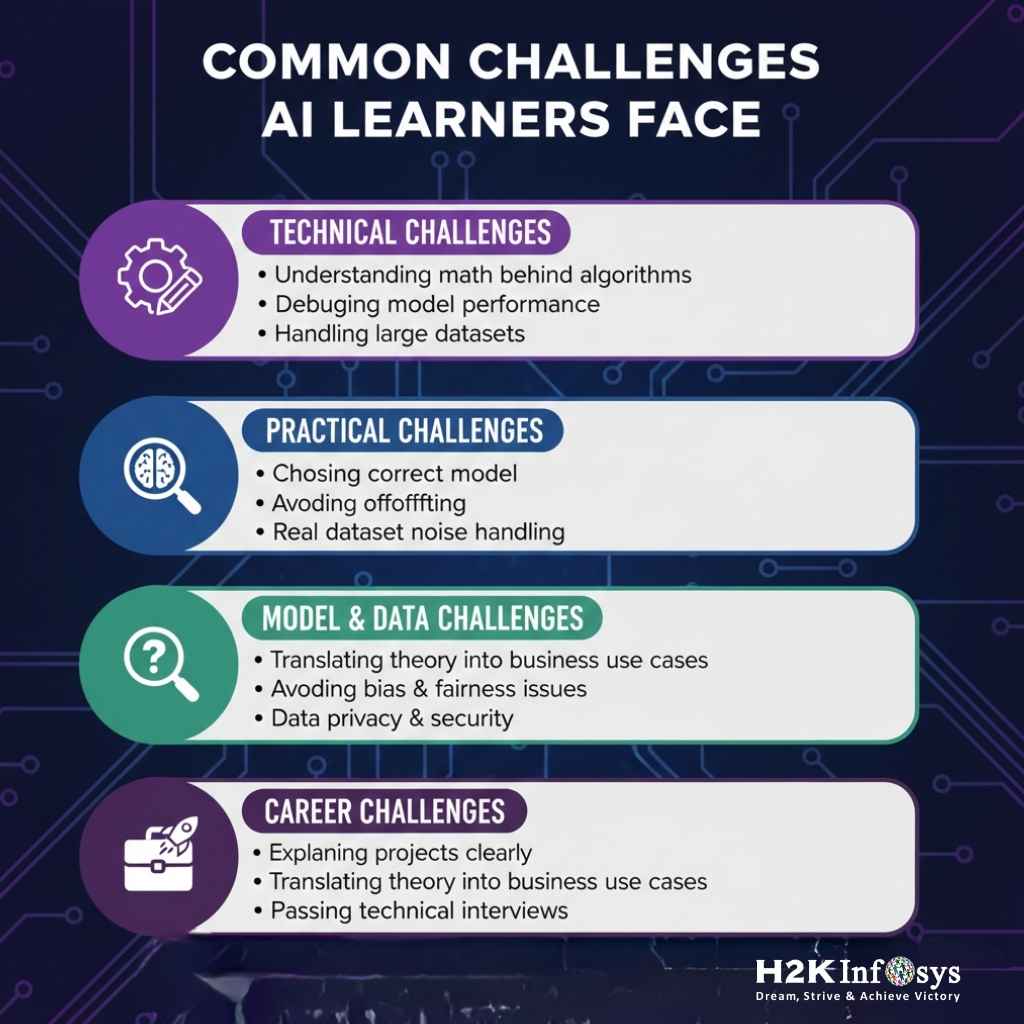
Common Challenges AI Learners Face
Technical Challenges
- Understanding math behind algorithms
- Debugging model performance
- Handling large datasets
Practical Challenges
- Choosing correct model
- Avoiding overfitting
- Real dataset noise handling
Career Challenges
- Explaining projects clearly
- Translating theory into business use cases
- Passing technical interviews
Structured ai learning helps address these step-by-step.
Tool Comparison Table (Beginner to Enterprise)
| Tool | Beginner Friendly | Enterprise Usage |
|---|---|---|
| Python | Yes | Yes |
| Scikit-learn | Yes | Yes |
| TensorFlow | Medium | Yes |
| PyTorch | Medium | Yes |
| AWS AI Services | Medium | Yes |
| Azure ML | Medium | Yes |
Role vs Skill Mapping
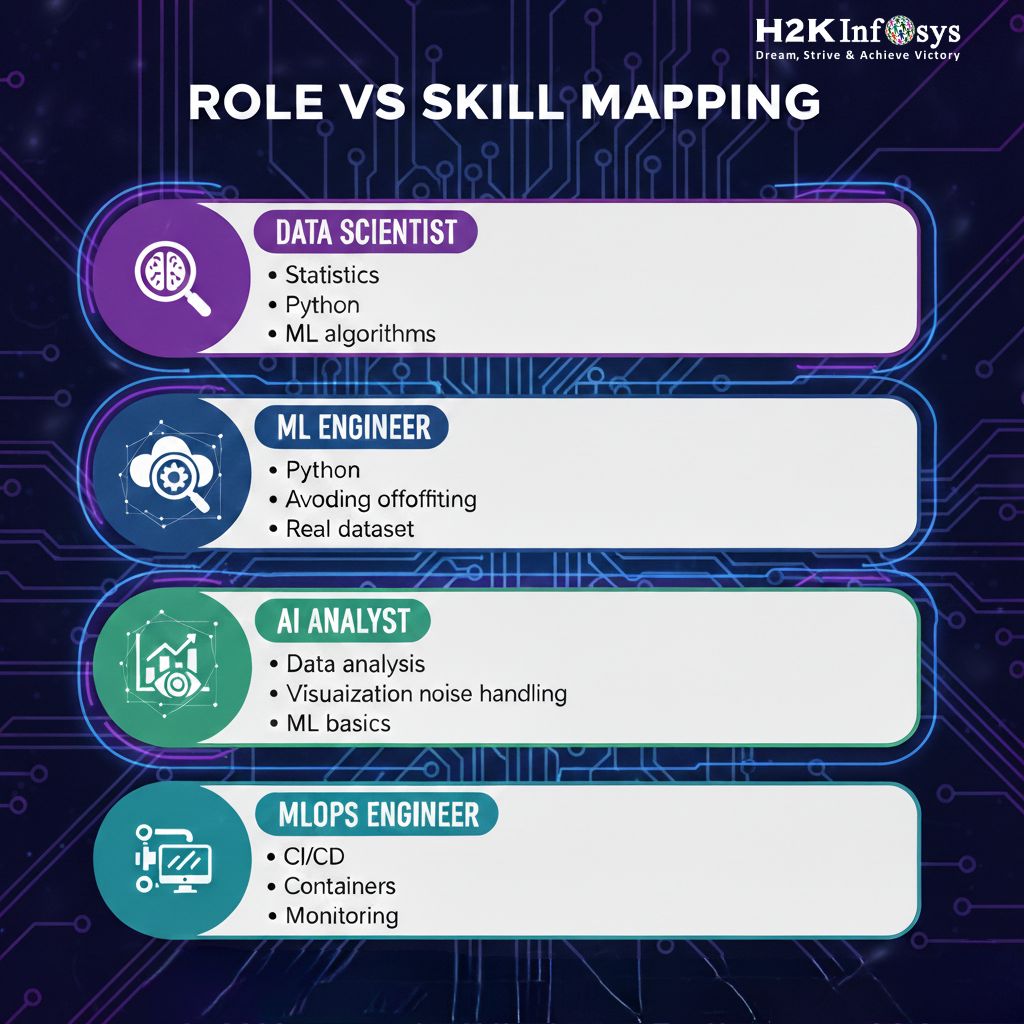
| Role | Must-Have Skills |
|---|---|
| Data Scientist | Statistics, Python, ML algorithms |
| ML Engineer | Python, Deployment, Cloud |
| AI Analyst | Data analysis, Visualization, ML basics |
| MLOps Engineer | CI/CD, Containers, Monitoring |
How AI Is Actually Used in Daily Work (Example)
Example: Customer Churn Prediction
Daily Tasks
- Pull data from database
- Clean missing values
- Train prediction model
- Evaluate accuracy
- Deploy model API
- Monitor performance weekly
FAQ Section
Do AI courses with placement guarantee jobs?
No. They improve readiness and reduce skill gaps but cannot guarantee hiring outcomes.
Are AI courses suitable for non-coding backgrounds?
Yes, if they start with programming basics and structured ai learning for beginners.
How long does it take to become job-ready in AI?
Typically 6–12 months depending on:
Practice hours
Project complexity
Learning consistency
Is math mandatory for AI?
Basic statistics and probability are essential. Advanced math depends on specialization.
Are projects important for AI hiring?
Yes. Most employers evaluate:
Problem-solving approach
Data handling ability
Model selection reasoning
When AI Placement Courses May NOT Help
They may be less effective if:
- Training is theory-only
- No real projects included
- No interview preparation
- Outdated tools used
When They Are Most Effective
They are most effective when they include:
- Real dataset projects
- Enterprise tool exposure
- Code + concept training
- Job preparation support
Key Takeaways
- AI placement courses can reduce learning-to-job transition time
- Real projects matter more than theory alone
- AI roles require both technical and practical business understanding
- Portfolio and interview preparation significantly impact hiring speed
- Structured Ai and machine learning courses help professionals switch careers faster when combined with consistent practice














One Response
Very insightful explanation of how AI courses with placement actually help candidates become job-ready faster. I liked the real-world workflow breakdown and the focus on portfolio, interview readiness, and enterprise use cases. For professionals coming from Java real time projects online training, this kind of structured AI and machine learning learning path makes it much easier to transition into AI roles with practical, industry-level exposure. Great read for both beginners and working professionals!