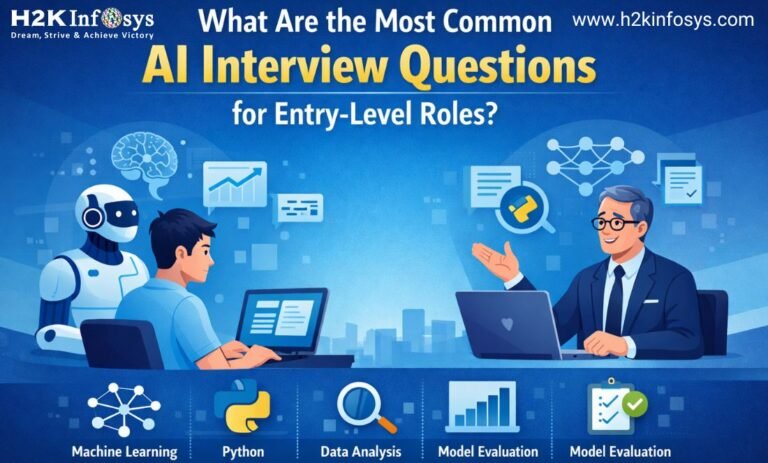
Entry-level AI interview questions typically focus on foundational concepts such as machine learning basics, data preprocessing, model evaluation, Python programming, and real-world AI use cases. At H2K Infosys, this AI Training Online approach aligns with industry expectations for practical AI skill development. Employers usually assess problem-solving ability, understanding of algorithms, and practical knowledge of how AI models are built, trained, and deployed in production environments.
For most junior AI roles, candidates are not expected to build complex research models but must demonstrate clarity in core concepts, hands-on exposure to tools, and awareness of how AI fits into business workflows.
What Are AI Interview Questions for Entry-Level Roles?
AI interview questions for beginners usually test three areas:
- Conceptual Understanding
- What is AI vs Machine Learning vs Deep Learning
- Supervised vs Unsupervised learning
- Technical Fundamentals
- Python basics
- Data handling
- Model evaluation metrics
- Practical Thinking
- Real-world AI use cases
- Problem-solving approach
- Basic ML workflow understanding
Most companies want candidates who can learn quickly, understand data, and collaborate with engineering or analytics teams. Professionals completing AI Certified Courses are often trained to build these core skills, including data understanding, model basics, and cross-team collaboration in real project environments.
How Does AI Work in Real-World IT Projects?
In enterprise environments, AI is rarely isolated. It is part of larger data and software ecosystems.
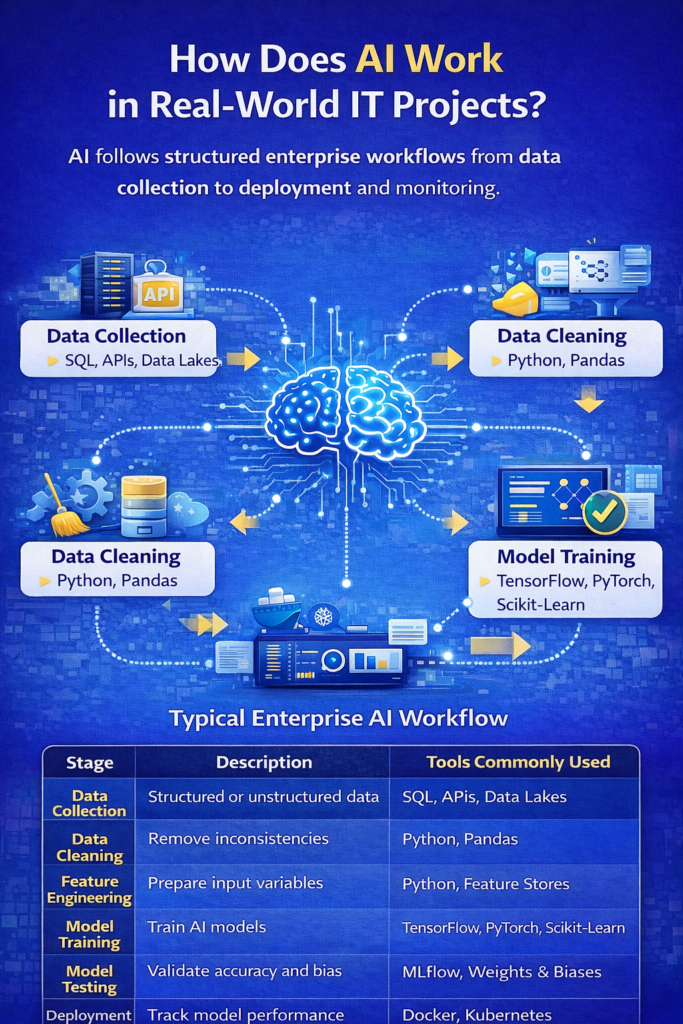
Typical Enterprise AI Workflow
| Stage | What Happens | Tools Commonly Used |
|---|---|---|
| Data Collection | Gather raw business or user data | SQL, APIs, Data Lakes |
| Data Cleaning | Remove duplicates, missing values | Python Pandas, NumPy |
| Feature Engineering | Transform raw data into usable inputs | Scikit-learn |
| Model Training | Train ML algorithms | TensorFlow, PyTorch |
| Model Evaluation | Test model performance | ROC-AUC, Precision, Recall |
| Deployment | Integrate into applications | Docker, Cloud APIs |
Real Example Scenario
Fraud detection systems:
- Input: Transaction data
- Process: Feature extraction + anomaly detection
- Output: Risk score
Entry-level candidates are often asked to explain this workflow in simple terms.
Why Are AI Interview Questions Important for Working Professionals?
AI Interview Questions for working professionals transitioning into AI roles: interviews evaluate:
- Ability to understand business problems using AI
- Data handling skills
- Model interpretation awareness
- Collaboration with DevOps and data teams
In 2026, AI hiring has become more skill demonstration focused rather than theory-heavy.
Companies often test:
- Hands-on coding logic
- Understanding of AI pipelines
- Practical debugging mindset
What Skills Are Required to Learn AI?
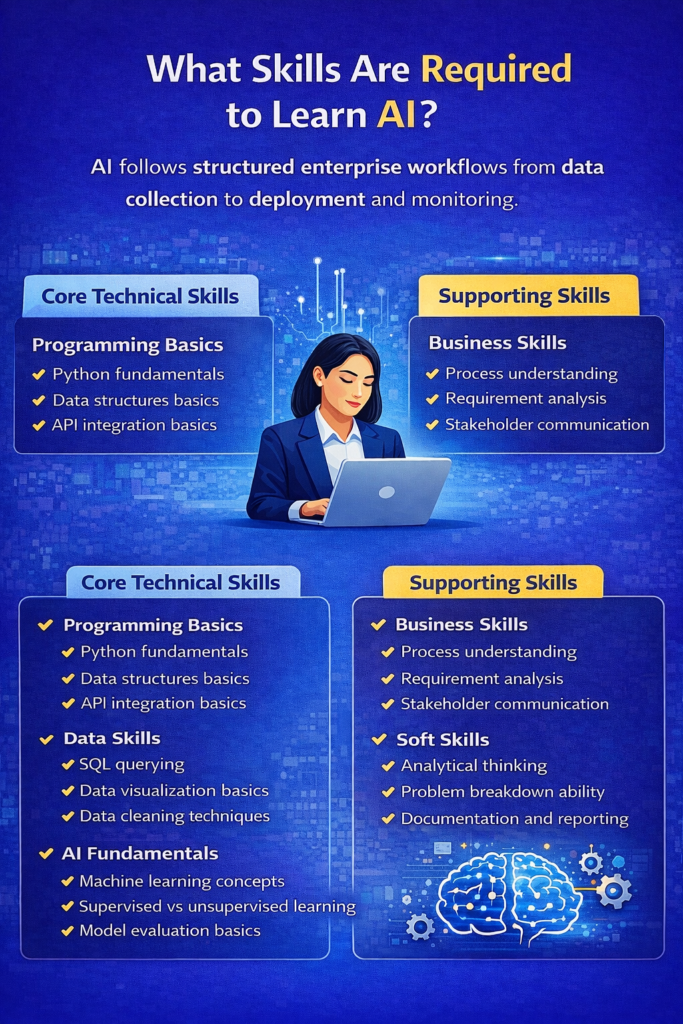
Core Technical Skills
Programming
- Python (mandatory in most AI roles)
- Basic SQL
Mathematics Foundations
- Linear algebra basics
- Probability concepts
- Statistics fundamentals
Machine Learning Concepts
- Regression
- Classification
- Clustering
Data Skills
- Data cleaning
- Visualization basics
How Is AI Used in Enterprise Environments?
Common Enterprise AI Use Cases
| Industry | AI Application |
|---|---|
| Banking | Fraud detection |
| Healthcare | Diagnosis prediction |
| Retail | Recommendation systems |
| Telecom | Customer churn prediction |
| Cybersecurity | Threat detection |
Enterprise Constraints Teams Face
- Data privacy regulations
- Model bias risks
- Scalability challenges
- Model monitoring requirements
Interviewers may ask scenario questions based on these realities.
Most Common AI Interview Questions (With Expert-Level Explanations)
1. What Is Artificial Intelligence?
AI refers to systems designed to simulate human decision-making using data, algorithms, and computing power.
Expected Answer Depth:
- Mention automation + prediction
- Mention learning from data
2. Difference Between AI, Machine Learning, and Deep Learning?
| Technology | Definition |
|---|---|
| AI | Broad field of intelligent systems |
| Machine Learning | AI subset that learns from data |
| Deep Learning | ML subset using neural networks |
3. What Is Supervised Learning?
Learning using labeled data.
Examples:
- Spam detection
- Price prediction
4. What Is Overfitting?
Model memorizes training data instead of learning patterns.
Solution Methods:
- Cross validation
- Regularization
- More training data
5. What Is Model Evaluation?
Measuring model accuracy using metrics.
Common Metrics:
- Accuracy
- Precision
- Recall
- F1 Score
6. What Is Feature Engineering?
Transforming raw data into meaningful input variables for models.
Example:
Converting timestamp → hour of day → useful for behavior prediction.
7. What Is the Bias-Variance Tradeoff?
Balance between:
- Model complexity
- Generalization ability
8. What Is Gradient Descent?
Optimization algorithm used to minimize loss function.
Simple Concept:
Move step-by-step toward lowest error.
9. What Is a Neural Network?
Layer-based architecture that processes data using weighted connections.
Entry-level expectation:
Basic understanding only.
10. Why Is Data Cleaning Important in AI?
Because poor data leads to poor model performance.
Common Tasks:
- Handling missing values
- Removing duplicates
- Normalization
Python AI Interview Questions for Freshers
Common Coding Topics
- Lists vs Dictionaries
- NumPy arrays
- Pandas DataFrames
- Reading CSV files
Example Pseudo Code:
import pandas as pd
data = pd.read_csv("data.csv")
data = data.dropna()
Interviewers check logic clarity more than syntax perfection.
Machine Learning Interview Questions for Beginners
Algorithm Understanding
Candidates should understand when to use:
| Algorithm | Use Case |
|---|---|
| Linear Regression | Prediction problems |
| Logistic Regression | Classification |
| Decision Trees | Rule-based predictions |
| K-Means | Clustering |
How AI Is Used Daily in Entry-Level Job Roles
AI Analyst
- Data preparation
- Basic model building
- Reporting insights
Junior ML Engineer
- Support model training
- Data pipeline work
- Testing model outputs
Data Associate (AI Teams)
- Labeling data
- Monitoring model accuracy
What Careers Are Possible After Learning AI?
Entry-Level Roles
| Role | Main Focus |
|---|---|
| AI Analyst | Business insights using ML |
| Junior Data Scientist | Model building basics |
| ML Support Engineer | Deployment support |
| AI QA Tester | Model validation testing |
Common Enterprise Tools Candidates Should Know
| Category | Tools |
|---|---|
| Programming | Python |
| ML Libraries | Scikit-learn |
| Deep Learning | TensorFlow |
| Data | Pandas |
| Visualization | Matplotlib |
Real-World AI Project Scenario (Interview Discussion Example)
Customer Churn Prediction
Steps:
- Collect customer behavior data
- Clean missing values
- Train classification model
- Evaluate recall score
- Deploy API prediction service
AI Interview Questions: Entry-level candidates should explain workflow, not advanced math.
Challenges AI Teams Commonly Face (Good Interview Discussion Topic)
- Data imbalance
- Model drift
- Explainability requirements
- Ethical AI compliance
Understanding these shows industry awareness.
Step-by-Step AI Interview Preparation Roadmap
Step 1
Learn Python basics
Step 2
Understand ML workflow
Step 3
Practice datasets
Step 4
Build 2–3 mini projects
Step 5
Practice interview Q&A
Best Practices for AI Interview Questions Preparation (2026 Industry Context)
- Focus on workflow understanding
- Practice explaining models simply
- Learn debugging basics
- Understand ethical AI concerns
- Learn basic deployment concepts
Key Takeaways
AI Interview Questions for Entry-Level Roles:
- Entry-level AI interviews focus on fundamentals, not research-level knowledge
- Python + data handling are core expectations
- Understanding ML workflow is more important than memorizing algorithms
- Real-world scenario thinking improves interview performance
- Data cleaning and model evaluation knowledge are essential
FAQs: AI Interview Questions for Entry-Level Roles
1. What are the most common AI interview questions for entry-level roles?
Common questions cover AI basics, machine learning, deep learning, algorithms, Python, data preprocessing, and real-world AI applications.
2. Do entry-level AI jobs require coding skills?
Yes. Basic Python and programming knowledge is commonly expected for many entry-level AI and machine learning roles.
3. What AI concepts should freshers prepare for interviews?
Focus on machine learning algorithms, supervised and unsupervised learning, neural networks, NLP, computer vision, model evaluation, and overfitting.
4. What Python questions are asked in AI interviews?
Interviewers may ask about data types, functions, loops, lists, dictionaries, NumPy, Pandas, and basic data manipulation.
5. Are AI interviews difficult for beginners?
They can be manageable with preparation. Beginners should build a strong foundation in AI concepts and practice explaining technical topics clearly.