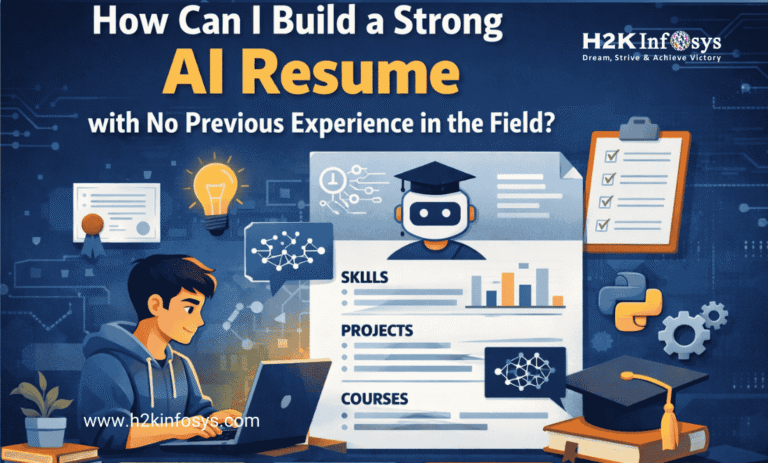
H2k Infosys Resume Building is Helpful to build a strong resume for an AI career without prior experience in the field can be challenging but entirely possible with the right strategy. The key lies in emphasizing transferable skills, practical learning, and the right Ai Learning for Beginners. By focusing on online AI training programs, hands-on projects, and relevant certifications, you can effectively demonstrate your commitment and potential to employers. This guide provides actionable steps to help you construct a resume that highlights your new AI skills, even if you’re just starting out.
What Is AI and Why Is It Important?
Artificial Intelligence (AI) refers to the simulation of human intelligence in machines that are programmed to think and learn like humans. AI systems can process vast amounts of data to make decisions, recognize patterns, and improve their performance over time. Today, AI is applied in industries ranging from healthcare and finance to logistics and retail. AI is increasingly becoming an integral part of IT workflows, and the demand for skilled professionals is on the rise, making it a lucrative field for career growth.
In real world IT projects, AI is used to automate tasks, enhance decision-making, improve customer experiences, and analyze complex datasets. As AI continues to evolve, its applications are expanding, and so is the need for professionals with hands-on skills.
How to Build a Strong AI Resume with No Previous Experience
1. Start with a Solid Foundation of AI Skills
Even if you have no formal experience in AI, you can still build a strong foundation through structured AI training online. AI training programs are designed to teach you both the theoretical concepts and practical skills needed to succeed in the field. When you enroll in these programs, focus on building competencies in the following areas:
- Machine Learning (ML): Understand algorithms, training models, and basic mathematical concepts.
- Data Science: Learn how to clean, manipulate, and analyze data.
- Programming: Python is a key language in AI development, and gaining proficiency in it is crucial.
- Deep Learning: Explore neural networks and advanced machine learning techniques.
- AI Frameworks and Tools: Gain hands-on experience with tools like TensorFlow, Keras, and PyTorch.
2. Get Practical with Projects and Certifications
Employers value practical experience, especially when you’re new to the field. Start by completing real-world AI projects that showcase your problem solving skills and ability to apply what you’ve learned in an industry context. For instance, work on predictive analytics, sentiment analysis, or building recommendation systems. You can find these types of projects in online AI training programs.
Certifications can also significantly boost your resume, even without prior professional experience. Some of the top certifications in AI include:
- Google AI Certification
- IBM AI Engineering Professional Certificate
- Microsoft Azure AI Fundamentals
These certifications demonstrate that you’ve acquired foundational knowledge in AI and are committed to continuous learning.
3. Highlight Transferable Skills
Even without previous AI experience, you likely have skills from other roles that are highly relevant to AI. These transferable skills include:
- Problem-solving: AI is all about solving complex problems with data.
- Programming: Experience in any programming language, especially Python, is valuable.
- Data Analysis: Any background in analyzing data will serve you well in AI tasks like data preprocessing.
- Mathematics: A strong understanding of statistics and algebra will help you grasp machine learning algorithms.
These skills, when framed appropriately, can make your resume stand out to hiring managers looking for candidates with the ability to learn and adapt quickly.
4. Build a Portfolio of AI Projects
A portfolio is a great way to demonstrate your hands-on skills to potential employers. Include the AI projects you’ve completed during your training programs or personal learning journey. For each project, provide:
- A brief description of the problem you solved.
- The tools and technologies you used.
- The results or outcomes of the project (e.g., model accuracy, performance improvements).
- Any challenges you encountered and how you overcame them.
Including links to GitHub repositories or live project demos will also enhance your portfolio’s credibility and visibility.
5. Networking and Showcasing Your Knowledge
AI is a community-driven field, and networking can open doors for opportunities. Join AI-focused groups and communities such as Kaggle, Stack Overflow, or LinkedIn. Participate in discussions, attend webinars, and contribute to open-source AI projects.
Building a strong network allows you to learn from industry experts, showcase your skills, and even get referred to jobs. Additionally, consider publishing blog posts, tutorials, or videos to showcase your understanding of AI concepts and share your journey. This can position you as a thought leader in the field.
What Are the Key Skills Required to Work in AI?
While AI is an interdisciplinary field, there are certain core skills that are universally important:
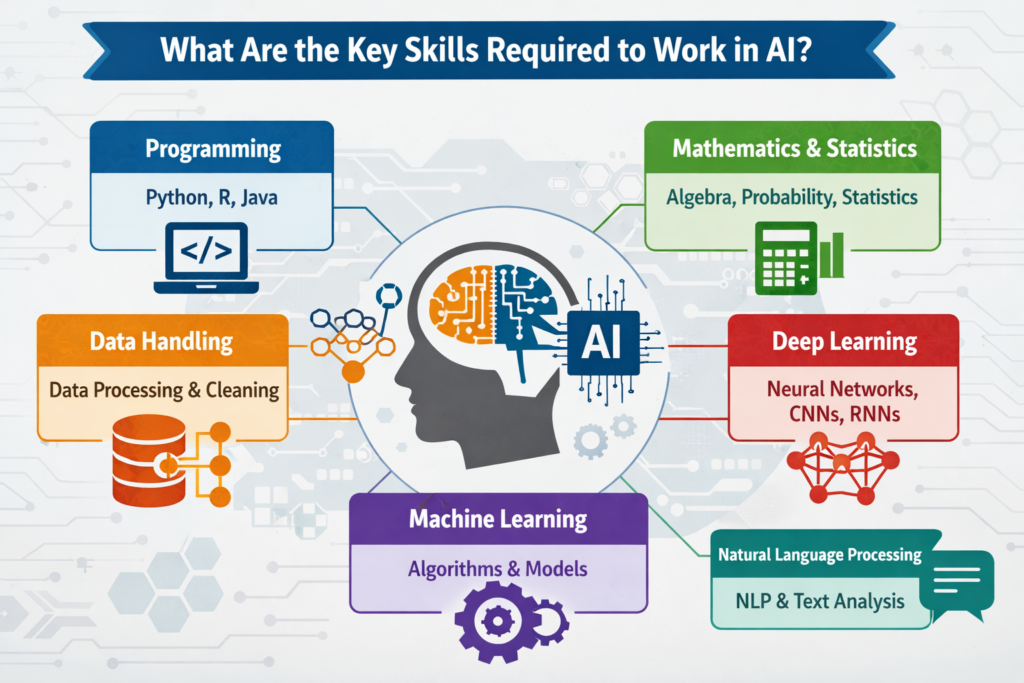
- Programming: Python, R, and JavaScript are widely used in AI development.
- Mathematics and Statistics: A solid understanding of linear algebra, calculus, probability, and statistics is essential for designing and understanding algorithms.
- Machine Learning: Familiarity with supervised and unsupervised learning algorithms is vital.
- Data Management: Knowing how to handle and preprocess large datasets is crucial in AI workflows.
- Cloud Platforms: Knowledge of cloud services like AWS, Azure, and Google Cloud Platform can be valuable as AI models often require cloud-based infrastructure.
How Is AI Used in Real-World IT Projects?
AI is used across a wide range of IT projects, including:
- Predictive Analytics: AI models help businesses forecast future trends based on historical data, such as predicting sales or customer behavior.
- Natural Language Processing (NLP): AI helps in creating systems that can understand and generate human language, such as chatbots and virtual assistants.
- Computer Vision: AI is used to process and analyze images and videos, helping in fields like medical imaging and autonomous vehicles.
- Automation: AI automates repetitive tasks like data entry, making IT processes more efficient.
By gaining experience in any of these areas, you can better align your skills with current industry demands.
What Careers Are Possible After Learning AI?
Once you’ve built a solid foundation in AI, numerous career paths open up. Some of the most common AI-related roles include:
- Data Scientist: Focus on analyzing data to derive insights and build predictive models.
- Machine Learning Engineer: Develop machine learning models and deploy them into production systems.
- AI Research Scientist: Work on advancing AI techniques and pushing the boundaries of what AI can do.
- AI Consultant: Help businesses integrate AI solutions to improve processes or products.
- Business Intelligence Analyst: Use AI techniques to help businesses make data-driven decisions.
These roles often require a mix of technical and soft skills, including problem-solving, communication, and collaboration.
How Do You Keep Your AI Resume Relevant?
As AI evolves, so do the tools and technologies used in the field. To keep your resume relevant:
- Stay up-to-date with the latest trends and developments in AI, such as advancements in deep learning or NLP.
- Learn emerging technologies like reinforcement learning, quantum computing, or AI ethics.
- Experiment with new tools and programming languages to stay ahead of the curve.
FAQ
What online AI training programs should I consider for beginners?
Online platforms such as H2k Infosys offer excellent AI training programs for beginners. Many of these programs provide hands-on experience and projects to help you build a strong foundation in AI.
How can I improve my chances of landing an AI job with no experience?
To improve your chances, focus on completing online AI training programs, building a portfolio of AI projects, and obtaining relevant certifications. Networking and showcasing your knowledge through blogs or social media can also help increase visibility to potential employers.
Is Python the only language I need to learn for AI?
While Python is the most popular language for AI development, learning other languages such as R or JavaScript can be beneficial depending on the specific AI applications you are working with.
Can AI certification guarantee me a job?
While certifications demonstrate your knowledge and commitment, they do not guarantee a job. It’s essential to combine certifications with practical experience, a strong portfolio, and networking to improve your chances of landing a job.
Conclusion
Building a strong AI resume without previous experience is possible by following a strategic approach:
- Start by gaining foundational AI skills through online training programs.
- Build a portfolio of real-world projects to showcase your abilities.
- Highlight transferable skills and certifications that can set you apart.
- Network with professionals in the field and contribute to open-source projects.