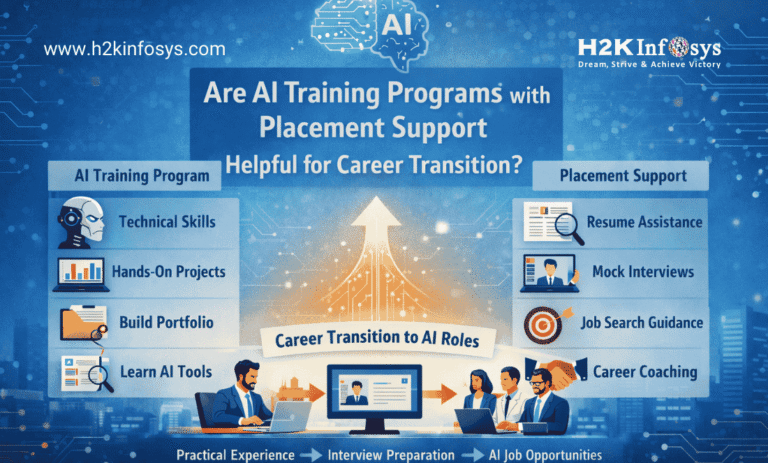
Yes, H2K Infosys AI training programs with placement support help career changers build job-ready artificial intelligence skills through structured learning, hands-on projects, and career preparation aligned with industry hiring requirements. AI training programs with placement support can be helpful for career transition because they combine technical skill development, hands-on project experience, and structured career preparation aligned with artificial intelligence job roles. A well-designed Ai Training Online pathway helps professionals learn practical AI tools, build portfolios, and prepare for technical interviews, which are essential requirements for transitioning into AI careers. Placement support typically includes resume guidance, mock interviews, and job search preparation, which can improve readiness for real-world hiring processes.
What Is an AI Training Program with Placement Support?
An AI Training Program with placement support is a structured learning pathway designed to teach artificial intelligence skills while also helping learners prepare for employment in AI related roles. These programs focus on technical training, hands-on projects, and career readiness components.
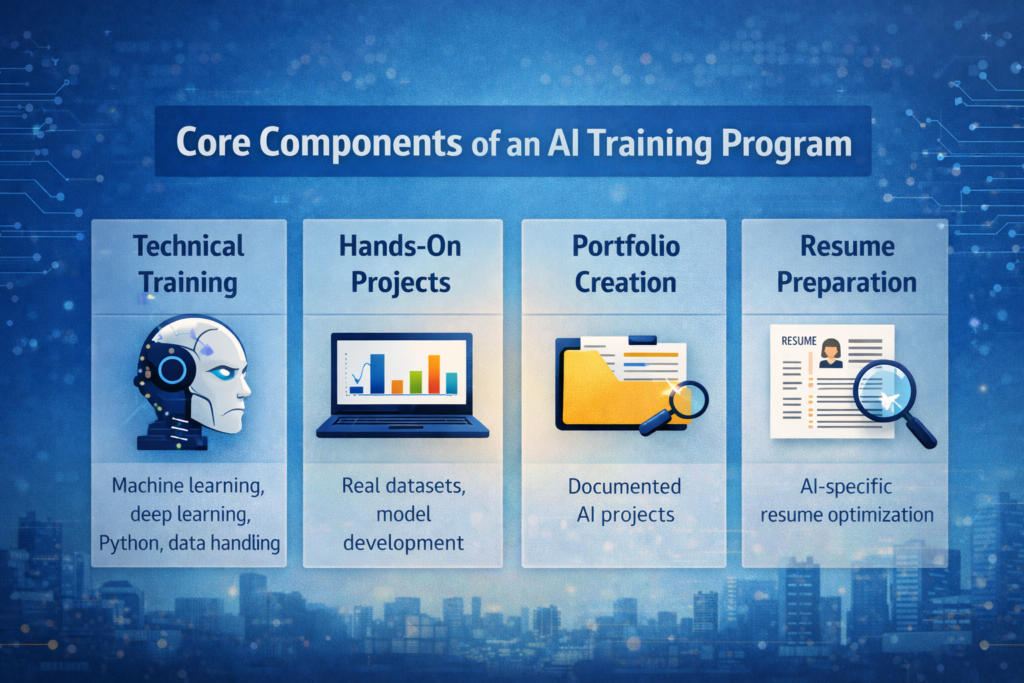
Core Components of an AI Training Program
Most structured ai training online programs include the following elements:
| Component | Description | Career Impact |
|---|---|---|
| Technical training | Machine learning, deep learning, Python, data handling | Builds technical competence |
| Hands-on projects | Real datasets, model development | Demonstrates practical skills |
| Portfolio creation | Documented AI projects | Shows capability to employers |
| Resume preparation | AI-specific resume optimization | Improves interview selection chances |
| Mock interviews | Technical and behavioral simulations | Improves interview performance |
| Job search guidance | Role targeting and application strategies | Supports career transition |
Placement support does not guarantee employment, but it helps professionals prepare effectively for AI job opportunities.
Why Is Placement Support Important for Career Transition into AI?
Career transition into artificial intelligence involves more than learning theory. Employers typically evaluate candidates based on applied skills, project experience, and readiness to work with enterprise AI tools.
Key Challenges Career Switchers Face
Professionals transitioning into AI often encounter the following challenges:
- Lack of hands-on project experience
- Limited understanding of enterprise AI workflows
- Difficulty translating previous experience into AI-relevant skills
- Lack of interview preparation specific to AI roles
- Uncertainty about job search strategy
Placement support helps address these gaps by providing structured preparation aligned with hiring expectations.
How Does an AI Training Program Work in Real-World IT Projects?
AI training programs typically simulate enterprise workflows that mirror real production environments. This prepares learners to work on real AI implementations.
Typical AI Project Workflow
Step 1: Data Collection and Preparation
AI engineers and analysts work with datasets using tools such as:
- Python
- Pandas
- NumPy
- SQL databases
Example task:
import pandas as pd
data = pd.read_csv("customer_data.csv")
data = data.dropna()
Data cleaning and preprocessing are critical because AI models depend on high-quality data.
Step 2: Model Development
Machine learning models are developed using libraries such as:
- Scikit-learn
- TensorFlow
- PyTorch
Example workflow:
- Select algorithm
- Train model
- Evaluate performancStep 3: Model Evaluation
Metrics commonly used include:
- Accuracy
- Precision
- Recall
- F1 score
These metrics help determine model effectiveness.
Step 4: Deployment Preparation
Enterprise teams deploy AI models using tools such as:
- Docker
- REST APIs
- Cloud platforms
Deployment allows AI systems to operate in production environments.
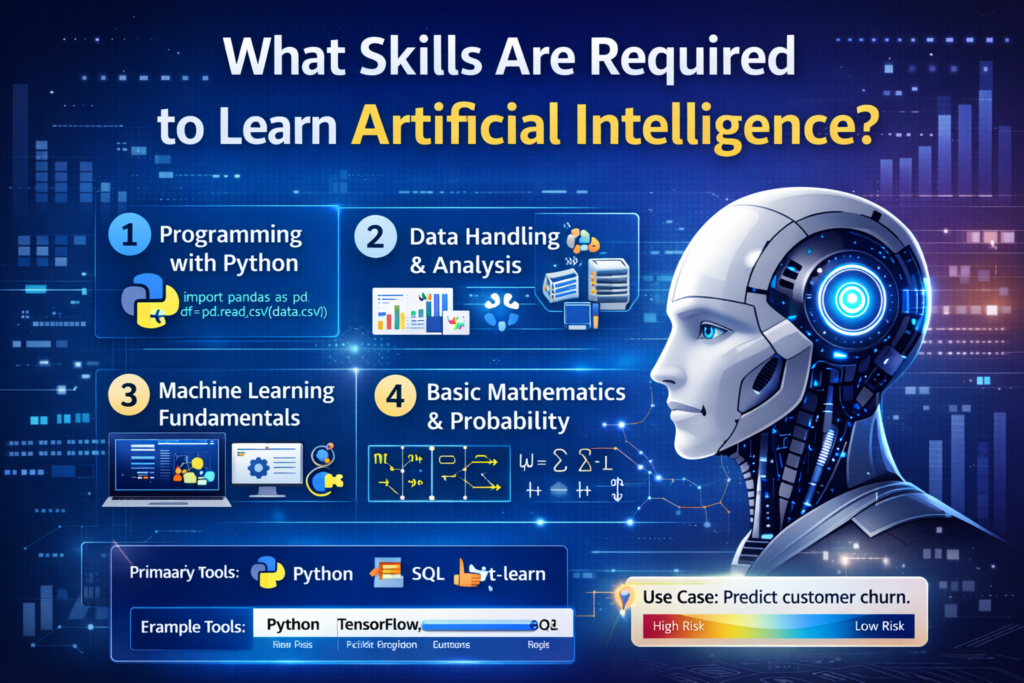
What Skills Are Required to Learn Artificial Intelligence?
Career transition into AI requires both technical and conceptual skills.
Technical Skills
| Skill | Purpose | Enterprise Usage |
|---|---|---|
| Python programming | Core AI language | Model development |
| Data analysis | Understand datasets | Data preparation |
| Machine learning | Build predictive models | Business automation |
| SQL | Query structured data | Database access |
| Deep learning | Neural network development | Image and speech processing |
Supporting Skills
| Skill | Importance |
|---|---|
| Statistics | Model accuracy evaluation |
| Problem-solving | Designing AI solutions |
| Software development | Building scalable systems |
| Communication | Explaining AI results |
How Is AI Used in Enterprise Environments?
Artificial intelligence is commonly used across industries to automate decision-making and improve operational efficiency.
Common Enterprise AI Use Cases
Healthcare
- Disease prediction models
- Medical image analysis
Finance
- Fraud detection
- Risk analysis
Retail
- Recommendation systems
- Customer behavior analysis
Cybersecurity
- Threat detection
- Intrusion monitoring
Manufacturing
- Predictive maintenance
- Quality control automation
These applications require professionals with hands-on AI training and project experience.
What Job Roles Use Artificial Intelligence Daily?
AI training programs help prepare learners for several AI-related job roles.
Common AI Job Roles
| Role | Responsibilities |
|---|---|
| AI Engineer | Develop AI systems |
| Machine Learning Engineer | Build predictive models |
| Data Scientist | Analyze and interpret data |
| AI Analyst | Support AI implementation |
| Automation Engineer | Implement AI workflows |
How Does Placement Support Help Professionals Prepare for AI Careers?
Placement support focuses on improving employability readiness.
Resume Preparation
AI resumes typically include:
- Technical skills
- Project experience
- Tools used
- Problem-solving examples
Resume optimization helps recruiters evaluate candidate readiness.
Mock Interviews
Mock interviews simulate real hiring scenarios:
- Technical questions
- Coding problems
- AI concepts
- Behavioral questions
This improves confidence and interview performance.
Job Search Preparation
Placement support may include:
- Resume targeting specific roles
- Interview preparation
- Job application strategies
These components help professionals navigate career transition more effectively.
How Does an AI Training Program Help Career Switchers Specifically?
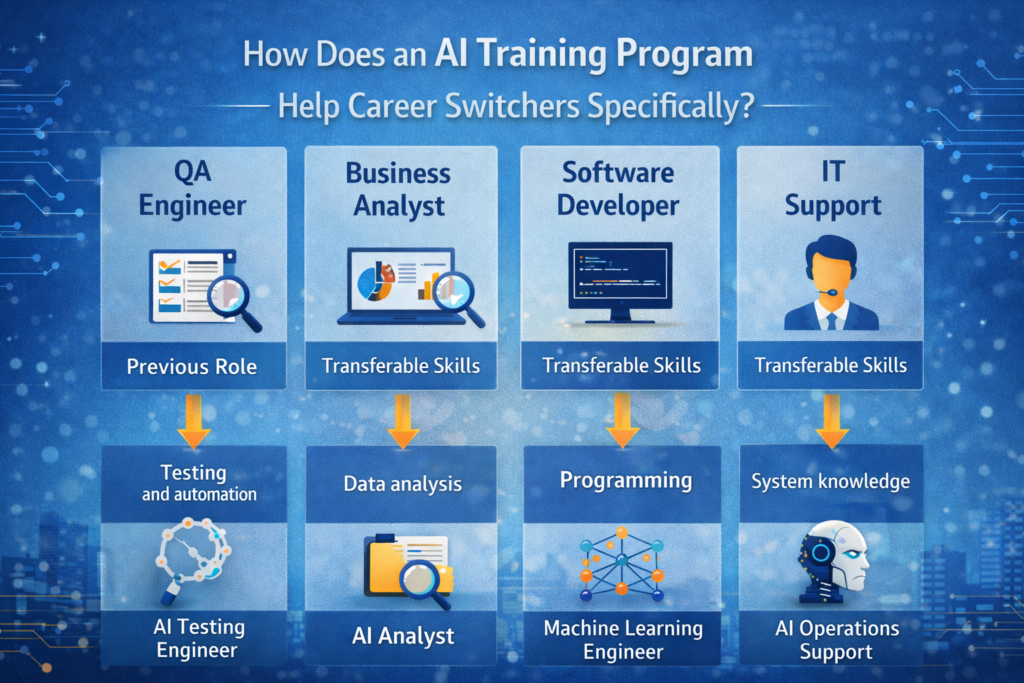
Professionals transitioning from QA, business analysis, IT support, or other roles can leverage existing technical knowledge.
Skill Mapping Example
| Previous Role | Transferable Skills | AI Career Path |
|---|---|---|
| QA Engineer | Testing, automation | AI testing engineer |
| Business Analyst | Data analysis | AI analyst |
| Software Developer | Programming | Machine learning engineer |
| IT Support | System knowledge | AI operations support |
Career transition becomes more feasible when existing skills are combined with AI training.
What Tools Are Commonly Used in AI Training and Enterprise AI Projects?
Understanding tools is essential for AI career readiness.
Common AI Tools
| Tool | Purpose |
|---|---|
| Python | Programming language |
| TensorFlow | Machine learning framework |
| PyTorch | Deep learning framework |
| Pandas | Data manipulation |
| SQL | Data querying |
| Jupyter Notebook | Development environment |
These tools are widely used in enterprise AI workflows.
How Long Does It Take to Transition into an AI Career?
Career transition timelines vary based on background and learning intensity.
Typical Timeline
| Phase | Duration |
|---|---|
| Learning fundamentals | 2–3 months |
| Project development | 2–4 months |
| Portfolio creation | 1–2 months |
| Interview preparation | 1–2 months |
Total transition time typically ranges from 4–9 months.
What Are the Advantages of AI Training Programs with Placement Support?
Placement-supported programs offer structured career transition assistance.
Key Benefits
1. Structured Learning Path
Helps learners progress systematically.
2. Real-World Project Experience
Builds job-ready skills.
3. Interview Preparation
Improves hiring readiness.
4. Resume Development
Enhances recruiter visibility.
5. Career Guidance
Helps learners understand AI job roles.
What Are the Limitations of Placement Support?
Placement support has benefits but also practical limitations.
Important Considerations
- Placement support is not a job guarantee
- Hiring depends on individual skills and preparation
- Market demand varies by region and industry
- Continuous skill improvement is necessary
Understanding these factors helps learners set realistic expectations.
What Careers Are Possible After Completing an AI Training Program?
Several career paths become accessible after completing AI training.
Career Options
| Career Path | Role Focus |
|---|---|
| AI Engineer | AI system development |
| Machine Learning Engineer | Model development |
| Data Scientist | Data analysis |
| AI Analyst | AI implementation |
| Automation Engineer | AI automation |
How Do Employers Evaluate Candidates with AI Training?
Employers evaluate candidates based on multiple factors.
Evaluation Criteria
- Project experience
- Technical skills
- Problem-solving ability
- Understanding of AI workflows
- Communication skills
Practical experience is often a key differentiator.
FAQ: AI Training Programs with Placement Support
Are AI training programs with placement support useful for beginners?
Yes, structured programs help beginners learn foundational AI skills and prepare for job roles through guided training and career preparation.
Do placement support programs guarantee jobs?
No, placement support helps prepare candidates, but employment depends on individual skills, preparation, and job market conditions.
Can professionals transition into AI without prior programming experience?
Yes, many professionals start with basic programming training and gradually build AI skills through structured learning.
What industries hire AI professionals?
Industries such as healthcare, finance, retail, cybersecurity, and technology commonly hire AI professionals.
What is the most important factor for transitioning into AI?
Hands-on project experience combined with strong technical skills is one of the most important factors.
Key Takeaways
- AI training programs with placement support help professionals prepare for career transition into AI roles.
- Practical project experience is essential for demonstrating job readiness.
- Placement support improves resume quality, interview preparation, and job search readiness.
- Enterprise AI roles require skills in Python, machine learning, data analysis, and model deployment.
- Career transition timelines typically range from 4 to 9 months depending on learning intensity.
- Placement support enhances employability preparation but does not guarantee employment.
To build practical artificial intelligence skills and prepare for career transition, explore structured AI courses designed for real-world application.
H2K Infosys offers hands-on training programs that help professionals develop technical skills and prepare for AI career opportunities.