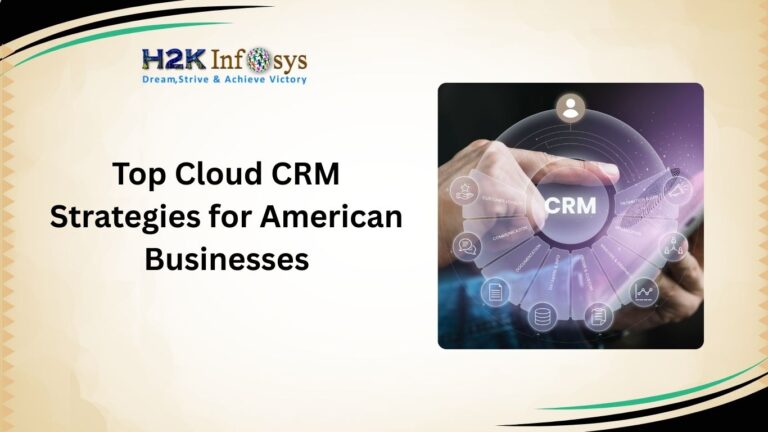
American companies are growing faster today by using smarter CRM Strategies than ever, and platforms like H2kinfosys that guide professionals to build real job-ready skills matching the businesses’ needs. Companies that think about customer data as a living, breathing asset not just a database are driving better sales, greater loyalty and fewer missed opportunities.
So let’s get into what’s actually working right now. Not theory, not buzzwords, simply what I have actually seen groups do inside routine growing businesses.
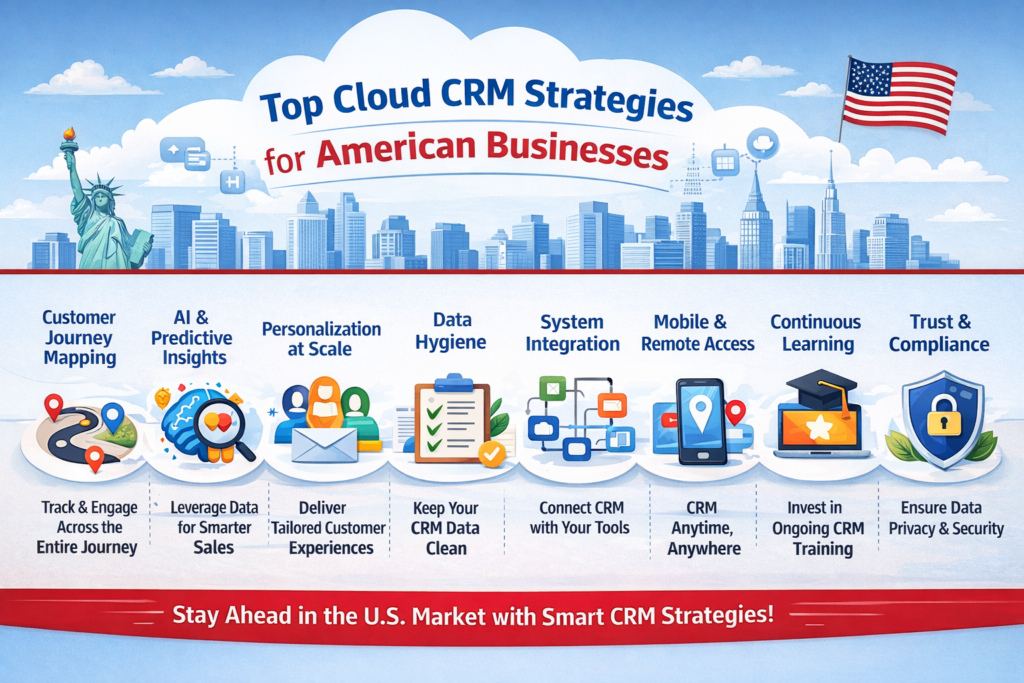
Why Cloud CRM is no longer an option for American Businesses
A few years ago, CRM systems were little more than polished address books. Today? They are the nerve center of operations. Above all in the U.S., where competition is fierce and consumers demand fast, personal experiences.
I recall working with a mid-size retail company that had an issue with repeat customers. Their marketing team blamed pricing. Its sales team attributed it to product mix. But the truth? They had data … just all over the place. As soon as structured CRM Strategies started coming into the picture, they began to observe purchasing trends that had never previously been seen. Within months, their repeat sales spiked.
It’s happening across industries from health care to fintech.
Cloud CRM provides the flexibility, real-time analytics and automation. And innovators, such as Salesforce, are at the forefront because they continue to adapt with AI, predictive insights and automation workflows.
Strategy #1: Create Customer Journeys, Not Pipeline
Too many businesses consider CRM only as a sales tool. That’s outdated thinking.
The real change is mapping the customer journey from awareness to loyalty. By that, I mean a shared view between marketing, support and sales teams.
Strong CRM Strategies today include:
- Tracking website behavior
- Capturing customer intent signals
- Monitoring service interactions
- Predicting churn before it happens
Journey-based automation is being used to trigger personalized onboarding for U.S.-based SaaS companies, for example. It feels more human. And customers notice.
Which is why professionals are now taking Salesforce administrator classes because personal knowledge of actual customer workflows is exploding.
Strategy #2: AI and Predictive Insights Are Quickly Becoming the More Predominant Normal
If you pay attention to recent industry news, you probably realized AI is ubiquitous. Well, in CRM it’s good for something. Not just hype.
American companies are applying AI to:
- Predict deal closure probability
- Recommend next best actions
- Detect buying intent
- Improve forecasting accuracy
There’s a sales manager I spoke to recently who made an interesting claim:
“We stopped chasing every lead. “We only focus on the right ones.”
This shift was the result of advanced CRM Strategies being driven by predictive analytics.
This is also one of the reasons why salesforce crm certification courses are a career accelerator. Companies don’t just want users now. They want strategists.
Strategy #3: Personalization at Scale (While Still Avoiding Robot Mode)
Here’s the problem that most companies have. They want automation but don’t want to sound robotic.”
The Best CRM Strategies Balance Automation with Authenticity For example:
- Sending human-tone follow-ups
- Marketing using behavioral triggers rather than generic campaigns
- Segmenting audiences deeply
- Creating micro-experiences
USA retail and finance as well as health care all investing heavily in this.
One health provider I partnered with began sending personalized appointment reminders tailored to the preferences of each patient. Not just SMS blasts. The result? More frequent engagement and less skipped visits.
That’s the power of modern CRM Strategies when applied wisely.
Strategy No. 4: Data Hygiene Is the Secret Growth Engine
Not glamorous. Not exciting. But absolutely critical.
Data is messy, and many American businesses die because of it. Are you still dealing with duplicate records, outdated contacts and incomplete information? It slows everything.
Smart CRM Strategies are a game-changer and centered around:
- Data cleaning workflows
- Validation rules
- Automated enrichment
- Regular audits
This is exactly where you would require Salesforce Admin Training. Good admins design systems that remain clean without continuous work.
And quite frankly, once teams get a taste of the difference, they never go back.
Strategy #5: Integration Over Isolation
Another big shift I’ve noticed? CRM is no longer standalone.
It connects with:
- Marketing platforms
- Finance tools
- Customer support systems
- E-commerce software
- AI analytics engines
New Age CRM Strategies Methods are ecosystem thinking.
A good example: an e-commerce brand integrated its CRM with customer service chat. Agents could suddenly see purchase history, preferences and previous complaints in real time. Customer satisfaction scores soared almost overnight.
And, this kind of transformation is why professionals are exploring Salesforce training online programs – because companies want talent that speaks cross-platform workflows.
Strategy #6: Implement Mobile CRM for Remote and Hybrid Workforces
In the post-pandemic world, remote work isn’t going away in the U.S.
Sales reps, field service teams and consultants require access on the fly. Thus companies are in the process of implementing mobile first CIM Strategies.
This includes:
- Real-time updates
- Mobile dashboards
- Voice-enabled CRM
- Instant customer insights
A field tech I met told me he used to bring notebooks. Now he updates everything on his phone in between visits.
Small shift. Huge productivity boost.
Strategy #7: Learn Continuously and Upskill
Here’s something many companies overlook. Crm is more concerned about people than the technology.
Investing in ongoing learning improves the return on investment for organizations. They invest in:
- Certification pathways
- Role-based training
- Hands-on labs
- Scenario-driven learning
And that’s why Salesforce certification courses are now explicitly linked to promotions and career advancement in many American companies.
The demand is real. The demand for well-qualified CRM professionals is higher than ever.
Real-World Example: a U.S.-Based Logistics Company That Scaled with Cloud CRM
I briefly consulted for a growing logistics company with no structure to manage customers.
They implemented layered CRM Strategies:
- Customer segmentation
- Automated follow-ups
- Predictive forecasting
- Integrated customer support
- AI-driven lead prioritization
Within a year:
- Revenue grew 27%
- Customer churn dropped
- Sales cycles shortened
But the biggest change? Their teams stopped guessing. Decisions became data-driven.
This is the true power of CRM Strategies when executed effectively.
Strategy #8: Establish Customer Trust and Compliance
U.S. privacy regulations are growing stricter. It made customers more cautious about data use.
It means that forward-thinking companies are having compliance woven into their CRM Strategies:
- Consent tracking
- Transparent communication
- Secure data storage
- Ethical AI use
Trust has come to be a source of competitive advantage.
Businesses that respect customer data are creating long-lasting loyalty.
The Future of CRM in 2026 and Beyond
If this continues, we’ll have:
- More AI copilots inside CRM
- Hyper-automation
- Emotion and sentiment analytics
- Deeper personalization
- Real-time decision engines
And the truth is, beyond October 2023, the divide between brands that implement smart CRM Strategies and those who do not will become more pronounced.
The winners won’t simply embrace technology. They’ll reconceptualize the way they build connections.
Conclusion
The biggest lesson I’ve learned? CRM isn’t software. It’s a mindset. American businesses that consider customer relationships their primary strategy, not just a department, grew faster while remaining resilient in uncertain markets.
So whether you are planning your next career move or thinking about business transformation now is the time to learn these evolving CRM Strategies. It is this combination of hands-on experience, practical learning and continuous upskilling that distinguishes professionals and organizations from others.
And if you want to know my opinion, the future of business growth in the U.S. will go to those who understand customers thoroughly, avoid abusing data and learn as they go.