Yes , beginners absolutely can switch careers into AI successfully. I’ve seen it happen more times than most people think, especially in the last two years as AI moved from a “future skill” to a “right now” career shift.
But it doesn’t happen by accident. It happens when beginners choose the right AI courses for beginners, build practical skills, and focus on real-world application instead of just collecting certificates.
Let’s talk about what this actually looks like in 2026.
Why Career Switching Into AI Is More Realistic Than Ever
Five years ago, moving into AI usually meant you needed a PhD or heavy research background. Today? Not so much.
The explosion of tools like ChatGPT, OpenAI APIs, and platforms from Google and Microsoft has shifted AI from theory-heavy to application-focused.
Companies now need:
- AI implementation specialists
- Prompt engineers
- AI automation consultants
- Data analysts using AI tools
- AI product coordinators
These roles didn’t even properly exist a few years ago.
And here’s something I’ve personally noticed: businesses care less about your previous degree and more about whether you can actually use AI tools to solve problems.
Who Is Successfully Switching?
Let me give you real patterns I’ve seen.
- A digital marketer learning AI automation to offer smarter ad campaigns
- A mechanical engineer moving into AI-powered predictive maintenance
- A teacher transitioning into AI content development
- A finance professional learning machine learning basics for risk analysis
The key? None of them started as AI experts. They started with structured AI courses for beginners that focused on fundamentals first Python basics, data handling, machine learning concepts then moved into applied projects.
The shift usually takes 6–12 months if done seriously.
Not overnight. Not in a weekend bootcamp.
The Smart Way Beginners Should Approach AI in 2026
Here’s where people mess up.
They jump straight into “advanced AI” because it sounds exciting. Deep learning, neural networks, transformers all buzzwords.
But strong foundations win.
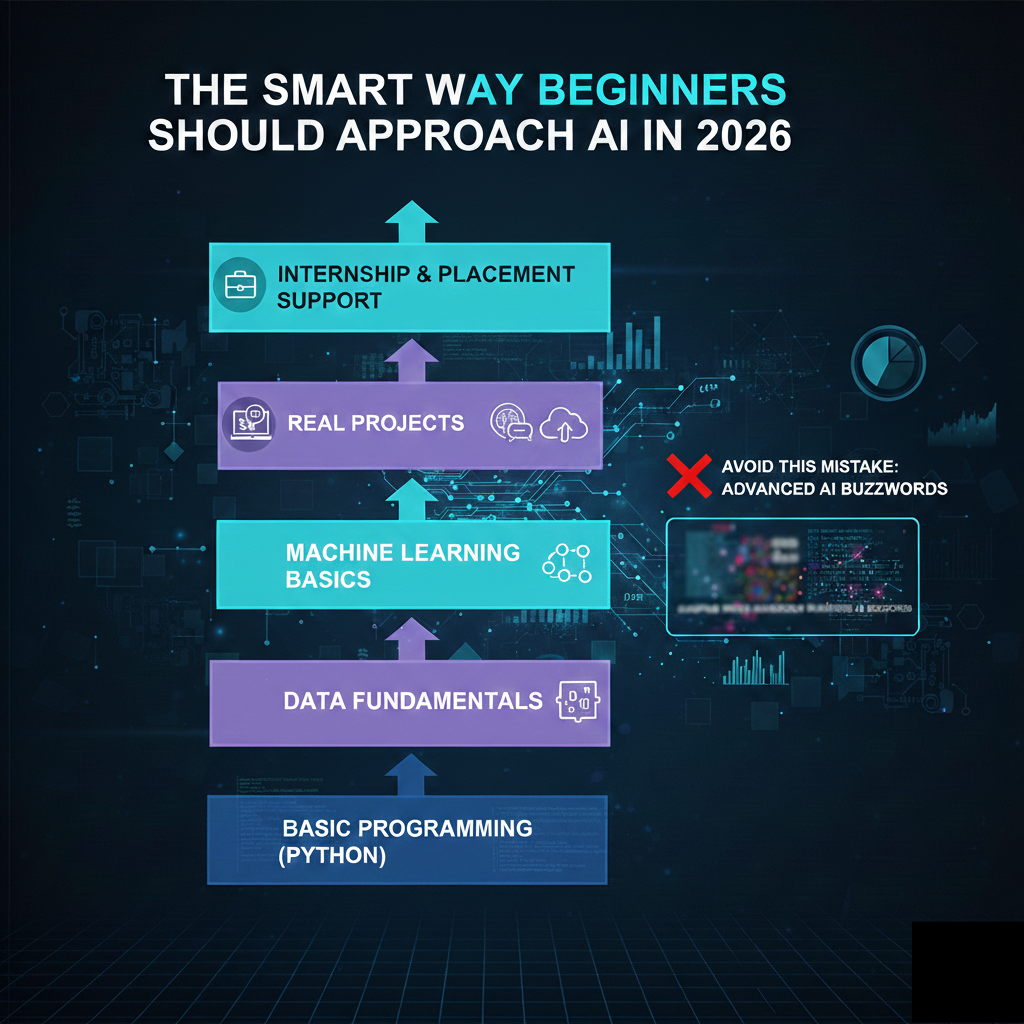
A good beginner roadmap looks like this:
- Basic programming (usually Python)
- Data fundamentals
- Machine learning basics
- AI tools and model usage
- Real projects
- Internship or placement support
This is why choosing an AI course with placement can make a big difference. Structure matters. Guidance matters. And placement support shortens the “now what?” phase after learning.
I’ve spoken with hiring managers recently who admitted something interesting , they prefer candidates who completed a serious Artificial intelligence course with placement because it shows applied training, not just theory.
What Makes a Beginner Actually Hireable?
Let’s be honest. Certificates alone don’t impress employers anymore.
What works:
- Portfolio projects on GitHub
- Real datasets used in projects
- Understanding how AI integrates into business workflows
- Ability to explain concepts simply
One hiring lead from a Bengaluru AI startup told me they hired a former HR professional because she built an AI resume screening prototype during her course. That project mattered more than her degree.
That’s the difference between passive learning and applied learning.
Current AI Job Market Trends (2026 Snapshot)
AI hiring hasn’t slowed — it’s just become more skill-specific.
Recent reports from global tech hiring platforms show:
- Increased demand for AI implementation roles
- Mid-sized companies adopting AI faster than large enterprises
- Startups building AI-first products across healthcare, fintech, and logistics
After the generative AI wave sparked by tools like GPT-4, businesses realized AI isn’t optional anymore.
Now they need professionals who can bridge tech and business.
That’s actually good news for career switchers.
You don’t need to invent algorithms.
You need to apply them.
Common Fears Beginners Have (And the Real Answers)
“I don’t have a technical background.”
Many successful AI professionals today came from non-CS backgrounds. Structured beginner learning fills gaps.
“Isn’t AI too competitive now?”
It’s competitive at the top level. Entry and mid-level applied roles are still expanding.
“What if AI replaces jobs?”
It’s replacing tasks ,not skilled professionals who know how to use AI strategically.
My Honest Advice If You’re Considering Switching
If you’re serious, do this:
- Pick structured AI courses for beginners, not random YouTube playlists
- Look for programs offering internship or placement support
- Build 3–5 serious portfolio projects
- Network with AI communities
- Follow industry updates regularly
And give yourself at least 6 months of focused effort.
I’ve watched people try to “half-commit” to AI learning while casually browsing lessons. It rarely works. The ones who succeed treat it like training for a marathon.
Is It Easy? No. Is It Possible? Absolutely.
Switching into AI as a beginner isn’t magic. It’s structured learning, consistent effort, and strategic positioning.
The presence of strong Artificial Intelliegence course with placement programs and growing demand for applied AI roles has lowered the barrier significantly compared to a few years ago.
If you approach it practically , focusing on fundamentals, projects, and real-world application , a career switch into AI in 2026 is not only possible… it’s realistic.
And honestly? We’re still early in the AI transformation wave.
That window hasn’t closed yet.