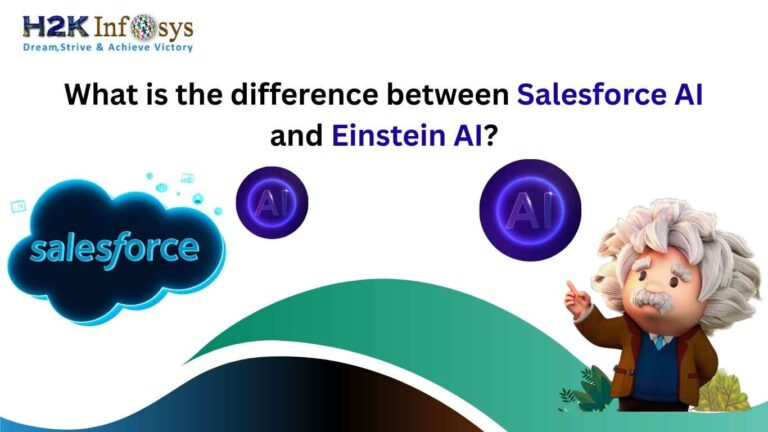
The difference between Salesforce AI and Einstein AI are closely related but not the same thing Salesforce AI is the broad artificial intelligence ecosystem inside the Salesforce platform, while Einstein AI is the specific AI technology layer that powers predictions, automation, and insights within Salesforce tools, something many learners first encounter while exploring programs like those from H2kinfosys.
If you’ve spent even a little time around the Salesforce ecosystem, maybe researching Salesforce certification training or looking into Salesforce CRM Administrator Training, you’ve probably heard both terms thrown around almost interchangeably. I remember the first time I heard them during a product demo; even experienced admins in the room were quietly Googling the difference.
So let’s clear things up in a practical, real-world way of difference between Salesforce AI and Einstein AI.
Understanding the Core Idea Behind Salesforce AI
At the highest level, Salesforce AI refers to the entire artificial intelligence strategy built into the Salesforce platform. Think of it as the umbrella that covers multiple AI tools, capabilities, and services.
Inside that umbrella lives Einstein AI, which is the actual technology engine doing the predictive work.
In other words difference between Salesforce AI and Einstein AI:
- Salesforce AI → The overall AI ecosystem across Salesforce products
- Einstein AI → The built-in AI technology that delivers predictions, automation, and recommendations
A lot of people assume they’re two separate products. They’re not. Einstein AI is essentially the “brain” working inside Salesforce AI.
And this Difference between Salesforce AI and Einstein AI has become more important in the last couple of years because Salesforce has expanded its AI stack rapidly, especially with generative AI developments announced at Dreamforce events.
Where Einstein AI Fits Inside Salesforce
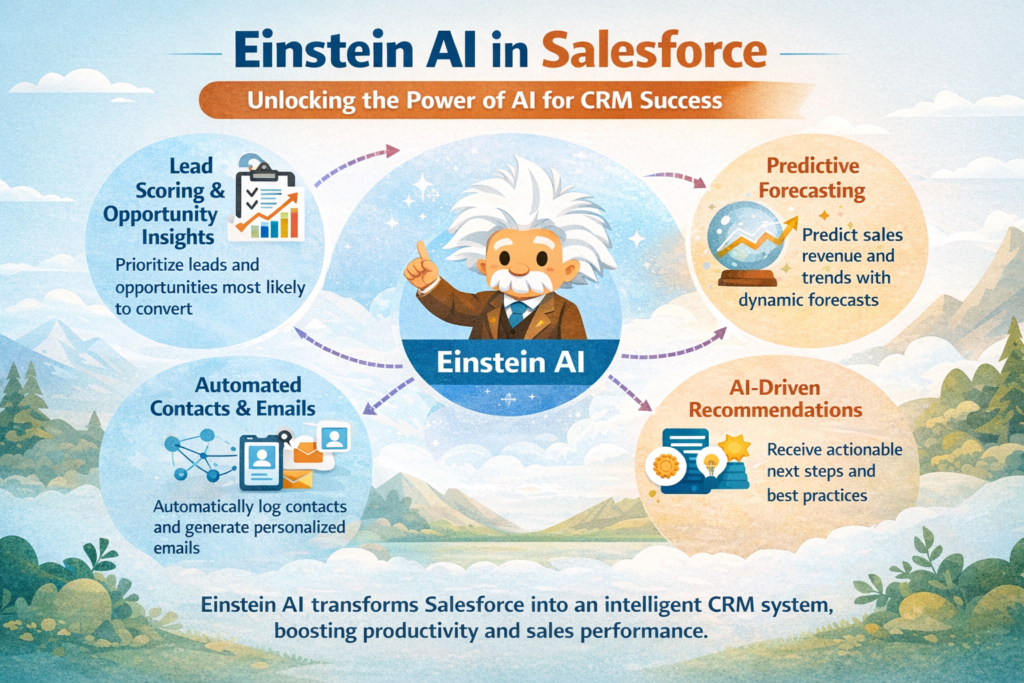
To understand the Difference between Salesforce AI and Einstein AI better, picture Salesforce like a big digital workplace platform.
- Sales Cloud
- Service Cloud
- Marketing Cloud
- Commerce Cloud
- Analytics tools
Across all of those tools sits Salesforce AI, coordinating intelligent capabilities across the platform. In this ecosystem, Einstein AI carries out the following activities: predictions, automated insights, recommendations, etc.
Some examples include:
- Lead scoring
- Predictions of opportunities
- Analysis of customer sentiments
- Suggestions for automated emails
- Predictions for forecasts
Einstein AI, one part of the Salesforce AI infrastructure, powers all of this.
By Salesforce features, we mean Einstein AI or smart functions woven into the future workflows of Salesforce.
A Simple Real-World Example
For example, consider a sales manager who opens Salesforce on Monday morning.
When he pulls up the pipeline dashboard, he sees something interesting:
- A top-value deal has now been marked “at risk.”
- The system proposes the next most appropriate action.
- It suggests reaching out to a particular decision-maker.
That prediction didn’t come from manual analysis.
Difference between Salesforce AI and Einstein AI: That’s Einstein AI analyzing historical deal data, communication patterns, and customer behavior.
And the reason it appears seamlessly inside dashboards, reports, and workflows is that it’s part of the wider Salesforce AI framework.
Why Salesforce Built Einstein AI in the First Place
Back when CRM systems first appeared, they were basically digital filing cabinets.
You stored leads.
You tracked contacts.
You recorded activities.
But around the mid-2010s, companies started asking a different question:
“Why should humans analyze everything manually if machines can find patterns faster?”
That’s where Einstein AI came in.
Salesforce introduced Einstein AI to help organizations move from data storage → data intelligence.
Instead of just holding information, the CRM could now predict outcomes.
Today, Salesforce AI combines machine learning, predictive analytics, automation, and generative tools all built on top of the original Einstein AI architecture.
Key Features Powered by Einstein AI
Let’s walk through some practical features powered by Einstein AI, because this is where things really get interesting for admins and developers.
1. Einstein Lead Scoring
Sales teams often struggle with prioritization.
Einstein AI analyzes past conversions and scores incoming leads automatically. The best prospects rise to the top.
This feature alone has helped some companies increase conversion rates by 20–30%.
2. Opportunity Insights
Sales reps constantly ask:
“Which deals are likely to close?”
Instead of making assumptions, Einstein AI examines historical data on opportunities, engagement patterns, and deal timelines.
It forecasts whether deals are:
- Likely to close
- At risk
- Stalled
Such information is provided via Salesforce AI dashboards.
3. Einstein Activity Capture
Another useful feature inside the Salesforce AI ecosystem is automated activity logging.
Emails and calendar events are captured automatically, while Einstein AI analyzes them to generate relationship insights.
Salespeople spend less time updating records and more time actually selling.
4. Predictive Forecasting
Forecasts used to be based on simple manual spreadsheets.
Einstein AI analyzes predictive forecasts and historical pipeline trends, generating them within the Salesforce AI reporting tools.
Generative Ainside Salesforce: The Next Evolution
Generative AI changed how people talked about Salesforce AI in 2023 and 2024.
Salesforce introduced tools like:
- Einstein GPT
- AI-generated email responses
- Automated case summaries
All of these still rely on Einstein AI models working behind the scenes.
While the branding may change here and there, the foundation remains the same.
The generative capabilities are essentially an extension of the original Einstein AI intelligence layer.
Why This Difference Matters for Salesforce Careers
If you’re planning to enter the Salesforce ecosystem, understanding this Difference between Salesforce AI and Einstein AI actually helps more than you might think.
Many people enrolling in Salesforce training classes initially assume AI is only relevant for developers or data scientists.
But that’s not really true anymore.
Even Salesforce administrators now interact with Salesforce AI features daily.
For example:
- Configuring prediction fields
- Enabling lead scoring
- Managing AI insights in dashboards
- Monitoring AI-driven reports
Because Einstein AI is embedded directly into the platform, admins often configure and manage these capabilities.
That’s why modern salesforce crm administrator training programs and Difference between Salesforce AI and Einstein AI now include AI concepts.
How Businesses Are Actually Using Salesforce AI Today
Let’s talk about what’s happening in real companies right now. Difference between Salesforce AI and Einstein AI.
A retail business utilizing Salesforce AI can monitor customer behavior such as Website visits, purchases, and support tickets.
Einstein AI will utilize this information for the purpose of creating tailored promotional offers
On the other hand, a B2B company can utilize Einstein AI to assess the likelihood of a customer leaving.
If customer engagement decreases abruptly, or if there are more support complaints, the system will identify the customer before they leave.
This kind of predictive insight has become one of the biggest selling points of Salesforce AI.
A Personal Observation From the Salesforce Community
If you follow Salesforce community forums or attend local Salesforce user group meetups, you’ll notice something interesting.
Five years ago, conversations were mostly about:
- workflows
- validation rules
- reports
Now?
AI topics dominate discussions.
Admins are learning how to configure Einstein AI predictions.
Developers have begun investigating AI-driven automation for Salesforce AI ecosystems.
During interviews, companies recruiting Salesforce professionals are increasingly inquiring about AI experience.
This trend explains why AI-related features are becoming a significant focus area for professionals engaged in Salesforce certification training.
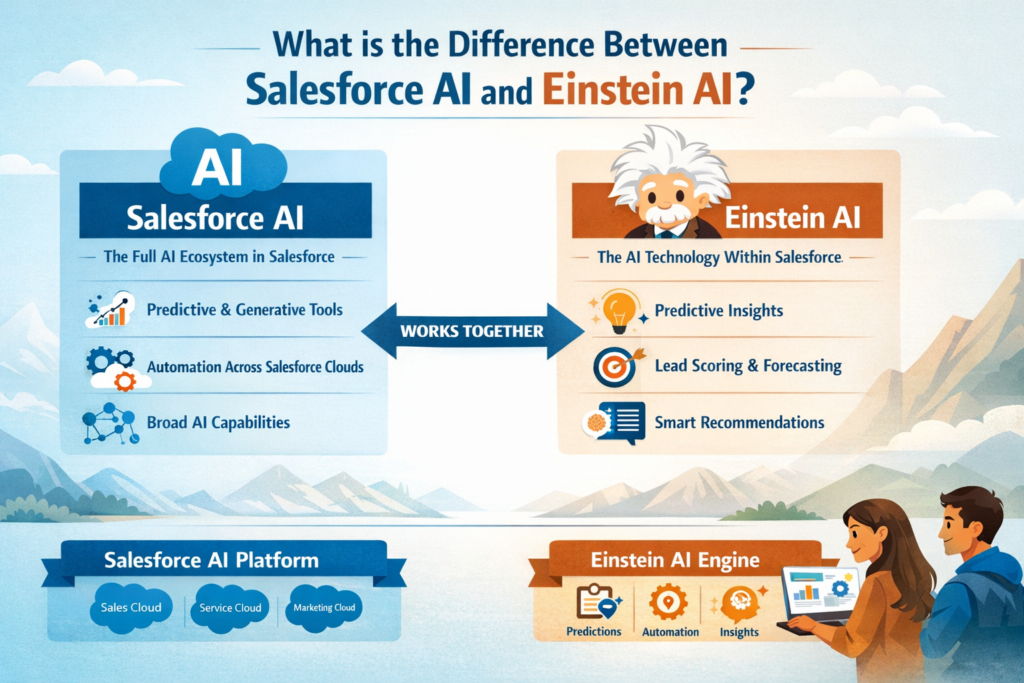
Difference between Salesforce AI and Einstein AI: The Simplest Explanation
In the interests of efficiency, let’s present a few key points difference between Salesforce AI and Einstein AI.
Salesforce AI
- The overarching AI ecosystem within Salesforce
- Comprises predictive, generative, and automation capabilities
- Functions within all Salesforce clouds
Einstein AI
- The one machine learning engine
- Provides predictive, prescriptive, and detailed insights
- Functions within the larger Salesforce AI framework
Therefore, when it is said that “Salesforce has AI”, it is indeed the Salesforce AI platform capability that is being referenced.
When they mention predictions or intelligent automation, they’re usually talking about Einstein AI.
The Future of AI in Salesforce
,Difference between Salesforce AI and Einstein AI: Salesforce is investing heavily in AI.
Recent announcements and updates indicate a clear path forward.
- integration of generative AI
- automation via AI
- reporting via natural language
- co-pilots powered by AI for CRM
With many of these new features, Einstein AI continues to evolve as the intelligence layer of Salesforce AI.
And if industry analysts are right, the next few years will push AI even further into everyday CRM workflows.
Sales reps may soon interact with Salesforce almost entirely through AI-assisted tools.
Final Thoughts – Difference between Salesforce AI and Einstein AI
The difference between Salesforce AI and Einstein AI is simpler than it first appears.
Salesforce AI encompasses all artificial intelligence functionalities throughout the Salesforce platform. Einstein AI, on the other hand, is the specific branch of machine learning that drives predictions, automation, and insight within that platform.
Having Difference between Salesforce AI and Einstein AI solid knowledge of the above relationship helps CRM Salesforce trainers and Salesforce training course candidates as they navigate the Salesforce platform.
If you are thinking about having a Salesforce career, knowledge of the difference between Salesforce AI and Einstein AI is a requirement.
Learning how to leverage AI is becoming a crucial part of the Salesforce ecosystem.
FAQs – Difference between Salesforce AI and Einstein AI
Are Salesforce AI and Einstein AI the same?
Not exactly. Einstein AI is a major part of Salesforce AI, while Salesforce AI also includes products and technologies such as Agentforce, Data Cloud, and generative AI tools.
What is Einstein AI used for?
Einstein AI helps businesses with lead scoring, sales forecasting, customer insights, email generation, case summaries, product recommendations, and workflow automation.
Does Einstein AI require coding?
Many Einstein AI features can be configured using Salesforce’s low-code tools. Coding may be required for advanced customization, integrations, and complex AI solutions.
Is Einstein AI included with Salesforce?
Some Einstein features are included in specific Salesforce editions, while others require additional licenses. Availability depends on the Salesforce product and subscription plan.
Which should you learn: Salesforce AI or Einstein AI?
Start with Salesforce fundamentals and Einstein AI features, then learn Agentforce, Data Cloud, prompt engineering, and AI automation. This provides a complete foundation for working with Salesforce AI.