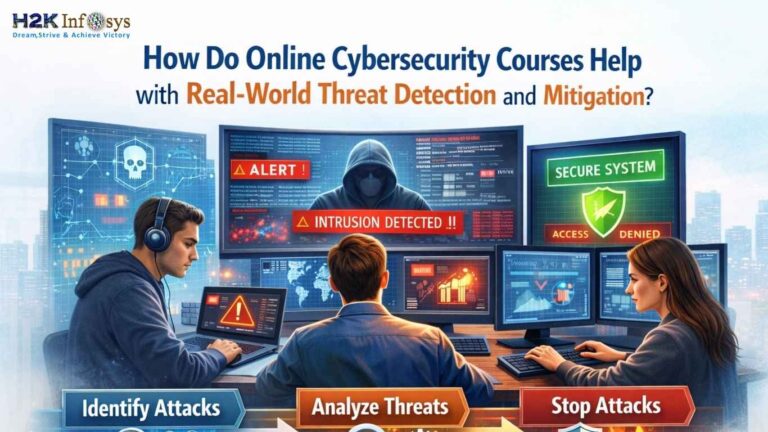
The automated systems used in virtual training environments used for attack analysis are aimed at mimicking real-life threats as closely as possible.H2k Infosys is one of the few companies that offers online cybersecurity training for students. The students are trained in real life defensive tactics; not just industry theory. They will learn how to analyze both real time and historical incidents, take action, and analyze real time events to perform system protection just like a real cyber defense analyst.
In today’s environments if a company has a current cyber threat, the threat is the primary concern. The threats are constantly evolving. They are more targeted, more sophisticated, and more automated, leading to incidents which are difficult to detect.
Overall, the threats which are faced in the modern world are real. The attacks faced by the companies which are analyzed as the weakest at defensive cyber protection, once considered advanced, are now the most common attacks faced by most companies.
This is a major contributor for the shift in cybersecurity programs. These programs must now focus on detection and response and practical threats. Theory and basics will not suffice for today’s environments.
Currently, many of the available programs include training in online cybersecurity, as well as job placement, due to the need for employees to fill actual security operations positions within companies.
Real Attack Simulations in Hands-On Labs
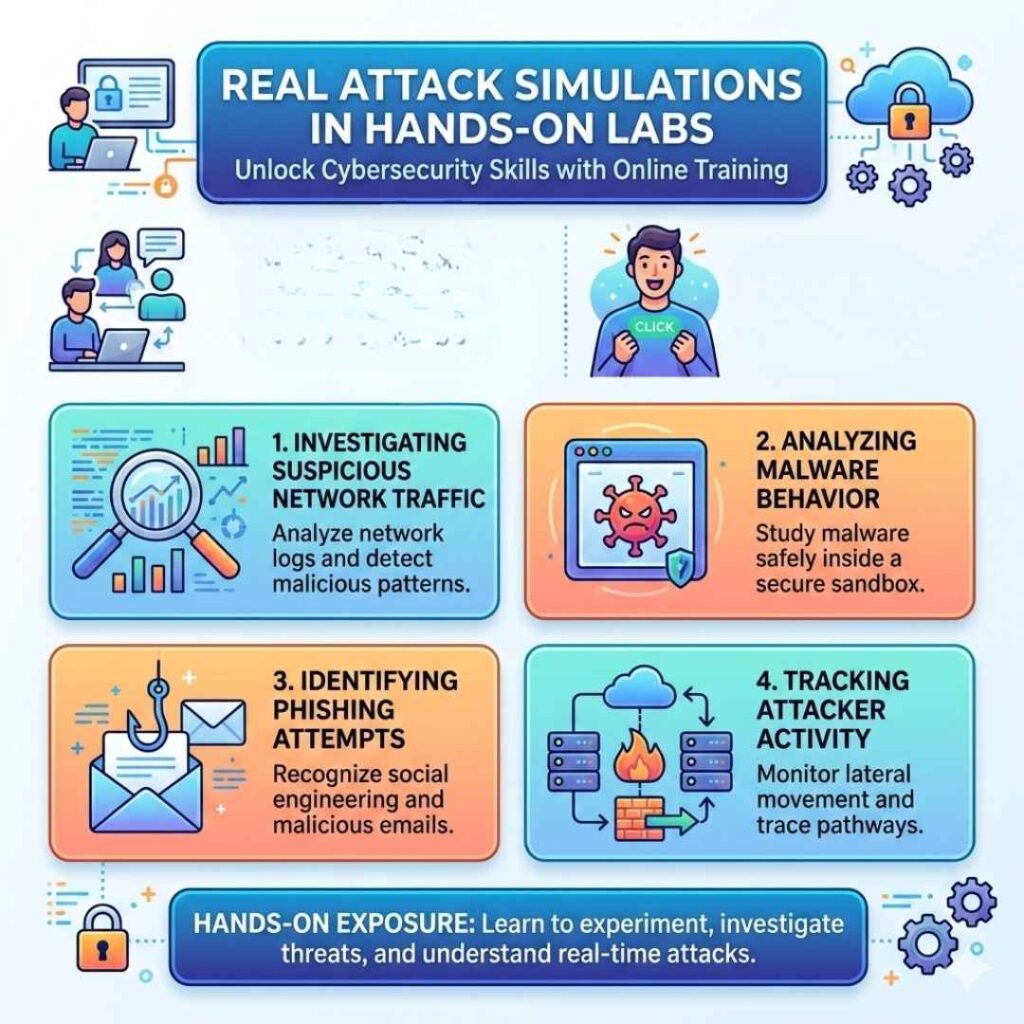
One of the most valuable features of modern online cybersecurity training programs is the lab environment.
Instead of only reading about malware or intrusion detection in theory, many students work inside virtual security labs that mirror the structure of real corporate networks. These environments allow learners to experiment, investigate threats, and understand how attacks actually unfold in real time. For people exploring cybersecurity jobs with training, this kind of hands-on exposure often becomes the moment when everything finally clicks.
Typical exercises in these labs include:
- Investigating suspicious or malicious network traffic
- Analyzing malware behavior inside a secure sandbox
- Identifying phishing attempts and social engineering tactics
- Tracking attacker activity as it moves across multiple systems
For example, a learner might log into a simulated company network and notice something unusual: several login attempts coming from unfamiliar offshore IP addresses. That’s the first red flag. From there, they dig into system logs, trace the activity across devices, and eventually isolate the compromised machine to stop the breach from spreading.
Scenarios like this create a safe but realistic environment where students practice the exact investigative process used by analysts inside a Security Operations Center (SOC).
And honestly, the first time someone watches an attacker move laterally through a network jumping from one compromised system to another it completely changes how they think about cybersecurity. What once seemed like abstract concepts suddenly feels very real.
Familiarity with the Tools of the Trade of Security Professionals
One of the many features that makes online cybersecurity courses so applicable is the students’ access to actual cyber security technologies.
Most students train using the following tools and applications:
– Security Information and Event Management (SIEM) systems
– Threat Intelligence Dashboards
– Endpoint Detection and Response (EDR) tools
– Vulnerability Scanners
Training programs focus on noise and other sources of distraction, teaching students which data are the most important and what data pose a real threat.
This is where most beginners face a real challenge in actual jobs. The flood of alerts never ends. The best courses simulate this challenge so that learners become accustomed to prioritization and rapid control of alerts.
For learners pursuing online cybersecurity roles, the hands-on experience with the tools is a key differentiator when competing for junior roles.
The Real Incident Response Training
There is an additional component to threat detection. The other half of this task is to respond to a situation that warrants it and may become an actual incident.
To this end, many online cybersecurity courses now include simulations of incident responses so that learners can practice.
– Attack recognition
– Threat containment
– Malicious access elimination
– Restoring affected systems
This is similar to a cyberattack “fire drill.”
For example, during a simulation of a ransomware incident, students may be required to:
– isolate infected machines
– an inspection of cyber encryption behavior
– perform backup restorations
– incident documentation
Such drills focus on high-stress environments where quick, critical, and correct choices are very important.
Exposure to Current Threat Trends
To stay relevant in this rapidly evolving field, online cybersecurity training programs must frequently revisit and revise their curriculum to meet the most effective objectives.
Recent course modules frequently discuss the following subjects:
– Phishing scams generated by AI
– Misconfigurations involving cloud security
– Vulnerabilities in supply chain systems
– Zero Trust Architecture
– The course work includes analysis of actual breaches that have occurred in the media
A hot topic case study that has been covered in many training courses is the recent surge of ransomware attacks on critical infrastructure. Students analyze how the attackers gained entry and what security measures may have been in place to mitigate the attack.
Mitigating the impact of real-world attacks is a vital classroom exercise.
Increasing Importance of Cybersecurity Sales Knowledge
It may come as a surprise, but more than just technical skills will be vital.
Understanding and selling security products to businesses is essential
This is the gap that some courses have addressed by incorporating training in online cybersecurity sales, which explains how security technologies resolve particular pains, such as ransomware, identity, and cloud security.
Professionals who integrate sales and technical skills often find positions as:
– Security Solutions Consultant
– Technical Account Manager
– Security Product Specialist
These positions are rapidly increasing as businesses begin to deploy more sophisticated integrated security solutions.
For the first time, job placement assistance has become a priority.
It is a recent trend that training providers have become increasingly oriented toward employment outcomes.
Most programs that provide cybersecurity training and job placement assistance aid students with:
- resume assistance
- simulation interviews
- guidance on certifications
- partnership with employers
Some programs even conduct simulated interviews for Security Operations Centers (SOCs), in which students have to respond to security incidents in real time.
For industry novices, this type of assistance is crucial. In online cybersecurity, industry experience is often more valued than advanced degrees or certifications.
Why Online Cybersecurity Training is Successful
Ten years ago, the only available education for online Cybersecurity was formal university education.
However, now, with the advancement of technology and the constant need for an adaptable curriculum, universities have fallen behind.
The rapidly changing landscape of cyber threats requires training providers to make frequent updates to the education system, including different labs and training programs that incorporate the most current cyber-attacks.
The instructors are often current industry cybersecurity professionals.
Combining theory, industry experience, and practical laboratory is what transforms beginners into professionals.
Online cybersecurity courses teach students to identify real-world threats by using simulated attacks with professional security tools, incident response training, and training related to current threats. Combined with career support and practical experience, these programs help students prepare for the current cybersecurity workforce.