Introduction
Cybersecurity is no longer just a problem for IT; it’s a problem for the whole company. At H2K Infosys, professionals are trained to understand evolving cyber threats and modern solutions like blockchain technology, proving how Blockchain Improve Cybersecurity in today’s digital world. Every year, businesses all over the world lose billions of dollars to data breaches, ransomware attacks, and identity theft. If you’re looking into new security solutions or Cyber security training courses to improve your team’s skills, you should really look into blockchain technology because Blockchain Improve Cybersecurity in ways traditional systems cannot. We’ve helped thousands of cybersecurity experts understand how new technologies like blockchain are changing the threat landscape and, more importantly, how to use them. This blog cuts through the noise and tells you the shocking truth about how blockchain is really changing cybersecurity and why Blockchain Improve Cybersecurity is becoming a critical industry focus.
The Cybersecurity Crisis Is Real, And Getting Worse
Before we talk about blockchain’s role, let’s talk about what we’re up against.
Reports from the industry say that by 2026, cybercrime will cost the world economy more than $10.5 trillion a year. That’s more than what most countries’ GDP is. Attack vectors are changing faster than traditional security systems can keep up. Hackers are getting smarter and smarter at taking advantage of huge security holes that are caused by centralized databases, weak authentication systems, and siloed security frameworks.
Firewalls, antivirus software, and intrusion detection systems are still important, but they aren’t enough on their own anymore. The industry is begging for solutions that are decentralized, can’t be changed, and are easy to see, and this is exactly where Blockchain Improve Cybersecurity by introducing stronger defense mechanisms. That’s where blockchain comes in.
What Is Blockchain, and Why Does It Matter for Security?
Most people associate blockchain with Bitcoin or NFTs. That’s understandable, but it misses the bigger picture. At its core, blockchain is a distributed ledger technology (DLT), and this is one of the main reasons why Blockchain Improve Cybersecurity across industries.
Every block in the chain contains:
- A cryptographic hash of the previous block
- A timestamp
- Transaction or event data
Because each block is cryptographically linked, altering any single record is nearly impossible, which is why Blockchain Improve Cybersecurity by ensuring data integrity and trust.
Shocking Truth #1: Blockchain Eliminates Single Points of Failure
One of the most dangerous vulnerabilities in traditional cybersecurity is centralized architecture. Blockchain removes this risk entirely, showing how Blockchain Improve Cybersecurity by decentralizing data.
For enterprises, this means:
- No single point of failure
- Fault tolerance
- Resistance to DDoS attacks
This architectural advantage clearly demonstrates how Blockchain Improve Cybersecurity at a foundational level.
Shocking Truth #2: Cryptographic Hashing Makes Data Tampering Virtually Impossible
Cryptography is what makes blockchain secure, and it’s much stronger than what most companies use to protect their data right now.
A cryptographic hash function, like SHA-256, processes every piece of data that goes into a blockchain. This makes a string of characters that is always the same length. If you change even one character in the input data, the hash output will be completely different. The avalanche effect means that any unauthorized changes to stored data can be seen right away.
This means in real-world cybersecurity situations:
Data integrity verification: Companies can keep hashes of important files on a blockchain. If malware, ransomware, or an insider threat changes those files later, the hash comparison will show it right away.
Security of the audit trail: Industries that have a lot of rules to follow, like healthcare, finance, and government, need audit logs that can’t be changed. Blockchain keeps a record of every action taken on sensitive data that can’t be changed.
Keeping evidence safe: In forensic investigations, blockchain can prove that digital evidence hasn’t been changed, which is a huge improvement over traditional chain-of-custody methods.
This is the kind of practical knowledge that sets top security professionals apart from average ones. That’s why the best cyber security training courses now include blockchain security modules as part of their core curriculum.
Shocking Truth #3: Decentralized Identity Management Destroys Password-Based Vulnerabilities
Let’s talk about the big problem: passwords don’t work.
More than 80% of data breaches happen when credentials are stolen. People still use weak passwords, use them on multiple platforms, and fall for phishing attacks, even though there have been campaigns to raise awareness for decades. Centralized identity management systems keep huge databases of usernames and passwords. Hackers love these databases because they are so easy to break into.
Blockchain brings us Self-Sovereign Identity (SSI), a new way for people to control their own identity credentials without having to rely on a central authority.
This is how it works:
- A blockchain stores verifiable credentials that prove a user’s identity, such as their name, age, certifications, and work history.
- The user has private cryptographic keys on their device.
- When they need to prove who they are, they only show the specific credential that is needed, without giving away any other personal information.
- The person who is verifying checks the blockchain to make sure it is real without going to a central password database.
- The effects are huge. There isn’t a single database of credentials that people can steal. Phishing attacks that try to get passwords don’t work anymore. It gets a lot harder to commit identity fraud.
For people who work in cybersecurity, knowing how to use blockchain-based identity solutions is becoming an important skill. Companies actively look for people who know how to use these frameworks when they hire. That’s why cyber security courses with placement that cover decentralized identity are becoming more and more valuable on your resume.
Shocking Truth #4: Smart Contracts Automate Security Enforcement Without Human Error
Human error causes many security breaches. Smart contracts reduce this risk, showing another way Blockchain Improve Cybersecurity through automation.
Use cases include:
- Automated access control
- Instant incident response
- Supply chain verification
- Zero-trust enforcement
These innovations reinforce how Blockchain Improve Cybersecurity through efficiency and accuracy.
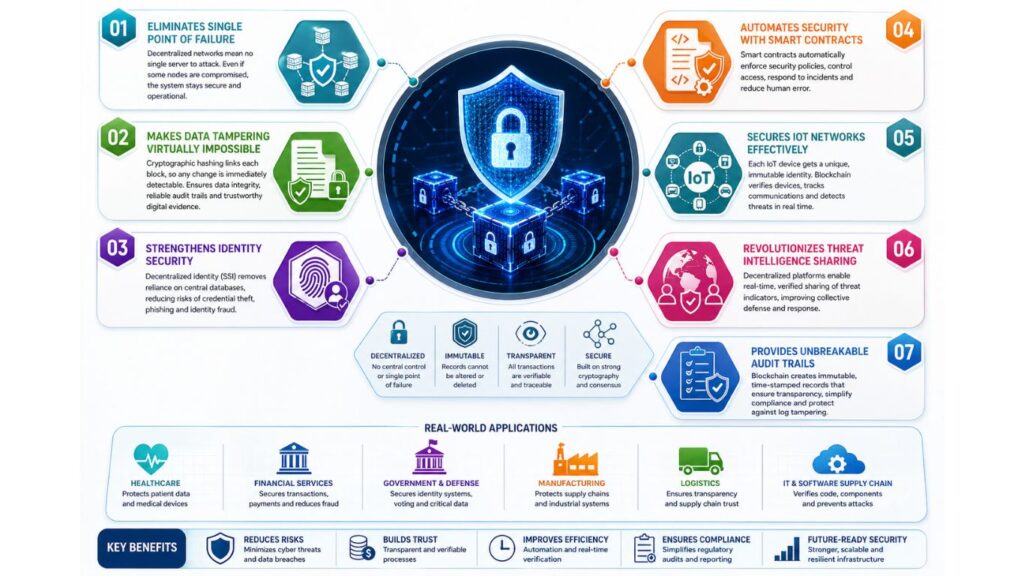
Shocking Truth #5: Blockchain Secures IoT Networks That Traditional Tools Can’t Protect
IoT devices are highly vulnerable, but blockchain offers a solution. By assigning unique identities to devices, Blockchain Improve Cybersecurity in IoT ecosystems.
Organizations can:
- Verify device authenticity
- Track communication securely
- Detect compromised devices
This is another powerful example of how Blockchain Improve Cybersecurity in emerging technologies.
Shocking Truth #6: Blockchain Revolutionizes Threat Intelligence Sharing
In the world of cybersecurity, here’s a dirty little secret: companies are terrible at sharing information about threats with each other. Companies keep threat data to themselves even when they are up against the same enemies because they are afraid of sharing proprietary information, don’t have trusted ways to share it, or can’t check the accuracy of shared intelligence.
What happened? The same attacks work on multiple organizations in a row, even though collective defense could have stopped them after the first hit.
- Blockchain makes a decentralized threat intelligence platform that people can trust.
- Companies add threat indicators (malicious IPs, malware signatures, attack patterns) to a shared ledger.
- Contributions are signed with cryptography, which makes sure that the right person gets credit and stops false information from spreading.
- Smart contracts can automatically pay people who help out and give more weight to credible sources of information.
- Everyone who takes part can see a real-time, verified threat database, and no one organization is in charge of the data.
This changes the way cyber warfare is uneven. Right now, attackers are sharing tools and strategies on dark web forums, but defenders are still in their own groups. Sharing threat intelligence on a blockchain-based platform levels the playing field.
Shocking Truth #7: Blockchain Provides Unbreakable Audit Trails for Compliance
One of the most expensive and time-consuming parts of modern cybersecurity is following the rules. Every rule, like GDPR, HIPAA, SOX, PCI-DSS, and ISO 27001, says that you need to keep detailed, accurate, and unchangeable records of how data was accessed, changed, and protected.
The biggest problem with traditional audit logging systems is that the logs can be changed or deleted. A skilled hacker who breaks into a system can also hide their tracks by changing log files. Because of this, forensic investigations are not always reliable, and compliance attestation is not always clear.
This all changes with blockchain’s unchangeable ledger.
Every action that is recorded on a blockchain is:
- Time-stamped with cryptographic accuracy
- Unchangeable this means it can’t be changed or deleted.
- Any authorized auditor can check it on their own.
Automatically put together, which cuts down on the work needed to report compliance
Real-World Blockchain Cybersecurity Implementations Today
This isn’t just a theory. Right now, blockchain cybersecurity solutions are being used in important fields:
In healthcare, blockchain technology is being used to protect the integrity of patient data, verify the pharmaceutical supply chain, and keep medical devices safe. Blockchain verification is finding fake drugs before they get to patients.
Financial Services: Big banks and payment processors are using blockchain to protect transactions between banks, stop fraud during settlement, and verify payments across borders in real time.
Government and Defense: A number of national governments are looking into using blockchain to protect voting systems, keep classified information supply chains safe, and verify government identity credentials.
Critical Infrastructure: Power grids, water treatment plants, and telecommunications networks are testing blockchain-based IoT security to stop cyberattacks backed by the government.
Software Supply Chain: After well-known supply chain attacks, companies like Microsoft and Google are putting money into blockchain-based software bill of materials (SBOM) systems to make sure that every part of their software is safe.
The Skills Gap Is Your Opportunity
There is a growing demand for professionals who understand how Blockchain Improve Cybersecurity. Organizations are actively seeking experts with these skills.
Training programs now include:
- Blockchain architecture
- Smart contract security
- Decentralized identity
- IoT protection
This demand exists because companies recognize how Blockchain Improve Cybersecurity and need skilled professionals to implement it.
Common Misconceptions About Blockchain Security
One of the biggest myths is that blockchain cannot be hacked. This is only partially true. While the blockchain ledger itself is extremely difficult to alter, vulnerabilities can still exist in smart contracts, private keys can be compromised, and consensus mechanisms can be targeted—such as in 51% attacks on smaller networks. This is why security professionals must understand these nuances instead of assuming blockchain is completely immune to threats.
Another common misconception is that blockchain will replace traditional security tools. In reality, blockchain is not a replacement but an enhancement to existing security systems. Organizations still rely on firewalls, endpoint protection, and threat detection tools. However, blockchain adds unique advantages like decentralization, immutability, and cryptographic verification that traditional systems alone cannot provide.
There is also a belief that only blockchain-focused companies need blockchain security expertise. This is far from true. Industries such as finance, healthcare, government, manufacturing, and logistics are rapidly adopting blockchain solutions. As a result, the demand for cybersecurity professionals who understand how to secure these implementations is growing across all sectors, not just within blockchain-native organizations.
How to Move Forward Right Now
If you’ve read this far, you recognize that blockchain is a genuine game-changer for cybersecurity, not a buzzword. The question is what you do with that recognition, especially as organizations realize how Blockchain Improve Cybersecurity in modern digital environments.
For individual professionals: Your career trajectory is directly tied to your skill currency. The organizations paying the highest cybersecurity salaries are the same ones building blockchain-integrated security architectures because they understand how Blockchain Improve Cybersecurity at scale. Investing in advanced training that includes blockchain security isn’t optional anymore, it’s strategic positioning in a market where Blockchain Improve Cybersecurity is driving hiring demand.
For organizations: The talent pipeline for blockchain cybersecurity professionals is thin. Organizations that invest in training their existing security teams on blockchain security principles will be significantly better positioned than those waiting to hire, especially as more enterprises adopt solutions where Blockchain Improve Cybersecurity becomes a core requirement.
For decision-makers evaluating vendors: Start asking your security vendors how blockchain integration fits into their product roadmap. Organizations that haven’t thought about this are already behind, particularly as industry leaders continue adopting models where Blockchain Improve Cybersecurity plays a central role in securing infrastructure.
Why H2K Infosys for Your Blockchain Cybersecurity Education
H2K Infosys has been at the forefront of cybersecurity education for years, consistently updating its curriculum to reflect where the industry is heading today. As organizations increasingly realize how Blockchain Improve Cybersecurity, our training programs are designed to align with real-world demands. Our cyber security training courses are developed with direct input from industry practitioners who are actively implementing solutions where Blockchain Improve Cybersecurity in live production environments.
What sets our cyber security course with placement apart:
Curriculum depth:
We go beyond surface-level blockchain concepts to cover security-specific implementations, attack vectors, and defensive strategies, helping learners understand how Blockchain Improve Cybersecurity in practical scenarios.
Hands-on labs:
Work in real blockchain environments where you practice security auditing, smart contract analysis, and incident response, gaining firsthand experience in areas where Blockchain Improve Cybersecurity is applied.
Industry connections:
Our placement network includes companies actively building blockchain security infrastructure, creating opportunities for professionals skilled in technologies where Blockchain Improve Cybersecurity plays a critical role.
Mentor access:
Learn from experienced practitioners who have deployed enterprise-grade solutions demonstrating how Blockchain Improve Cybersecurity across industries.
Career support:
From resume optimization to interview preparation and direct introductions to hiring managers, we ensure you are ready for roles that demand expertise in areas where Blockchain Improve Cybersecurity is becoming essential.
The cybersecurity professionals who will lead the next decade of enterprise security are those building these competencies today. As organizations continue to adopt solutions where Blockchain Improve Cybersecurity, the window for early-mover advantage is open, but not indefinitely.
Conclusion: The Blockchain Security Revolution Is Already Here
Blockchain’s contribution to cybersecurity isn’t a future promise it’s happening now. From eliminating centralized risks to securing IoT systems, it’s clear that Blockchain Improve Cybersecurity across every layer of digital infrastructure in Cyber security training courses.
Organizations relying only on traditional security are already falling behind. The reality is simple: Blockchain Improve Cybersecurity in ways that are essential for the future. Whether you’re a professional, business leader, or organization, understanding how Blockchain Improve Cybersecurity is no longer optional, it’s critical for staying secure in 2026 and beyond.