People often assume becoming a Data Analyst is mostly about learning tools like SQL, Excel, Tableau, or Python. Sure, those matter. No question about it. But hiring managers today usually want something deeper. They want Data Analysts who can actually think through business problems, explain insights clearly, and work with messy, imperfect datasets that don’t magically clean themselves.
That shift became even more obvious recently as businesses started relying more on AI-assisted reporting, automation dashboards, and predictive analytics tools. Companies now expect junior Data Analysts to understand not just the technical side, but also how decisions get made inside organizations.
This is one reason H2K Infosys gets attention from aspiring professionals. Their Data analytics training doesn’t feel built around memorizing definitions for an exam you’ll forget a month later. It focuses more on applying concepts in practical scenarios. And honestly, that tends to help people retain skills better.
How H2K Infosys Helps Future Data Analysts
Practical Learning Instead of Endless Theory
One challenge many beginner Data Analysts face is confidence. They complete online lessons, maybe follow YouTube tutorials for weeks, but then freeze the moment they open a real business dataset.
That’s actually more common than people admit.
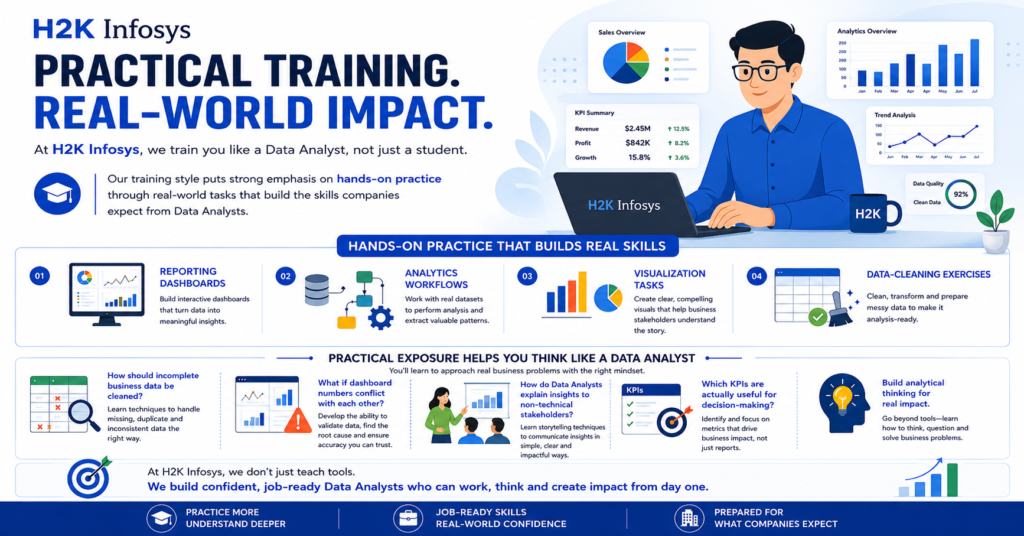
The training style at H2K Infosys puts strong emphasis on hands-on practice. Students work on reporting dashboards, analytics workflows, visualization tasks, and data-cleaning exercises that resemble the kind of work companies expect from Data Analysts in real environments.
That practical exposure helps learners start thinking through questions like:
- How should incomplete business data be cleaned?
- What if dashboard numbers conflict with each other?
- How do Data Analysts explain insights to non-technical stakeholders?
- Which KPIs are actually useful for decision-making?
A lot of self-paced programs barely touch these situations, which is probably why many learners still feel underprepared after finishing them.
Why Data Analyst Online Classes Continue Growing
Over the last few years, professional learning changed pretty dramatically. Flexible schedules, live virtual sessions, recorded classes, and remote mentorship made Data analyst online classes far more accessible to working professionals, college students, and career changers.
At the same time, not every online course delivers meaningful results.
Some programs look polished from the outside but mostly rely on passive video watching. Future Data Analysts often finish those courses with theoretical knowledge but very little confidence handling practical work.
H2K Infosys approaches Data analyst online classes a bit differently by combining instructor-led training with practical assignments, guided projects, and career-focused learning paths. That structure tends to keep learners more engaged instead of drifting through lessons without direction.
I’ve also noticed many aspiring Data Analysts now specifically search for programs that include mock interviews, resume support, and portfolio guidance because employers increasingly care about practical experience, not just certifications sitting on a LinkedIn profile.
The Growing Importance of Google Data Analytics Certification
The Google data analytics certification has become one of the more recognized entry-level credentials for future Data Analysts. It introduces learners to core concepts like spreadsheets, SQL, data cleaning, reporting, visualization, and analytical thinking.
Still, there’s something people learn pretty quickly during job searching: certification alone usually isn’t enough anymore.
Recruiters often expect Data Analysts to show practical projects, portfolio examples, and some understanding of business problem-solving. That’s why many learners use the Google data analytics certification as a foundation and then look for additional structured training where they can apply those concepts more realistically.
H2K Infosys helps bridge that gap by giving aspiring Data Analysts more exposure to practical workflows, reporting tasks, and project-based learning after foundational certification programs.
How H2K Infosys Supports Career Changers
Something interesting about analytics right now is how many Data Analysts actually come from completely different industries.
Some start in finance. Others move from healthcare, retail, customer support, operations, or even teaching backgrounds. Companies increasingly value people who understand business processes alongside analytics tools.
That’s where structured learning becomes useful.
H2K Infosys helps future Data Analysts learn step by step without overwhelming beginners immediately with advanced technical concepts. Many learners appreciate that the focus stays connected to real business applications rather than only software features.
And honestly, you can usually tell the difference during interviews.
Data Analysts who understand the “why” behind the numbers often communicate much more naturally than candidates who memorized technical interview answers without understanding context.
Real-World Skills Modern Data Analysts Need
The analytics field keeps evolving fast because AI tools, automation systems, and business intelligence platforms are changing how organizations use data every day.
Modern Data Analysts are increasingly expected to understand:
- SQL querying
- Excel reporting
- Power BI dashboards
- Tableau visualization
- Python basics
- Data cleaning
- Business storytelling
- KPI reporting
- AI-assisted analytics tools
H2K Infosys structures training around these practical expectations so future Data Analysts develop skills that align more closely with current industry hiring trends.
There’s also growing demand for analysts who can validate AI-generated reports instead of blindly trusting automation. Businesses learned pretty quickly that automated insights still need human interpretation. That human judgment layer has quietly become one of the strongest advantages skilled Data Analysts bring to teams today.
Why Mentorship Still Matters for Data Analysts
A lot of aspiring Data Analysts underestimate how important mentorship can be.
When someone gets stuck on SQL joins, reporting logic, dashboard design, or visualization problems, having access to experienced instructors can save an enormous amount of time and frustration. Self-learning works for some people, definitely, but many learners improve much faster when they receive guidance from professionals who understand real industry workflows.
H2K Infosys provides mentorship that helps learners move beyond isolated tutorials and understand how analytics work inside actual business environments.
That practical mindset becomes especially useful during interviews where hiring managers often ask scenario-based questions rather than textbook definitions.
Career Support for Future Data Analysts

Learning technical skills is only one part of becoming a successful Data Analyst.
A lot of aspiring professionals still struggle with:
- Resume building
- LinkedIn optimization
- Portfolio preparation
- Interview confidence
- Explaining projects clearly
H2K Infosys also focuses on career preparation because technical knowledge alone does not automatically translate into job offers.
Recruiters usually pay close attention to candidates who can explain how they solved business problems using data instead of simply listing tools they studied online.
That communication ability separates average Data Analysts from stronger candidates more often than people realize.
Final Thoughts
The demand for Data Analysts keeps growing as businesses across healthcare, finance, retail, logistics, marketing, and technology continue relying on data-driven decision-making. Future Data Analysts who combine technical knowledge, practical experience, communication skills, and business understanding will likely have stronger long-term opportunities in the industry.
H2K Infosys supports aspiring Data Analysts through project-based learning, Data analyst online classes, mentorship, practical analytics exposure, and career-focused preparation aligned with current industry expectations. When combined with foundational programs like the Google data analytics certification, structured practical training can help future Data Analysts feel more prepared for real-world analytics careers instead of just theoretical learning.