Training computer systems to learn from data , recognize patterns and make decisions that would normally need human thought. For beginners, the most important thing to understand is this : artificial intelligence is not magic, and it’s definitely not “alive.” It’s a set of technologies built by people, trained on massive amounts of information, and designed to solve specific problems faster and smarter.
That sounds simple enough on paper. But the first time most people actually use AI tools whether it’s ChatGPT helping draft emails, Netflix recommending something weirdly accurate, or Google Maps predicting traffic before you even leave home it suddenly feels a little surreal.
I remember explaining AI to a friend last year while we were waiting for coffee. He said, “So the machine is basically thinking?” Not exactly. Artificial intelligence doesn’t think like humans do. It predicts. It calculates. It notices patterns humans would miss because, honestly, no person can manually process billions of data points every second.
And that’s where things get interesting.
What Artificial Intelligence Actually Means
Artificial intelligence is a broad field of computer science focused on building systems that can perform tasks requiring human-like intelligence.
That includes things like:
- Understanding language
- Recognizing images
- Predicting outcomes
- Recommending products
- Detecting fraud
- Driving cars
- Generating text, video, or code
The artificial intelligence boom exploded again in the last couple of years because generative AI tools became accessible to regular people. Before that, AI mostly lived quietly behind the scenes inside apps, algorithms, and enterprise systems.
Now? It’s everywhere.
A college student uses AI to summarize lecture notes. A designer uses it for mockups. A doctor uses AI-assisted diagnostics. Even small businesses are automating customer support with AI chatbots.
What’s funny is that many people were already using AI long before they realized they were using AI.
So , How Does AI Actually Work?
At its core, AI works through three main ingredients:
- Data
- Algorithms
- Training
That’s the foundation.
Imagine teaching a child to recognize cats.
You show thousands of cat pictures.
Some are fluffy. Some are grumpy. Some are orange little chaos creatures knocking cups off tables.
Over time, the child learns patterns:
- Cats usually have whiskers
- They have pointy ears
- They move a certain way
AI learns similarly, except on a much larger scale.
The “learning” is done by machine-learning models. These models examine large quantities of data and discover relationships between patterns.
For example:
- Spotify learns your music taste
- Amazon predicts what you might buy next
- Gmail filters spam emails
- AI image tools recognize objects inside photos
None of these systems “understand” things emotionally or consciously. They simply become very good at prediction.
And honestly, prediction is incredibly powerful.
The Difference Between AI and Machine Learning
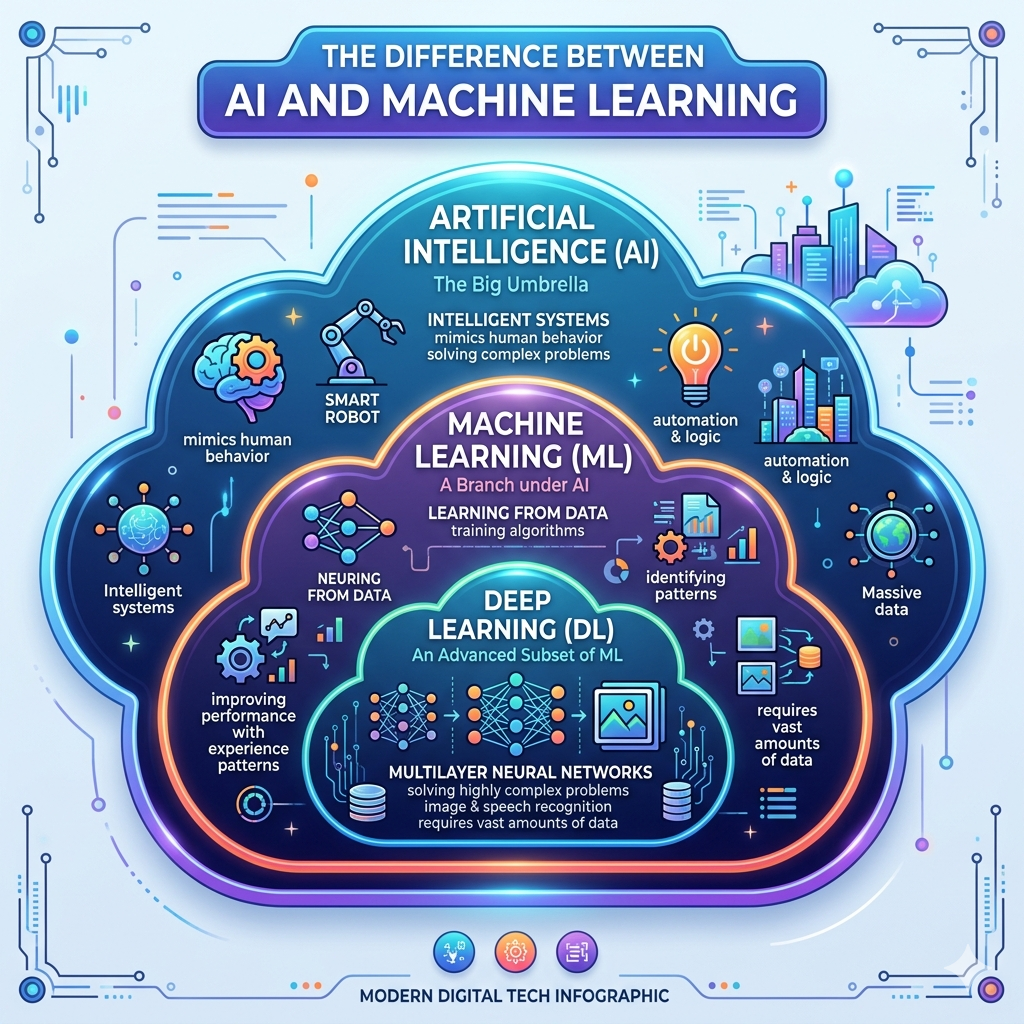
A lot of beginners mix these up.
Here’s the easiest way to think about it:
- Artificial Intelligence is the big umbrella.
- Machine Learning is one branch under it.
- Deep learning is a more advanced subset of machine learning
Machine learning allows systems to improve automatically through experience.
Instead of programmers writing rigid instructions for every situation, the machine learns from examples.
That’s why so many people search for ai machine learning courses when they start exploring this field. The two topics are deeply connected.
And right now, companies are hiring people who understand both.
Not necessarily researchers with PhDs either. Businesses need:
- AI analysts
- Prompt engineers
- Automation specialists
- AI product managers
- Data annotators
- ML engineers
- AI operations professionals
The ecosystem around AI became much bigger than people expected.
What Beginners Usually Get Wrong About AI
This part matters.
A lot of newcomers think learning artificial intelligence means immediately diving into advanced math, neural networks, and scary-looking Python code.
That’s usually the fastest way to overwhelm yourself.
The better approach?
Start practical.
Learn what AI tools actually do in real-world situations first.
Use AI image generators for inspiration Play around with AI coding assistants Use automation tools Understand how prompts impact outputs Once you know your use cases, the technical concepts start to click naturally.
I’ve seen beginners progress much faster this way compared to people trying to memorize theory without context.
Another misconception: people assume artificial intelligence will instantly replace every job.
Reality is more nuanced.
AI is replacing repetitive tasks faster than entire professions.
The people adapting well right now are the ones learning how to work with AI rather than compete against it.
Why AI Is Growing So Fast Right Now
Three big reasons:
1. More Computing Power
Modern graphics cards can process huge data sets at incredible speeds.
Without that hardware leap, today’s AI models wouldn’t exist.
2. Massive Data Availability
AI systems need data to learn.
The internet basically became one giant training ground.
3. Public Adoption Exploded
Once generative AI tools became easy to use, businesses rushed to integrate them.
And investors noticed.
Companies in the healthcare, finance, education, cybersecurity, and retail industries spent heavily on AI in 2025 alone.
One thing I keep noticing in industry conversations: businesses are no longer asking if they should adopt AI.
They’re asking how fast they can implement it without falling behind.
That’s a very different mindset from even two years ago.
Real-World AI Examples Beginners Can Relate To
Sometimes artificial intelligence explanations become too abstract.
So let’s ground this in real life.
AI in Healthcare
AI systems now help detect diseases from medical scans faster than traditional workflows.
Doctors still make final decisions, obviously. But AI helps identify patterns humans may miss in high volume work loads.
AI in Banking
Banks use AI for finding unusual transactions and flagging potential fraud in real time.
AI in Education
Students are using AI tutors for personalized explanations.
Some platforms adjust lesson difficulty based on learning speed, which honestly feels futuristic when you first see it happen.
AI in Content Creation
Writers, marketers, and video creators use AI for:
- Idea generation
- Research assistance
- Editing
- Voice cloning
- Video subtitles
- Script drafts
The important thing is that skilled creators still guide the final outcome.
AI speeds up workflows. Human judgment still shapes quality.
Should Newbies Learn to Code?
Not necessarily.
Not really.
People find this surprising.
You can definitely start to learn AI concepts without having to become a hardcore programmer first.
Many user-friendly platforms, in fact, do practical AI literacy first, before technical depth.
- AI fundamentals
- Prompt engineering basics
- Introductory machine learning concepts
- Real-world applications
- Ethical AI discussions
- Hands-on projects
Coding helps later, especially Python, but you do not need to master software engineering before entering the AI world.
That myth scares away too many people.
The Skills That Matter Most in AI Careers
People assume AI careers are purely technical.
Some are.
But companies increasingly value hybrid skills.
Top professionals tend to have some combination of
- Communication skills
- Analytical thinking
- Domain expertise
- AI tool proficiency
- Problem solving ability
- Adaptability
For example, a marketing expert who understands AI automation can become incredibly valuable.
Same for teachers, healthcare workers, finance professionals, or designers.
AI is becoming less about one isolated “tech field” and more about enhancing existing industries.
That shift is huge.
What Beginners Should Learn First
If I had to tell someone where to start today, I would recommend the following roadmap:
Step 1: Learn the Basics of AI
Learn:
- What is AI
- Different types of AI
- Basic of Machine Learning
- Common terminology
Step 2: Use AI Tools Every Day
Theory knowledge is not as important as practical exposure.
Experiment constantly.
You learn quickly when you break things, test prompts, and compare outputs.
Step 3: Learn Basic Python
Not advanced programming.
Just enough to understand automation and simple machine learning workflows.
Step 4: Do Small Projects
You will learn faster through small projects than passive study.
Examples:
- AI chatbot
- Image classifier
- Resume analyzer
- Sentiment analysis tool
Step 5: Explore Specialized Areas
Once fundamentals click, you can branch into:
- Generative AI
- Computer vision
- NLP
- Robotics
- AI cybersecurity
- Data science
This is usually where people start looking for ai machine learning courses that align with career goals.
The Role of AI Training and Placement Programs
One trend growing rapidly right now is career-focused AI education.
A lot of learners don’t just want theory anymore. They want employable skills.
That’s why programs offering ai training and placement support have gained attention.
The stronger programs usually focus on:
- Hands-on projects
- Industry tools
- Portfolio building
- Mock interviews
- Internship opportunities
- Career guidance
Some even partner directly with hiring companies.
And honestly, practical exposure matters a lot.
Recruiters are caring less and less about certificates and more and more about whether candidates can actually apply AI concepts in realistic scenarios.
A beginner who built three useful projects often stands out more than someone who only watched tutorials for six months.
Is AI Dangerous?
This question comes up constantly.
AI itself is a tool. The risks depend on how humans use it.
Current concerns include :
- Misinformation
- Deepfakes
- Privacy issues
- Biased algorithms
- Job replacement
- Security threats
Governments and tech companies are actively discussing AI regulation because the technology is moving faster than policies .
At the same time, AI also offers enormous benefits:
- Faster medical research
- Improved accessibility tools
- Smarter disaster prediction
- Better automation
- Enhanced productivity
The future probably won’t be “AI destroys everything” or “AI fixes everything.”
Reality is usually messier than internet headlines.
The Human Side of Learning AI
One thing nobody really talks about enough:
Learning AI can feel intimidating at first because the field moves unbelievably fast.
You open social media and suddenly there’s:
- A new AI model
- Another AI startup
- Some viral automation workflow
- Another debate about jobs disappearing
It can feel like everyone else already understands everything.
Most people don’t.
Even professionals in the industry are constantly learning because the ecosystem changes every few months.
The people succeeding long-term are usually not the ones trying to know everything.
They’re the ones staying curious consistently.
That matters more.
Final Thoughts
AI functions by training systems to spot patterns, process data and refine predictions over time. But for beginners, the best way to get a handle on AI is by doing, not hype or fear.
Start small.
Experiment with tools.
Learn how machine learning works.
Build projects.
Keep up with industry trends.
And don’t worry if you feel confused in the beginning. Nearly everyone entering AI feels that way at some point.
The field is evolving incredibly fast, but that also creates opportunity.
Right now, people who combine curiosity, adaptability, and practical AI skills are putting themselves in a very strong position for the next decade.
And honestly? We’re probably still at the beginning of what AI will eventually become.