
Introduction
Every growing company needs people who can turn data into decisions. That role belongs to the Business Analyst. A Business Analyst connects business goals with technical solutions. This role creates real impact across industries such as finance, healthcare, retail, and technology.
Many learners ask one key question. What are the best learning paths for aspiring business analysts? The answer is not a single route. It is a structured journey that builds skills step by step. This guide explains that journey in detail. It focuses on practical skills, industry needs, and real work scenarios.
If you want to succeed in business analyst training, you must follow a clear and proven path. This article will guide you through each stage.
Why a Structured Learning Path Matters
A structured path helps you avoid confusion. It gives direction and saves time. Without a plan, learners often jump between topics. That creates gaps in knowledge.
According to industry reports, companies prefer candidates who show both domain knowledge and tool expertise. Over 70 percent of employers expect Business Analysts to understand data tools along with business processes.
That is why strong learning paths for aspiring business analysts focus on both theory and practice.
Core Skills Every Business Analyst Needs

Before you explore paths, you must understand the core skills.
1. Business Understanding
You must understand how companies work. You must know how revenue flows. You must understand customer needs.
2. Data Analysis
You must analyze data using tools. You must draw insights from numbers.
3. Communication Skills
You must explain ideas clearly. You must interact with stakeholders.
4. Documentation Skills
You must write clear reports. You must create requirement documents.
5. Problem Solving
You must identify issues. You must suggest solutions.
Strong learning paths for aspiring business analysts always build these skills first.
Step 1: Build Basic Knowledge
Every journey starts with basics. This step is important in all learning paths for aspiring business analysts.
Key Topics to Learn
- Business fundamentals
- Types of business models
- Basic statistics
- Introduction to data
Example
A retail company wants to increase sales. A Business Analyst studies sales data. The analyst finds that weekend sales are higher. The company increases weekend promotions. Sales grow.
This simple example shows how basic knowledge leads to results.
Step 2: Learn Business Analysis Concepts
You must learn core concepts used in business analyst training.
Important Concepts
- Requirement gathering
- Stakeholder analysis
- Process modeling
- Gap analysis
Simple Workflow Diagram
Business Need → Requirement Gathering → Analysis → Solution → Implementation
This workflow appears in most real projects.
Structured learning paths for aspiring business analysts include these concepts early.
Step 3: Master Data Analysis Tools
Data drives decisions. You must learn tools that help analyze data.
Essential Tools
- Excel
- SQL
- Data visualization tools
Sample SQL Query
SELECT product_name, SUM(sales) AS total_sales
FROM sales_data
GROUP BY product_name
ORDER BY total_sales DESC;
This query helps identify top products.
Why This Matters
Companies expect analysts to handle data. Many business analyst certification courses include tool training.
Strong learning paths for aspiring business analysts always include hands-on tool practice.
Step 4: Learn Documentation Techniques
Documentation is a key part of business analyst training.
Common Documents
- Business Requirement Document
- Functional Requirement Document
- Use Case Diagrams
- User Stories
Example User Story
As a customer, I want to track my order so that I know delivery status.
Clear documentation improves project success.
This step is essential in all learning paths for aspiring business analysts.
Step 5: Understand Agile and Project Methods
Modern companies use Agile methods. You must understand how teams work.
Agile Concepts
- Sprint planning
- Daily stand up
- Backlog management
Example
A team builds a mobile app. The team works in short cycles. Each cycle delivers a small feature. The Business Analyst defines user stories.
This approach improves speed and flexibility.
Many business analyst certification courses include Agile training. This makes Agile a key part of learning paths for aspiring business analysts.
Step 6: Work on Real Projects
Theory alone is not enough. Practice builds confidence.
Project Ideas
- Sales dashboard
- Customer analysis report
- Process improvement plan
Example Project Flow
- Define problem
- Collect data
- Analyze data
- Present findings
Real projects help you understand real challenges.
Effective learning paths for aspiring business analysts always include project work.
Step 7: Learn Domain Knowledge
Domain knowledge improves job performance.
Common Domains
- Banking
- Healthcare
- E commerce
- Insurance
Example
In banking, analysts must understand loans and interest rates. In healthcare, analysts must understand patient data.
Domain knowledge adds value to business analyst training and placement programs.
This step strengthens learning paths for aspiring business analysts.
Step 8: Build Communication Skills
Communication drives success.
Key Areas
- Presentation skills
- Stakeholder interaction
- Report writing
Example
An analyst presents findings to managers. Clear communication helps managers make decisions.
Strong communication is part of all learning paths for aspiring business analysts.
Step 9: Prepare for Certification
Certifications validate your skills.
Benefits
- Industry recognition
- Better job opportunities
- Higher salary potential
Many business analyst certification courses prepare learners for exams.
Certification strengthens your profile. It is a key step in learning paths for aspiring business analysts.
Step 10: Focus on Placement Readiness
Many learners aim for business analyst training and placement.
Preparation Steps
- Resume building
- Mock interviews
- Case study practice
Common Interview Questions
- Explain requirement gathering
- Describe a project you worked on
- How do you handle stakeholders
Placement readiness is the final step in learning paths for aspiring business analysts.
Real World Case Study
Case: Improving Customer Retention
A telecom company faced customer loss. A Business Analyst studied customer data.
Steps Taken
- Collected churn data
- Identified high risk customers
- Suggested loyalty programs
Result
Customer retention improved by 20 percent.
This case shows the impact of structured learning paths for aspiring business analysts.
Common Mistakes to Avoid
Many learners make avoidable mistakes.
Mistakes
- Skipping basics
- Ignoring tools
- Avoiding practice
- Weak communication
Avoiding these mistakes improves success in business analyst training.
These mistakes often break learning paths for aspiring business analysts.
Sample Learning Roadmap
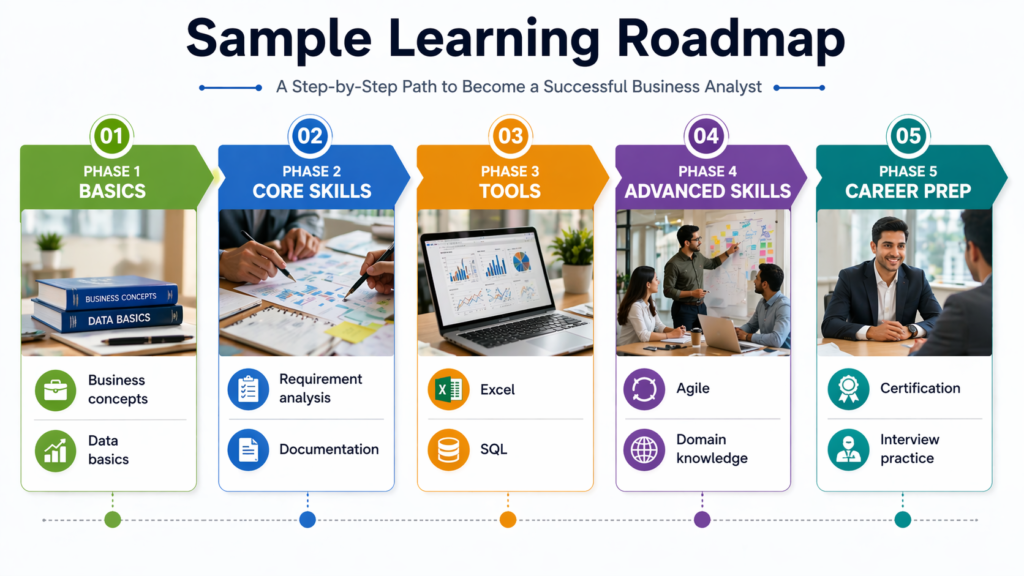
Phase 1: Basics
- Business concepts
- Data basics
Phase 2: Core Skills
- Requirement analysis
- Documentation
Phase 3: Tools
- Excel
- SQL
Phase 4: Advanced Skills
- Agile
- Domain knowledge
Phase 5: Career Prep
- Certification
- Interview practice
This roadmap represents structured learning paths for aspiring business analysts.
Industry Demand and Growth
The demand for Business Analysts continues to grow.
Key Insights
- Companies rely on data driven decisions
- Digital transformation increases demand
- Skilled analysts earn competitive salaries
Reports show steady growth in analytics roles.
This demand makes learning paths for aspiring business analysts more valuable than ever.
Practical Tips for Success
Stay Consistent
Practice daily. Build habits.
Focus on Projects
Projects build confidence.
Learn from Feedback
Feedback improves skills.
Stay Updated
Industry trends change often.
These tips support effective learning paths for aspiring business analysts.
Key Takeaways
- A structured path leads to success
- Core skills include analysis and communication
- Tools are essential for data handling
- Projects provide real experience
- Certification improves career growth
These points summarize strong learning paths for aspiring business analysts.
Conclusion
A clear path helps you build the right skills and achieve your career goals. Start your journey today and follow structured steps to succeed in business analyst training.