Software testing is changing fast. Traditional quality assurance methods still matter, but artificial intelligence is adding a new layer of speed, accuracy, and insight. As companies push for faster releases and better user experiences, they need QA professionals who understand both testing fundamentals and AI-powered tools. That is why more learners are enrolling in QA testing with AI online training courses.
These courses are designed to help beginners, manual testers, automation engineers, and even experienced QA professionals understand how AI fits into modern software testing. They usually combine core QA concepts with practical instruction on automation, machine learning-assisted testing, intelligent test generation, and data-driven quality strategies.
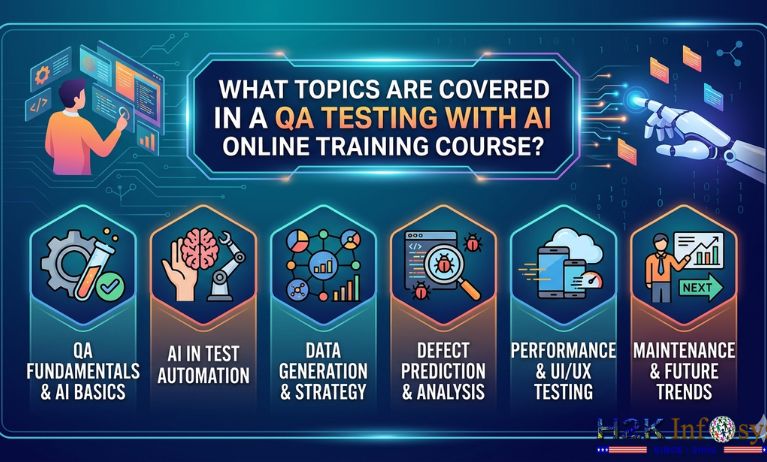
So, what topics are usually covered in a QA testing with AI online training course? Here is a detailed look at the key subjects learners can expect.
1. Introduction to QA Testing With AI
Most courses begin with the basics of software quality assurance. Before learners can understand how AI improves testing, they need a strong foundation in what QA is and why it matters.
This section often covers the difference between QA testing with AI control, the software development life cycle, and the role of testing within Agile and DevOps environments. Students are introduced to key testing principles such as defect prevention, requirement validation, test planning, and risk-based testing.
Courses also explain the main types of software testing, including functional testing, non-functional testing, smoke testing, regression testing, integration testing, and user acceptance testing. This foundation helps learners see where AI tools fit into the broader QA process instead of viewing them as standalone solutions.
2. Manual Testing Fundamentals
Even in an AI-focused program, manual testing remains important. A strong online training course usually teaches learners how to create test cases, execute test scenarios, log bugs, and verify fixes.
Students often learn how to analyze software requirements, identify test conditions, and write clear, reusable test cases. They may also explore exploratory testing techniques, boundary value analysis, equivalence partitioning, and decision table testing.
This topic matters because AI-powered testing tools are only as effective as the testing logic behind them. Understanding manual testing helps learners evaluate results, spot gaps, and make better decisions when AI tools generate test suggestions or automate repetitive tasks.
3. Test Automation Basics
A major part of QA testing with AI involves automation. Before students can work with AI-enhanced testing platforms, they need to understand standard test automation concepts.
This section typically introduces automation frameworks, scripting basics, and common testing tools used for web, mobile, and API testing. Learners may study topics such as test scripts, object repositories, assertions, test runners, and reusable functions.
QA testing with AI courses often explains when to automate and when not to automate. This is a valuable lesson because many teams waste time trying to automate unstable or low-value test cases. Good training teaches students how to identify automation candidates and build maintainable automated test suites.
4. Programming and Scripting for Testers
Many AI-enabled QA tools are easier to use if learners have at least basic coding knowledge. That is why online training courses often include programming or scripting modules.
Depending on the course, students may be introduced to languages such as Python, Java, or JavaScript. They usually learn variables, loops, functions, conditions, exception handling, and file handling. Some courses also include version control basics using Git.
For QA professionals, this coding knowledge supports automation, API validation, test data handling, and integration with AI-powered tools. Even no-code or low-code AI platforms become easier to understand when learners know the logic behind how scripts and workflows operate.
5. AI Fundamentals for Testers
One of the defining features of this kind of course is an introduction to artificial intelligence concepts in a testing context. The goal is not always to turn QA professionals into data scientists, but to help them understand the language and capabilities of AI.
This topic often covers the basics of artificial intelligence, machine learning, natural language processing, computer vision, and predictive analytics. Learners are taught how AI systems recognize patterns, analyze data, and make recommendations based on historical behavior.
The focus is usually practical. Instead of going deeply into complex mathematics, most courses explain how AI can support testing activities like defect prediction, intelligent test creation, UI element recognition, and self-healing automation scripts.
6. AI-Powered Test Case Generation
A growing number of testing platforms use AI to create or suggest test cases from requirements, user stories, or application behavior. This has become an important topic in QA training.
Students learn how AI can analyze documentation and generate test scenarios faster than manual methods alone. They may also study how AI identifies edge cases, high-risk paths, and missing coverage areas.
A good course also explains the limitations of AI-generated test cases. Learners are taught to review, refine, and validate machine-generated outputs. This is important because AI can accelerate planning, but human oversight is still essential for accuracy, relevance, and business context.
7. Self-Healing Test Automation
One of the most popular AI-related QA topics is self-healing automation. Traditional automated tests often fail when an application’s user interface changes slightly. AI-powered tools can reduce this problem by recognizing elements more intelligently.
In this module, learners usually explore how self-healing works, why brittle test scripts are a common challenge, and how AI-based locators can improve test stability. They may work with tools that automatically adapt to layout changes, renamed elements, or minor design updates.
This topic is especially useful for teams that struggle with high automation maintenance costs. It shows learners how AI can improve efficiency, not by replacing testing knowledge, but by reducing repetitive script repair work.
8. Visual Testing and Computer Vision
Modern applications are highly visual, which makes UI consistency and layout validation more important than ever. QA testing with AI courses often includes visual testing as a specialized subject.
Students learn how AI and computer vision compare screens, detect visual bugs, and identify differences that traditional assertion-based tests might miss. This can include checking alignment, font display, broken images, overlapping content, and responsive design behavior across devices.
Visual testing training helps learners understand that quality is not only about functionality. A feature can technically work and still deliver a poor user experience if the interface is broken. AI-based visual testing tools help catch those issues more effectively.
9. API Testing and AI Assistance
Most modern software systems depend heavily on APIs, so API testing is often part of a complete QA with an AI curriculum. Learners are introduced to API requests, responses, status codes, authentication, and data validation.
The AI angle may include intelligent test suggestion, anomaly detection in API responses, and automatic identification of unusual behavior patterns. QA Testing With AI also cover how AI can help generate test payloads or flag risky endpoints based on usage patterns.
Understanding API testing expands a learner’s value in the job market because it shows they can test beyond the user interface and verify the core services that power applications.
10. Defect Prediction and Analytics
AI can do more than execute tests. It can also help teams make smarter decisions about where to focus their efforts. That is why many online training courses cover defect prediction and QA analytics.
This topic often explains how AI models use past defect data, code changes, user behavior, and test execution history to identify high-risk areas in an application. Learners study dashboards, patterns, trends, and metrics that support better release decisions.
Instead of testing everything with equal effort, teams can use predictive insights to prioritize the most vulnerable features. QA Testing With AI that includes this topic, prepare students for a more strategic QA role, where they contribute to planning and risk management.
11. Test Management and Reporting
A useful QA testing with AI also teaches students how to organize testing work and communicate results clearly. AI may enhance execution, but test management still depends on structure and teamwork.
Students usually learn about test plans, traceability matrices, defect lifecycle management, and reporting practices. They may also explore tools for requirement tracking, collaboration, and sprint-based QA workflows.
In AI-enabled environments, reporting can become more advanced through smart dashboards, auto-generated summaries, and trend analysis. Courses often show learners how to interpret those outputs and present meaningful quality insights to developers, managers, and stakeholders.
12. Agile, DevOps, and Continuous Testing
QA today is closely tied to Agile delivery and DevOps pipelines. Because of this, many QA testing with AI courses include modules on continuous integration, continuous testing, and release automation.
Learners study how testing fits into rapid development cycles, how automated tests run inside CI/CD pipelines, and how AI can support faster feedback. Some courses also introduce concepts like shift-left testing, shift-right testing, and production monitoring.
This topic helps learners understand that modern QA is not a final checkpoint. It is a continuous activity built into every stage of software delivery. AI supports that model by helping teams test faster and make better use of data.
13. Real-World Projects and Tool Practice
The best online courses go beyond theory. They include hands-on exercises, case studies, and real-world projects using current QA and AI testing tools.
Students may practice creating automated tests, generating AI-assisted test cases, validating APIs, or building workflows for web and mobile applications. Project work often helps learners understand how different topics connect in a real testing process.
This practical experience is often the most valuable part of the course because employers want professionals who can apply knowledge, not just define terms.
Final Thoughts
A QA Testing With AI, it usually covers much more than just software testing basics. It combines manual testing, automation, coding, AI concepts, analytics, and modern delivery practices into one career-focused learning path.
For beginners, it offers a structured introduction to the future of quality assurance. For working professionals, it provides a way to upgrade skills and stay competitive in a changing industry. Most importantly, it shows that AI is not replacing QA testers. It is giving them better tools to work smarter, test faster, and deliver higher-quality software.